1. Much of Red Anemones is driven by what families pass down quietly rather than openly. What first sparked your interest in inherited memory and the emotional weight of what goes unsaid?
From time to time, I think most of us wonder about the subtle, unspoken inheritances we carry with us, and how those unknowingly shape us. I’m not personally a genealogy junkie, but when Covid boredom set in I did a little internet sleuthing and discovered a matrilineal Jewish great-grandmother who had emigrated to the US through Ellis Island. I knew absolutely nothing about this family history, but once discovered, my great-grandmother quickly took up residence in my head. Eventually I realized she had a story she wanted to tell and my interest in untold family stories unfolded from there.
Another thing that captivated me was that this is a Jewish story, and one important way Jews have survived for five thousand years is by telling their stories. I really wanted to contribute to that legacy, especially now, when there is another aspect to inherited memories and family legacies that specifically concerns the Jews and is surfacing in real time. History forgotten is history doomed to be repeated and, unfortunately, today’s political climate is flourishing in an environment of gestapo tactics against American immigrants, and Americans sympathetic to the immigrant cause. This is no different from what Jews, and those Germans sympathetic to the Jews, suffered in Nazi Germany. This needs to be said out loud, even when it’s difficult, painful or risky. We cannot afford the luxury of silence in the face of growing antisemitism and anti-immigrant sentiment; otherwise, the weight of history will come crashing down on us once again.
I live in the Upper Midwest, not far from Minneapolis, and am acutely aware that because there are a lot of immigrant farm workers in this region, very soon ICE will be in my own community. I meet these immigrants every day where I grocery shop, stop for a sandwich or do other errands. As a Jew I believe in welcoming the stranger and my attention is now intensely focused on how I can personally fulfill this mandate at a time when silence is not an option.
2. Natalie’s search unfolds through diaries and letters rather than straightforward revelation. What did working with these fragments allow you to do structurally and emotionally that a linear narrative wouldn’t?
From the outset I believed this story contained a strong social message about the struggles immigrants, especially Jewish immigrants, in America faced, and I was intent on finding the best way to convey that message. Working with fragments of information wherever I could find it gave me a baseline from which the story could emerge but didn’t bind me to specific details. This allowed the characters the freedom to tell the story on their own terms.
3. History enters the book not as backdrop, but as a force shaping personal choices and silences. How did you approach integrating early immigrant pressures, prejudice and assimilation into the intimate lives of your characters?
It was tricky in the beginning, but it quickly became obvious that the story’s power rested in its historical foundations, and this needed to be evident to the reader throughout the book. The most effective way to achieve this was with flashbacks. Once the characters and I agreed on this storytelling mode, the flashbacks occurred organically as they were needed to deepen the plot and move the story along.
4. Natalie’s evolving understanding of herself feels both unsettling and liberating. Were there moments in her transformation that surprised you as the writer?
Not really. Natalie is a self-confident, self-aware young woman who isn’t afraid to embark on a journey of self-discovery and follow it wherever it leads her. She not afraid of the inevitable bumps in the road or of the final outcome, and I never expected her to back away from this challenge. I hope she inspires readers on their own personally transformative journeys to continue forward with resolve and courage, because the results can be astonishing – and wonderful.
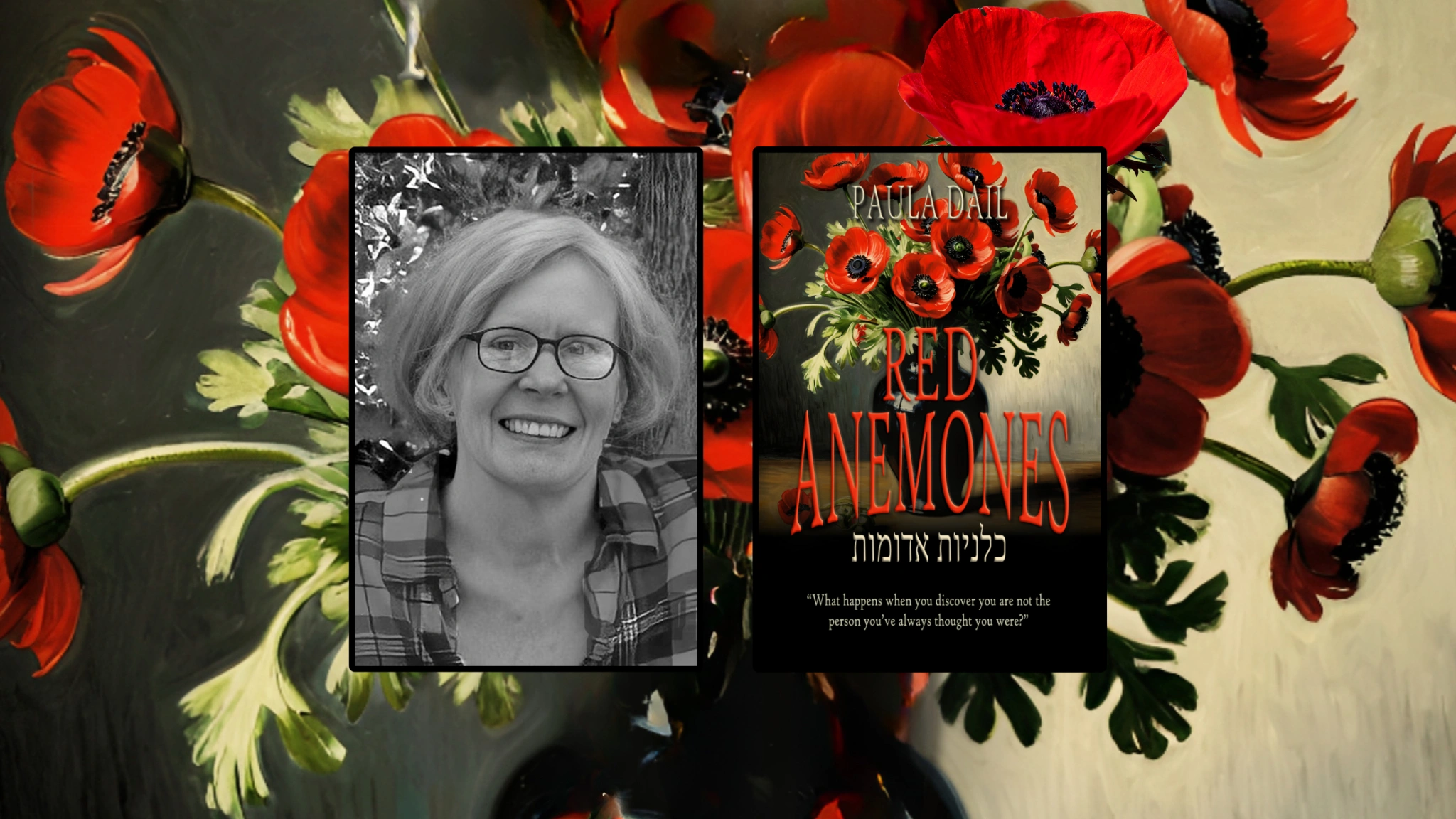
5. The image of the red anemone carries symbolic weight throughout the novel. When did that metaphor crystallize for you, and how did it guide the emotional architecture of the story?
The novel’s original title was My Mother’s Secret, which I liked, but it wasn’t very imaginative. Early last spring I was driving across the rural countryside on my way to Walmart and noticed how, after a particularly harsh winter, the apple trees in a local orchard were beginning to bloom once again and I recalled how I had once marveled at the ability of red anemones to carpet the Negev Desert and Judean foothills in Israel, a nation with some of the most uninhabitable land on the planet, with beautiful red blooms every spring – and suddenly, I had my title!
The entire emotional architecture of the novel is built around the remarkable endurance of the Jewish people and culture across five thousand often tumultuous, and sometimes horrific years. No matter what happens to them, the Jewish people carry on, celebrating the joy and beauty in life with each step forward. The red anemone, Israel’s national flower, is the best possible symbol of the hope and resilience that flows in the blood of the Jewish people.
6. Since the novel is inspired by real events, how did you decide where to remain faithful to lived experience and where fiction could open new emotional or narrative possibilities?
In many respects, all stories are inspired by real events and lived experience, so this wasn’t a big concern for me. My job as a writer is to be the vehicle through which characters can emerge and then get out of their way so they can tell their story on their terms. I left the emotional narrative decisions entirely up to them.
This said, I’m a social scientist, and we operate foremost in a world of facts over emotion. There were times when I struggled with how emotional or imaginative the story could be without compromising its core message. Fiction can be a very effective vehicle for social messaging, but it has to be done in the context of factual reality. In this story, an undeniable factual reality is that Jews have faced antisemitism across history and circumstances, including emigrating to America, yet move forward anyway, making tremendous contributions to medicine, science, the arts and so on…
7. The book ultimately wrestles with what it means to confront truth after long silence. What kinds of conversations — personal, cultural or intergenerational — do you hope the novel invites?
It would be great if the story encourages readers to have difficult conversations of all kinds, but I especially hope it helps readers understand how difficult and risky these conversations can be and the value of respecting another person’s silence. The tension between an individual’s desire for answers and another individual’s need for privacy and leaving questions unanswered, perhaps for very valid reasons, is a central theme the book explores. I hope this theme prompts readers to think more deeply about what we are and are not willing to reveal, because that challenge hovers over most relationships. There are also concerns surrounding the ethical responsibilities that come with engaging in deeply vulnerable, emotional conversations about cultural heritage, intergenerational legacies and personal identity.
The right to remain silent versus the moral obligation to speak out against injustice when we encounter it is another dilemma. Is silence ever an option in these situations? I personally believe it is not.