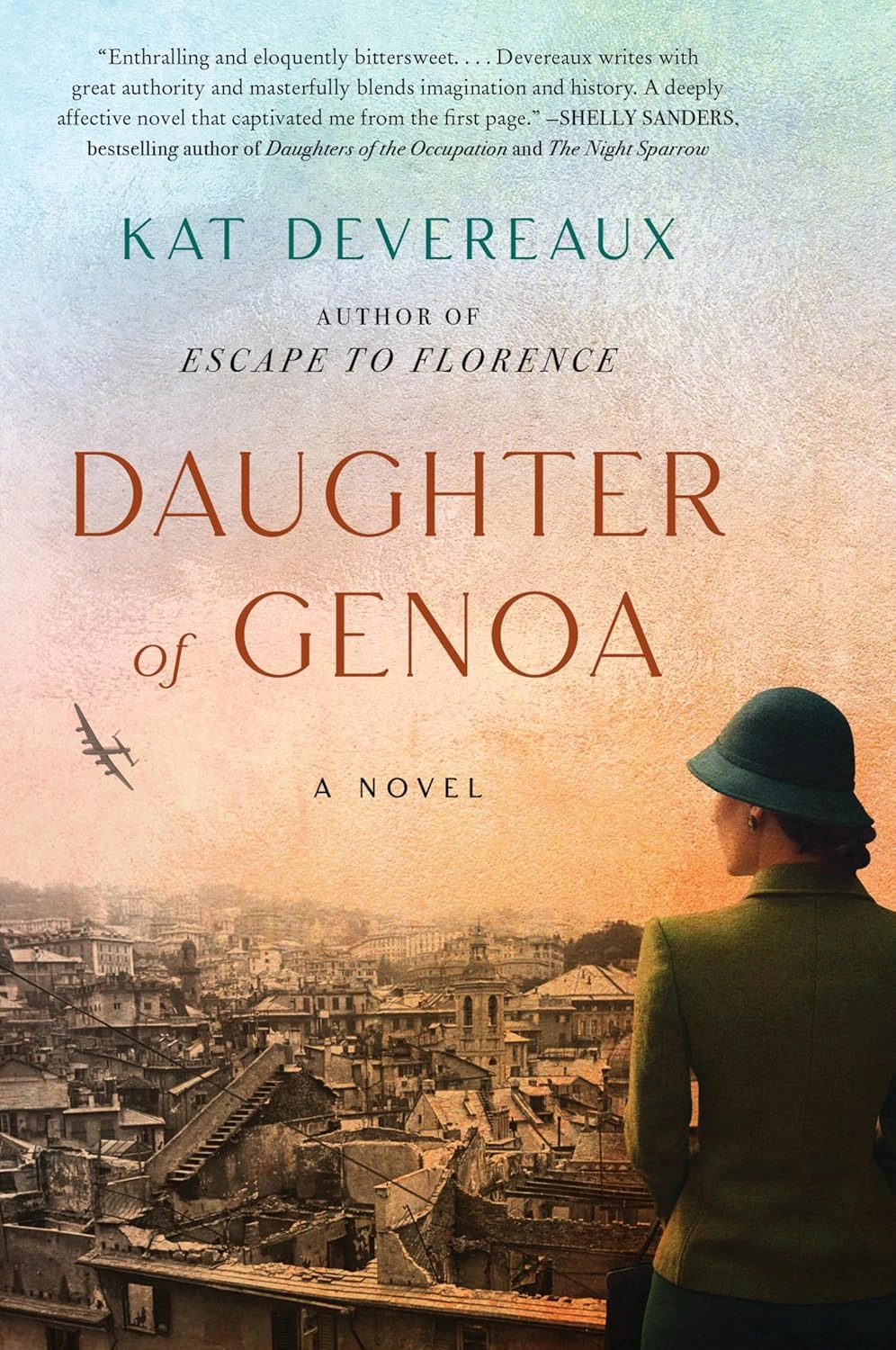
Daughter of Genoa by Kat Devereaux
“He who saves a single life saves the entire world” – The Talmud
Author Kat Devereaux has written an impressive second work of historical fiction with Daughter of Genoa. The plot centers on protagonist Anna Levi Pastorino, a half-Jewish widow whose existence in Genoa in 1944 is precarious. Believing blame and lies about their daughter-in-law, her in-laws offered neither sustenance nor means of support after her husband Stefano’s death. Her greedy landlady signora Pittaluga periodically has raised her rent and threatened her with exposure to the police. Anna takes in laundry, irons and mends clothing to eke out a pittance augmented by small sums she withdraws from Stefano’s bank account which the bank manager kindly, though likely illegally, allowed her to continue to access. Anna’s mother was Presbyterian Scottish and her father Jewish American. Her family had fled to the United States years earlier but she had unwisely chosen to remain behind with Stefano.
Life on the Brink in Wartime Genoa
Daughter of Genoa begins in earnest as sirens sound alarms for residents to hasten to air raid shelters. Anna is vulnerable to arrest and seldom leaves her tiny apartment. She experiences both alarm and revulsion in the underground tunnel that serves as shelter when she espies a Jesuit priest seated across from her. Her father had taught her to loathe Jesuits as being “the Pope’s Enforcers, relentless champions of Christian supremacy” and now this man clad in a black cassock is staring at her. At dawn the all clear sounded leaving them blinking in the sunlight which revealed that her apartment building containing all her meager possessions had been hit by a bomb and now lay in ruins. Dejected, undernourished and certain of impending doom, Anna is astonished when Father Vittorio, the Jesuit from the tunnel, rescues her from almost certain arrest by the Nazis patrolling the streets. A Protestant older couple, Bernardo, a typographer, and Silvia, his wife take her into their home above their shop providing food, shelter and companionship. In short order, Anna learns they are all part of the DELASEM spawned Resistance dedicated to helping Jews. She is instructed not to make a sound when anyone is in the shop or at the door. They have a hiding place for her if zealot Italian Fascists or Nazi soldiers disturb them.
A Dangerous Network of Rescue and Deception
Father Vittorio visits often as does a handsome man known as “Mr. X” and it becomes clearer to Anna when she receives forged identity documents including a passport and a ration card these are not merely social calls. Daughter of Genoa is a sweeping tale grounded in factual history of danger, deceit and tremendous courage along with a hint of romance and a richly imagined storyline. Genoa is historically home to one of the oldest Italian Jewish communities in Italy.
This fine work of fiction sheds light on the lesser known organization known as DELASEM based in Italy which existed from 1939-1947. This is the acronym for the Delegation for the Assistance of Jewish Emigrants or Delegazione per l’Assistenza degli Emigranti Ebrei. It was established by well-connected lawyer Lelio Vittorio Valobra in the port city Genoa in 1939 subsequent to the introduction of anti-Semitic legislation and remained under his direction. From 1933 until late fall 1938 when the Mussolini led fascist government introduced a series of “Racial Laws”, Italy was a Jewish safe haven; one of the few countries where thousands of foreign born Jews fleeing persecution in their home countries under Nazi Germany’s control could escape. The widespread Expulsion Decrees began in September 1938 in Fascist occupied countries forcing widespread emigration among the Jewish populations. They were stripped of their homes, businesses, property and wealth, ousted from schools, universities and their jobs, and forbidden from marrying or even associating with non-Jews. Conditions worsened following the German occupation of Italy that began on September 9, 1943 which made all Jews in Italy subject to arrest and deportation to concentration camps. These draconian measures prompted more Italians, even those who otherwise supported fascism, to engage in resistance activities.
Officially DELASEM’s purpose was to provide assistance to Jewish refugees and later Italian Jews in facilitating emigration for them. Funding came primarily through Paris from international Jewish institutions as well as funds collected in Italy. At its height, DELASEM opened branch offices in twenty-one Italian cities and in Italian occupied territory. Historic details of its operation were lost when the main office and archives were destroyed in the many bombings of Genoa. The many participants in what became a vital part of the Resistance underground network rarely revealed their clandestine activities post-war. Prior to Italy’s entry into World War II on June 10, 1940, it is estimated DELASEM assisted 9,000 refugees by transporting them to safety. After this date, those considered enemy foreign nationals, including Jews, were arrested and sent to camps or placed under police surveillance. DELASEM additionally assumed responsibility for the welfare of the interned Jews.
Remembering the Unsung Heroes of the Resistance
Jesuit priests, Carthusian monks and many other courageous ordinary citizens helped create and print false identity papers allowing hundreds of hidden Jews to escape from fascist Italy. The celebrated champion bicyclist Gino Bartali, three-time winner of the Italian Giro d’Italia, two-time winner of the Tour de France, and a devout Catholic, was a courier for the resistance. By claiming he was ‘in training’ while covering large distances, he evaded Nazi inspection of his bicycles which contained falsified documents hidden in their framework. Post-war, he refused to discuss the extent of his activities. Based on multiple testimonies from Jews he had saved, he was recognized posthumously on July 13, 2013 as Righteous among the Nations by Yad Vashem.
Rome was liberated by Allied Troops that included this reviewer’s late father on June 4, 1944, but Genoa was occupied by the Germans for another ten months. The city and its citizenry endured horrendous conditions with repeated bombings, starvation conditions, curfews and other harsh restrictions with betrayals, multiple arrests, deportations and murders. Kat Devereaux included two real people in Anna’s fictional tale. They are Massimo Teglio, a businessman and aviator, the head of northern Italy’s DELASEM after November, 1943 who worked closely with Don Francesco Repetto, secretary to the unusually sympathetic Jesuit Cardinal Boetto. Massimo’s family were Sephardic Jews who lost many family members deported to and killed in Auschwitz Concentration Camp. He was called Signor X, regarded as Italy’s Jewish Scarlet Pimpernel and although he carried a million lire bounty on his head, he survived the war and lived until 1990. Don Francesco Repetto, hunted by the Gestapo, successfully hid in the mountains, was honored by Yad Vashem as Righteous among the Nations in 1976, and died peacefully in 1984. Cardinal Pietro Boetto who died of a heart attack in 1946 was posthumously honored by Yad Vashem in 2016.
During the post-war period between 1945 and 1947, DELASEM assisted families in reuniting with their children, many of whom were hidden in convents or private homes. They also assisted the Jews who returned from deportation or concentration camps that wished to remain in Italy and helped others to emigrate to what would become Israel or other welcoming countries. The life-saving work of this unique aid and resistance organization merits wider acknowledgment. Through Daughter of Genoa, historian, translator, educator and editor Kat Devereaux has given readers a colorful, fascinating story and vital history lesson. Kudos! This notable work is her second novel following Escape to Florence (2023). Readers will eagerly await her next book.
Additionally, readers may take note of Angela Shupe’s highly recommended debut novel In the Light of the Sun, which was inspired by true family events. This is another fascinating recently published work of historical fiction featuring la Resistenza, the underground resistance in Florence, Italy during the same time period. Two sisters with an Italian father and Filipina mother are aspiring opera singers, continents apart and separated by WWII. Following intensive training, Rosa has made her debut in Florence but is interrupted by the war and circumstances impel her to become involved with the resistance. Younger sister Caramina courageously works with their family against the barbaric Japanese occupation of The Philippines.
About Kat Devereaux:
 Kat Devereaux was born near Edinburgh, and has lived in the United States, Russia, France, Chile, Germany and Italy. She now lives in the beautiful Czech city of Prague. She is a historian by training and an enthusiast by nature.