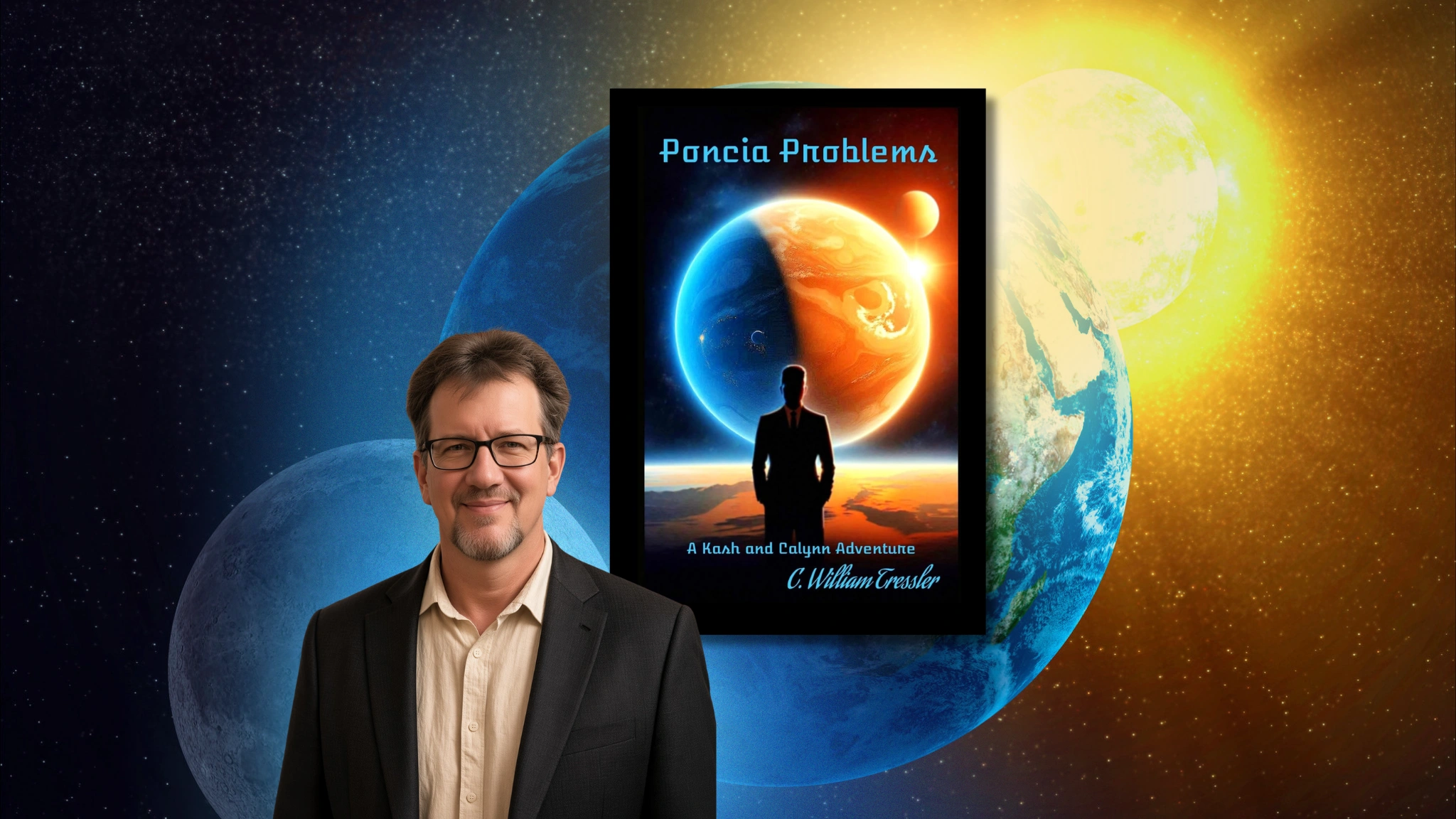
What began as a simple short story quickly grew into an entire universe for C. William Tressler, author of Poncia Problems, the first installment in his planned Kash and Calynn’s Adventures series. Blending fast-paced action, inventive worldbuilding and plenty of sharp-witted banter, Tressler introduces readers to a sprawling sci-fi world where corrupt governments, god-like alien races and strange new planets are all part of the adventure. At the heart of it all are Kash and Calynn, two characters whose chemistry and personalities ultimately proved too big for a single short story. We spoke with Tressler about how Poncia Problems spiraled into a 90,000-word novel, the real-world ideas behind his alien civilizations, the family influences that shaped his humor and what readers can expect as Kash and Calynn’s adventures continue.
You mention this started as a series of short stories before “running away” with your imagination. What was the moment you realized Kash and Calynn’s story had outgrown that format and needed to become a full novel and eventually a series?
I talked about writing shorts and blogs with them for a month or so while I was writing a different novel, mentioning all the different concepts and bits I could do with them and how open the world would be. Hilarious little scenes would roll off my tongue in conversation with friends and family. The possibilities are quite literally as endless as the universe itself. So, one day I finally sat down to write a short story with them. It was supposed to be a simple rescue mission in the town square of a hot, dirty planet.
I knew the first short story would be a little longer. I was expecting 7,000 words or so because of having to introduce them and the world they live in. But with each passing paragraph, there was more and more I wanted to tell. I wanted to introduce the Thracians, and show Calynn as part of the ship before she got a new body. And explain my crazy take on traveling faster than light. But then continuing Calynn’s arc to showcase her new talents was a must. From there the story just spiraled out of control and they consumed me… 90,000 words later, Poncia Problems was born.
I could hardly believe it myself.
How much of the terraforming science and cross-planet biology in the book is grounded in real astrobiology concepts, and how much did you invent to serve the story?
I knew most Sci-fi readers would understand terraforming. That’s been a staple in the genre forever. So, I didn’t want to harp on it too much. The different biology was intriguing though. Look at us as a planet, why are those from the Netherlands so much taller than those from Laos or Nepal? Hair, skin tone, and facial features differ greatly from one continent to another. Now multiply that by having them come from different galaxies with different gravities and slightly different chemicals in the air. The possibilities are truly endless.
Folks with blue, gray, or red tints to their skin to add to our black, brown and white. The height differences, different skin and hair textures, and some with fur or ears like a cat. Not to mention the animals too. Like the cats from the one blog I did that were the size of elephants… imagine those purrs. I’ve also had them comparing the food to foods here at home. Kash repeatedly says that the seafood is always the closest to what he grew up eating here on Earth. Again, endless possibilities that are so much fun to write.
It also gives me the opportunity to engage with worlds in various states of development. I haven’t done that yet, but a plot on a steampunk planet with a modest amount of character and tech work does exist and is definitely on the way.
The opening scene throws readers straight into a public execution and an angry mob. Was that a deliberate choice to set the tone for the “corrupt society” themes you mention in the preface, and how did you decide how dark to let this world get?
Like I said above, it was originally intended as a short, so throwing the reader into the action was a must. But when I started to realize that this was turning into a full-blown novel, I did come back and do a bit of a rewrite to ramp up some of that corruption that is always looming in the background. But no matter how many times I rewrote the chapter, that opening scene never wavered. It always felt right the way it set the tone for this particular planet.
I’m also a bit of a cynic, so highlighting the evil that people are capable of was easy for me. With how harsh life would be on Poncia, the people would be on edge looking for a reason to release those pent-up frustrations. A mob mentality seemed a natural fit.
And then the corrupt government wasn’t exactly hard to write. Inspiration for that is just a news broadcast away.
The Huma present themselves as god-like architects of humanity while other characters clearly resent that hierarchy. Were you consciously building an allegory about power, colonization or inherited privilege, or did that tension emerge more organically as you developed the world?
I’m going to walk the fence here and say both. I knew there needed to be a hierarchy of power and the constant friction that would provide, but I did allow plenty of room for the creative process. It did take some trial and error to find what felt gritty enough but also realistic enough that the reader can believe it. Greedy corporations forming a government so they have control of the masses really helped deliver that gritty baseline where you could easily believe it was a breeding ground for both evil and good.
Having the Huma intertwined with the Consortium government as a guiding force brings their dichotomy to the forefront. They wage wars against entire systems to bring them into the fold of the Consortium, but also do humanitarian aid and feed the hungry. They try to correct any terraforming errors, like on Poncia, to help the people, but will force someone like Kash to help them. They feign nobility but in their actions, they are more like tyrants.
A race that is much older than the rest, who claim that they “seeded the stars,” just sounds full of themselves. Their haughty attitudes make them easy to dislike, even when their intentions are good. The defiance Kash and Calynn display when interacting with them will continue to anger and irritate the Huma in future books.
You dedicate the book to your family and specifically mention your daughter as a sounding board. Did their reactions or feedback ever change the direction of the story?
I would say not to any large degree, no. Or at least nothing that made the plot take a hard left turn anyway. I bounced plenty of ideas off my daughter but it was more of the nuance stuff rather than anything major. When I was on the fence about having Kash and Calynn become a couple, my daughter thought it would be better if they weren’t. But when I actually wrote that part, Kash and Calynn had other plans.
Some of Calynn’s dialogue was directly influenced by things that came out of the mouth of my wife, my daughter, my mom, or my sister though. It may or may not have been when I was being a smartass. You’ve got no proof. You can’t prove a thing.
But I would be remiss if I didn’t give some credit to my mom and my sister, all my aunts and uncles and cousins, and my best friend. I was surrounded by good-natured but sharp wit, and copious amounts of laughter growing up. The roots of the banter back and forth between Kash and Calynn can be traced back to those that made me laugh throughout my impressionable years. It shaped me and in turn shaped them.