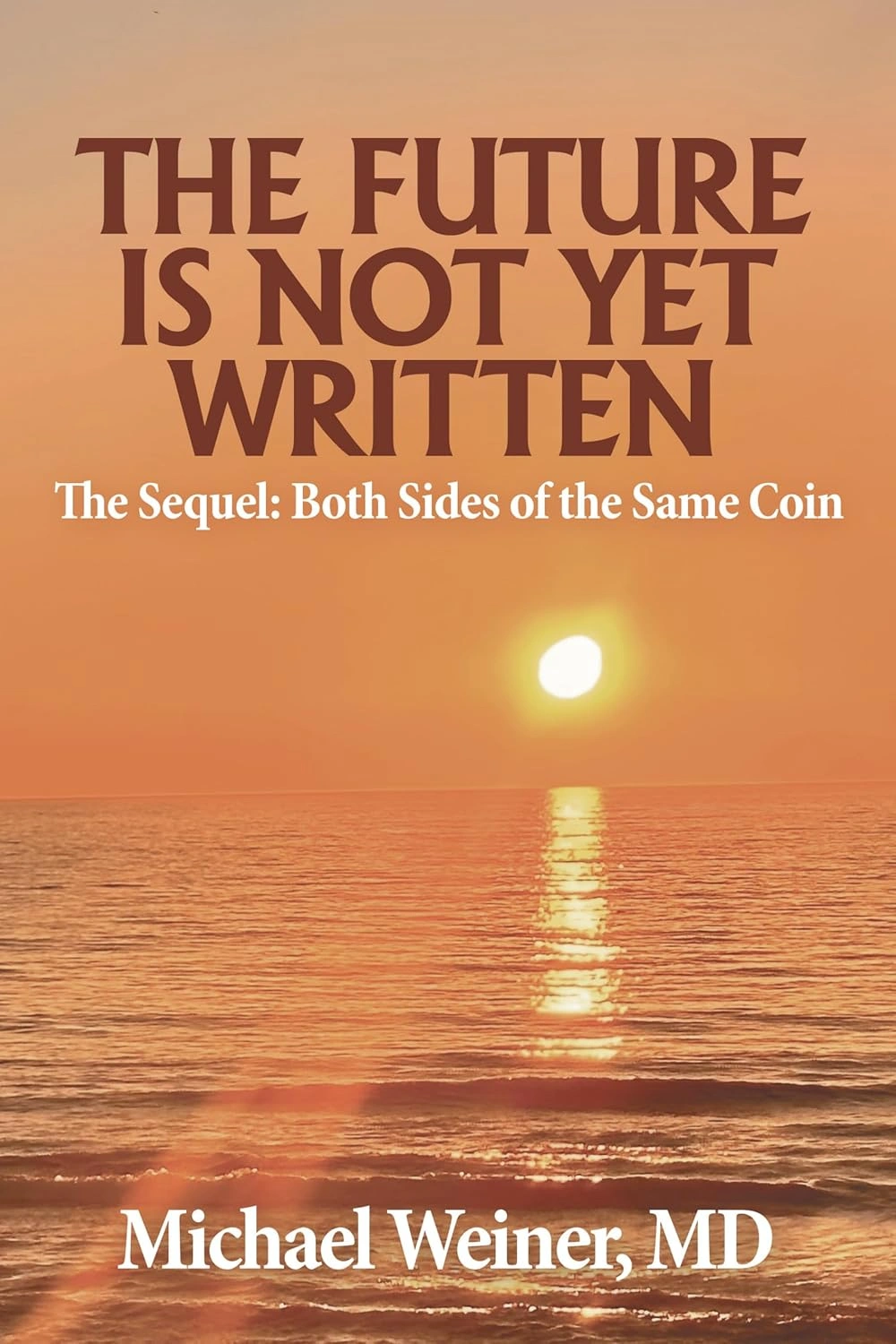
The Future Is Not Yet Written by Michael Weiner, MD
The Future Is Not Yet Written, Michael Weiner’s sequel to Both Sides of the Same Coin, begins where many stories might end: in the stunned aftermath of September 11, 2001. The novel follows the children, spouses and surviving relatives of the Klein, Carbone, Doyle, Roth and Bartell families, whose lives have already been shaped by the earlier generation and are now irrevocably altered by national tragedy.
Several family members die in the World Trade Center attacks, leaving spouses to manage households, children forced to grow up too quickly and relatives searching for ways to honor the dead without being trapped by loss. From there, Weiner carries the story across nearly two decades, ending in another collective crisis: the COVID-19 pandemic. Between those upheavals, the novel becomes a chronicle of what happens to families after catastrophe, years after the first shock has passed.
A Branching, Complex Novel
This is not a conventionally plotted novel built around one protagonist and one central conflict. It moves more like an extended family record, following one branch and then another as grief, ambition, illness, love and reinvention ripple across generations. Elizabeth Klein, suddenly widowed, must decide what kind of life she wants after years inside Richard’s carefully managed world. Marissa Goldstone Carbone returns to medicine after losing Michael, but reshapes her career so she can be more present for her children. Lauren Stein Roth, with less support, faces family fracture and professional collapse before finding a steadier path. Ellis Williams and Christine Brown create a blended household out of two grieving families. Zach Bartell channels loss into Hammertown Farm. Willie and Belinda James enter from outside the original family circle, yet their friendship with Elizabeth becomes one of the novel’s warmest connections.
The large cast is part of the book’s design. Weiner is interested in the way lives touch, separate and touch again. People are linked by marriage, old friendships, shared schools, business partnerships, charitable work, medical crises and the fact of having survived the same historical moment. One family’s recovery is never entirely separate from another’s: a friendship becomes a lifeline, a professional connection becomes a second chance, a child’s illness reshapes a foundation’s mission.
The novel’s strongest theme may be the randomness of life — and the responsibility that follows. The characters are often privileged, educated and financially secure, but none of that shields them from death, cancer, anorexia, depression, PTSD, autism, suicide, estrangement or fear. Weiner does not treat these experiences as melodramatic twists, but as part of family life’s unpredictable terrain. The question is rarely whether pain can be avoided. It cannot. The question is what people do afterward.
Transmuting Pain Into Action
That is where the book finds much of its emotional force. Again and again, grief pushes characters toward action. Erica Klein’s struggle with anorexia eventually shapes her work helping others with eating disorders. The Doyle Foundation expands its mission after Suzanne Jones’ cancer. Stefan’s losses deepen his commitment to public service and LGBTQ rights. These arcs give the book its forward motion: not suspense in the usual sense, but the steady pull of watching people adapt.
Weiner’s style is distinctive. He writes in a precise, reportorial mode, often pausing to explain a hospital department, legal dispute, real estate project, school, foundation, medical condition or financial arrangement. That documentary quality gives the book its texture. It creates a world populated by institutions, careers, neighborhoods, rituals and systems — the machinery through which modern American families live.
That attention to detail also makes the characters feel rooted. We come to know them through decisions as much as dialogue: where they move, what work they choose, how they raise children, how they remember the dead. By the time the novel reaches the pandemic, these families no longer feel like names in a sprawling cast list. They feel like people whose histories have been built in front of us, one choice and one loss at a time.
Richly detailed and deeply compassionate, The Future Is Not Yet Written is a family saga of love, loss and resilience, following interconnected families as they navigate two decades of tragedy, reinvention and unexpected hope. Weiner’s characters cannot control history, illness or chance. What they can do is keep building lives that remain open to change — and in that, readers may find both comfort and encouragement for their own struggles.
About Michael Weiner, MD
 A native New Yorker, Dr. Michael Weiner is a pediatric oncologist, philanthropist, and author. He served as the head of Pediatric Oncology at Columbia University Irving Medical Center. He has written more than fifty peer-reviewed medical articles and abstracts. The founder of the Hope & Heroes Children’s Cancer Fund, Dr. Weiner has also authored three non-medical books.