
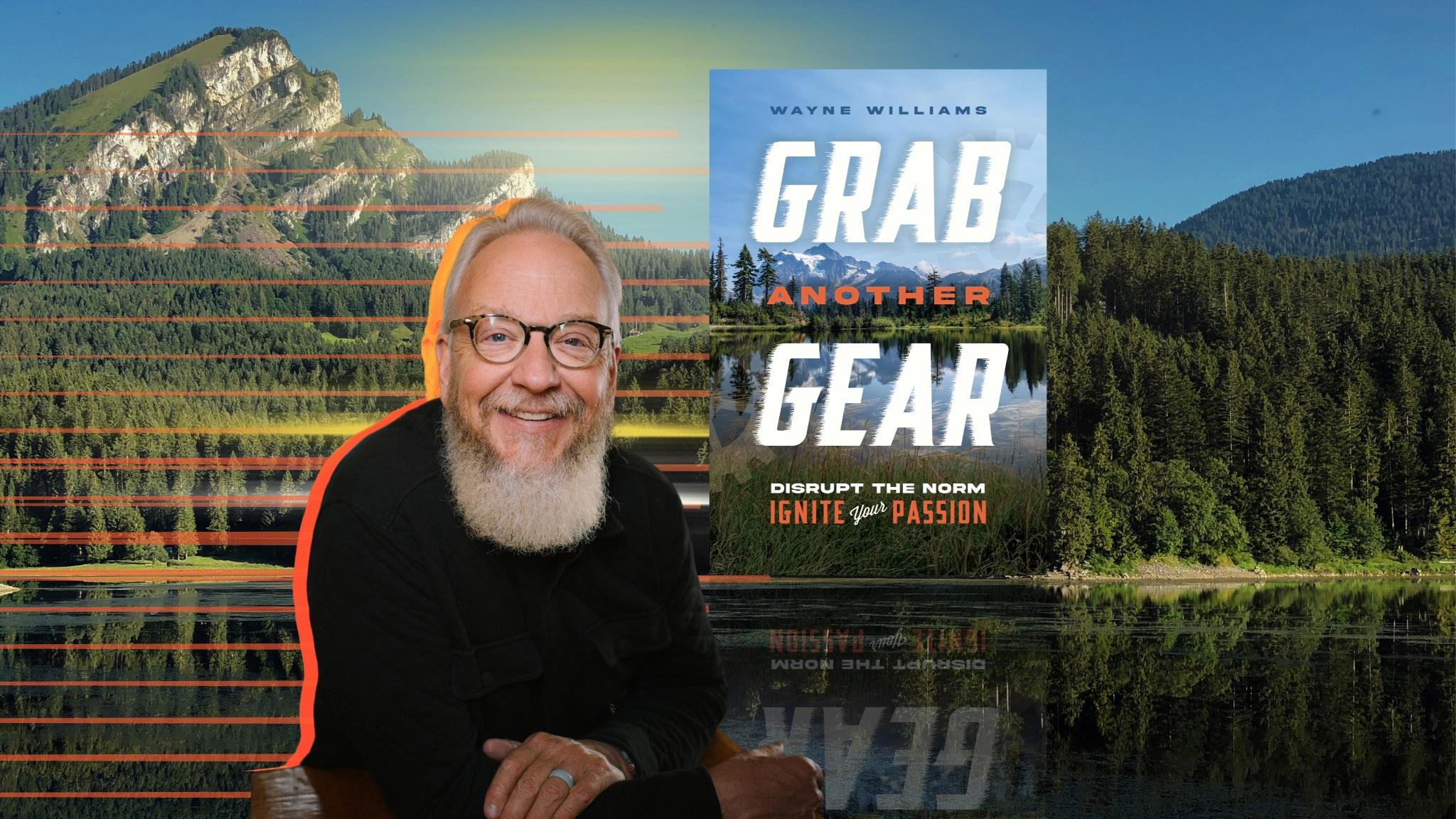
For many leaders, success becomes a destination. For Wayne Williams, it became a detour. In his new book, Grab Another Gear, the entrepreneur, coach and business leader draws on the world of cycling to explore what happens when life forces us to shift direction — whether through failure, transition, loss or unexpected opportunity. Williams knows that terrain firsthand. After watching a company once valued at more than $1.4 billion unravel during the dot-com crash, he was forced to confront questions far deeper than revenue or achievement. In this conversation, he reflects on identity beyond accomplishment, the challenge of releasing control, the power of community and why the life we’re meant for often begins just beyond the gear we’re afraid to shift into.
It was the day before Thanksgiving 2000. A month earlier, everything looked bright — we were heading toward $275 million in revenue, 2,300 employees across six operations around the world, a valuation north of $1.4 billion, and an IPO in front of us. Then the dot-com bomb hit. Subscription prices fell off a cliff. Order rates dropped. Cancellations poured in. Over the next twenty-four months, our employee base went from 2,300 to 500, and revenue fell from $275 million to $60 million. More than once that season, I found myself in bed in the fetal position — not wanting to get up.
That’s not a story I tell to sound dramatic. I tell it because it’s where I learned the difference between coasting and driving. For years I’d had my identity wrapped up in that business — it was my thing, the place I’d poured my energy and my ambition into, and the people. When I finally sold it in 2017, a third-generation family business, the valuation was nowhere near what it had been at the top. A mentor looked me in the eyes and asked, “How embarrassed are you going to be to sell for so much less than you once expected?” I didn’t hesitate: “I’m not embarrassed at all. Because I’m not living for my peers.”
My wife Terina once asked me, point blank, “How many tracks are you on?” I couldn’t answer it cleanly, and that was the answer. When you can’t name all of your courses or your tracks, you’re not driving them — they’re driving you.
Once it’s visible, sort each track into one of two piles: a mountain or a hill. Mountains are non-negotiable — tied to your convictions, your family, and your calling. Hills are preferences — good, but not load-bearing. You don’t have to release a single thing in that first sitting. You just have to stop pretending every track is a mountain. The moment you can see which ones are hills, the downshift stops feeling like loss and starts feeling like clarity. And remember — grabbing another gear doesn’t always mean accelerating. Sometimes it means braking on purpose or eliminating a track.
It works because it does an end-run around our self-talk. I engaged a coach 15 years ago to access my mirror gear. They asked me a question that I had the answer to deep in my head. I let the answer flow out and went, “Wow!” We have the answers inside most of the time; we just need someone to engage our mirror gear and unearth it. Most of us are fluent at narrating our own lives in the most flattering, most defensible terms. We know the script. But that question doesn’t ask what you think — it asks what your spouse, your business partner, your kids, and the people in the passenger seat already know and have maybe been trying to tell you. Almost everyone goes quiet because they already know the answer. They’ve known it for a while. They’ve just been driving past it.
The first and hardest step is internal: accept that you’re a steward, not an owner. Nothing you’ve built is ultimately yours to keep — the business, the title, and even being a parent are seasons you’re entrusted with, not a possession. That sounds simple. It’s brutal in practice, because most of us have quietly fused our identity to the thing we’re holding. Letting go of control feels like letting go of self.