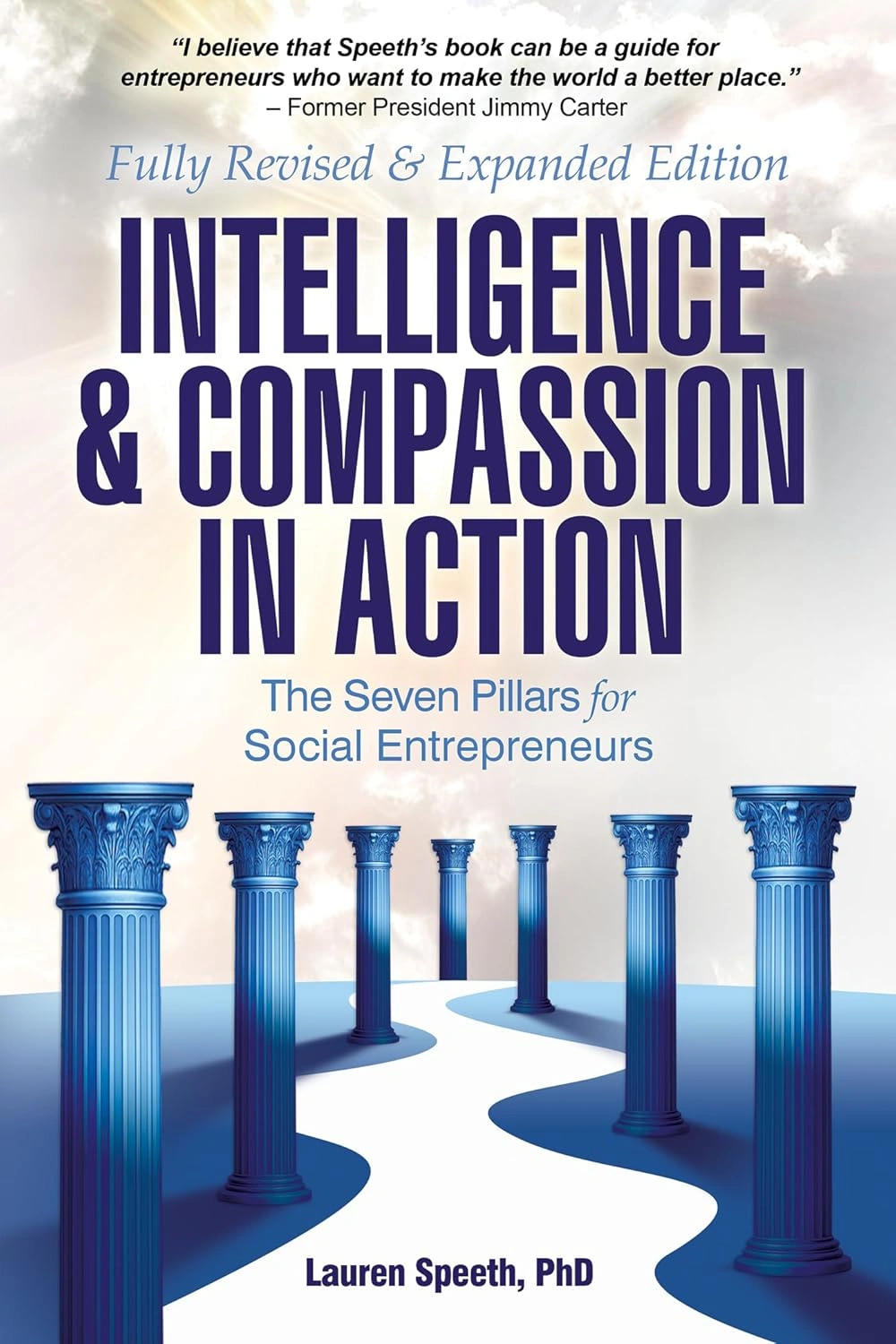
Intelligence & Compassion in Action: The Seven Pillars for Social Entrepreneurs by Lauren Speeth, PhD
Caring about the world can be exhausting. There is always another crisis, another cause, another reason to feel both morally summoned and practically overwhelmed. Intelligence & Compassion in Action: The Seven Pillars for Social Entrepreneurs begins in that very human place: Lauren Speeth, PhD, looking at the world’s needs and wondering how one person, one foundation, one small group of committed people could possibly make a meaningful difference.
The answer, at least in this book, comes from a private 2005 meeting with President Jimmy Carter. When Speeth asked him how to choose among so many possible projects, how to avoid discouragement and how to make an actual difference, Carter offered seven criteria. Speeth has since developed them into a working framework she calls the Seven Pillars: Vision, Special Skills, Non-Duplication, Partnership, Credit Sharing, Feedback and Staying Power.
What makes the book valuable is that Speeth shows readers how to transform compassion into action. It’s a force that needs direction, structure and discipline to effect meaningful change. The result is part leadership manual, part memoir, part nonprofit casebook and part moral invitation. It is not a quick-read pep talk. It is denser than that, richer than that, and more useful because of it.
Seven Pillars, One Practical Question
At the heart of the book is a deceptively simple question: How do we help in a way that actually helps?
The first pillar, Vision, asks readers to stop trying to fix everything and identify the problem that truly calls to them. For Speeth, vision is not just inspiration; it is focus, self-knowledge and the ability to explain a desired future clearly enough that others can see it too.
Special Skills then brings the dream down to earth. What do you know how to do? What do you love doing? What abilities, relationships, resources or life experiences can you bring to the work? Speeth’s definition of skill is refreshingly broad. Technical expertise matters, but so do communication, character, persuasion, creativity and the ability to imagine possibilities where others see only obstacles.
Non-Duplication is one of the book’s strongest ideas. Speeth argues that changemakers should not rush to repeat what others are already doing well. The better question is where one’s efforts can fill a true gap — an underserved community, an overlooked need, a missing service or a fresh application of an existing idea.
Partnership follows because no serious social effort succeeds alone. Speeth is clear-eyed about this. Partnerships can magnify impact, but they require judgment, humility and attention to power dynamics. Credit Sharing, in turn, becomes more than good manners. It is an ethical and practical practice because people are more likely to keep giving their best when their contributions are seen.
Feedback may be the pillar that most separates this book from softer inspirational fare. Speeth insists that good intentions must be tested against results. What changed? What failed? What needs correction? Finally, Staying Power acknowledges the emotional reality of changemaking: fatigue, setbacks, indifference, political upheaval and the temptation to quit too soon.
From Theory to Application Through Storytelling
The case studies are where Speeth’s framework gains weight. The March of Dimes material, used in the discussion of Credit Sharing, is especially compelling because it shows change as a many-handed achievement. The fight against polio depended on public figures, researchers, donors, volunteers and ordinary citizens. Speeth’s point is not simply that credit should be shared, but that the work itself was shared all along.
The robotics education pilot in Brazil is another standout. Sparked by one sponsored child’s interest in science, the project grew through ChildFund and The Elfenworks Foundation into a locally supported STEM and robotics initiative reaching multiple schools. It is a strong illustration of Non-Duplication: the idea mattered not because robotics education was new everywhere, but because it was new and needed there.
The Ukraine case study, connected to Staying Power, may be the most affecting. Work that began around environmental education through Ukraine’s National Ecological and Naturalistic Center took on new urgency after the war began. Digital educational resources became a way to reach displaced children, preserve connections and continue to serve a vision under circumstances no strategic plan could have fully anticipated.
Throughout, Speeth’s writing is earnest, wide-ranging and personal. She moves easily from history to environmental education, from nonprofit strategy to faith-based initiatives, from global case studies to moments from her own life. The book is full of examples, quotations, reflections and practical questions. That abundance gives the book its credibility. Speeth writes like someone who has spent years trying to make these ideas work in actual communities, with actual partners, under actual constraints.
Intelligence & Compassion in Action is a thoughtful and deeply practical guide for readers who know that wanting to do good is only the beginning; the real work is learning how to transform compassion into positive change.
About Lauren Speeth, PhD
 Award-winning author Lauren Speeth has shared her knowledge and wisdom over the years with audiences around the world – including Africa, Asia, Australasia, Europe and the Middle East – to critical acclaim. As a teacher, writer, and filmmaker, Lauren’s areas of expertise span self-help, social entrepreneurship, the American experience, Irish spirituality, music and storytelling. As President of Elfenworks Productions and Founding CEO of The Elfenworks Foundation, she leverages a lifetime of high-tech experience ranging from Silicon Valley startups to Fortune 500 companies.
A lifetime Carter Center Board of Councilors member and External Advisor for the Stanford Center on Poverty and Inequality, Dr. Speeth is also a Regent Emeritus of Saint Mary’s College and Member Emeritus of the Peninsula Symphony’s First Violin Section. She is a trained Climate Reality Leader and also holds a PhD in Innovative Urban Leadership.
Following the very wisdom she shares in her books, she and her colleagues have sparked projects worldwide in partnership with like-minded nonprofits and educational institutions, fostering student engagement for a more hopeful tomorrow. Her motto is simple: “Never underestimate your ripple.”