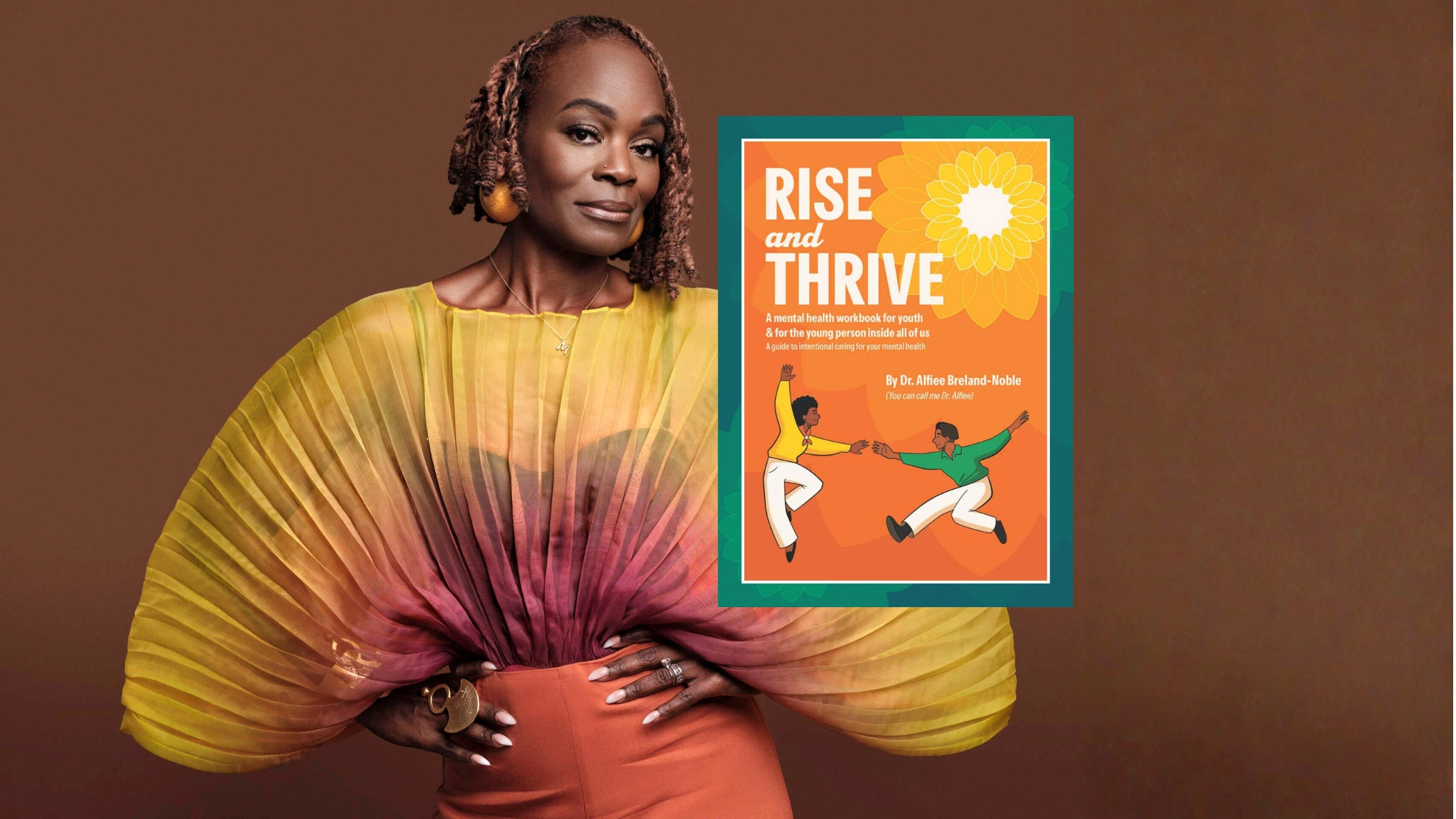
Dr. Alfiee Breland-Noble has spent three decades working to expand what mental health care can look like — especially for young people whose experiences have too often been overlooked by traditional systems. In Rise and Thrive, she brings that work directly to teens and young adults, offering an inclusive, culturally relevant guide to emotional wellness, identity, self-care and resilience. Designed for real-life use, the book combines accessible explanations, reflection prompts, coping tools and memorable “mindset remixes” to help young readers navigate anxiety, stress, depression, school, work, family, friendships and the process of becoming more fully themselves.
We recently had the opportunity to discuss the book with Dr. Alfiee and learn more about why culturally responsive mental health support matters, how young people can begin to recognize and regulate difficult emotions, and why she believes every young person deserves what she calls “optimal mental health.” She also spoke about the research gaps surrounding youth of color, the importance of evidence-informed care and her hope that Rise and Thrive will help young readers feel seen, valued and empowered to seek the support they deserve.
What do you find to be the biggest challenge facing teen and childhood mental health at this time?
Too often, marginalized youth and young adults (and the communities they come from) are made to feel that mental health care is a privilege for others. And too often these young people and their families are made to feel unwelcome by or disconnected from traditional providers. My life’s work is creating space to challenge the perception that only certain people deserve what I call #optimalmentalhealth. My philosophy is that everyone — inclusive of all aspects of identity — deserves the chance to achieve #optimalmentalhealth.
In the book, you discuss how neurodivergent children and teens often struggle with balancing their diagnosis and mental health concerns. If you could tell them one thing, what would it be?
Like I say in Rise and Thrive, “You are a gift.” I want ALL young people, especially those who have struggled to fully embrace who they are, to feel seen, heard and valued. I wrote Rise and Thrive to teach them that their uniqueness should be celebrated, but when mental health concerns, learning differences and social challenges get in the way, life can be difficult. Ultimately, I want young people to know that difference is to be understood, acknowledged and embraced; never to be feared.
What is something you’d like to share with youth who struggle with anxiety or anger when they need help self-regulating?
Throughout my book, I give example after example of the “how-tos” of self-care and emotion regulation. There is an entire section of my book that explains what emotion regulation is and gives some strategies for achieving it. Ultimately, it is most important to label our feelings honestly so we can plan for how to address them. So, my advice always begins with asking, “Do you know when you are dysregulated?” and “How do you know?” These questions are the starting point; the remaining steps (after this recognition and acknowledgment) are in my book.
Most people, when faced with mental health struggles, ask themselves, “What do I do?” What would be the first thing you’d tell them?
I am a big believer in what I call “pre-work.” For me, the FIRST self-reflective question must be, “Am I ready to feel something different?” I love this initial grounding question because it offers clarity and guidance. In other words, if we are not yet ready to feel something different than what we’ve been carrying, we may lack the motivation to stick with doing the work that will help us feel better.
Every generation struggles with different emotional and mental health needs. For Gen Z and the generation following them, what is an easily accessible tool they can use today?
My book! Rise and Thrive includes so many practical tools and activities that young people can start using immediately.
As a parent/caregiver and psychologist, what has been the biggest challenge that you have witnessed in your life and career for children and teens battling stressors and other mental health contributing issues?
The single biggest challenge that I have witnessed in my career related to teens and their stressors has been adults who fail to acknowledge that diverse youth have widely varying mental health needs. When I started in this field 30 years ago, the conversations often focused on the absence of a robust body of research about youth mental health. Beyond that, the almost complete absence of data to teach us about the needs of diverse and intersectional youth was a huge gap in our knowledge.
My work of the past 30 years has always been grounded in reversing those trends, filling the gaps and using innovative approaches to change the narrative. I have consistently done that through my nonprofit, The AAKOMA Project, and am doing it once again with Rise and Thrive. As a mom, everything I teach in my book is what I did for my own children and the hundreds of patients I’ve treated in my lifetime, as well as the millions of people I have touched through my public-facing work.
Are there any issues you want to share that you feel affect youth mental health differently across diverse groups of youth?
100 percent, yes. There is almost no evidence base for the mental health needs of youth of color. I know this because I’ve sat on dozens of national and international task forces and committees studying these issues as a senior scholar of the field over the past 30 years. Yes, there is SOME data, but for certain populations, there is little to none. So, my new book and my work are about filling in those gaps in the research. Ultimately, what makes youth and young adults of color stand apart is the need for exponentially more research to be conducted with them in mind. This is necessary to help our field create better interventions and approaches to helping ALL youth achieve optimal mental health.
How is your book evidence-based? What makes it that way?
The technical definition of evidence-based medicine is simply that a medical procedure or approach has been tested through research, is informed by provider expertise, and includes patient preferences. This definition was originally based solely on the first of the three aspects I mentioned, but over the years, it has evolved to include patient preferences and provider expertise. I was doing evidence-informed work (including all three aspects of what we now called evidence-based) 30 years ago when I started, and before patient preferences and provider expertise were even considered as part of the equation.
In essence, I was one of the earliest adopters of the concept of evidence-based as we now define it, and I was far ahead of the curve. Further, I refer to my work as evidence-informed because mental health treatment approaches cannot be evidence-based if they lack the kind of information that makes them applicable to the widest possible range of people. And I used an evidence-informed approach, grounded in mental health equity-focused research I led, throughout my book Rise and Thrive.
Why did you write this book? Who do you hope will benefit from it?
I wrote this book because I saw a need and wanted to fill it. I saw how many young people of diverse backgrounds struggled with their mental health, and I knew too many people who struggled to find culturally relevant help for their loved ones. So, I wrote Rise and Thrive as a resource for them, knowing that others would benefit because I believe deeply that a rising tide lifts all boats. And I created Rise and Thrive to be that rising tide.
What is the takeaway you hope for when people read your book?
I’d say that every young person should remind themselves that they deserve peace, they deserve a mental health provider and mental health approaches that understand them beyond a surface level, and that they should be unapologetic about vetting mental health professionals and approaches to find the right fit for them. I believe we all deserve healing, and I hope that anyone seeking a new and unique resource that speaks directly to them based on lived experience will give themselves permission to seek out my book Rise and Thrive and use it.
What’s next for you?
I am currently on a book tour promoting Rise and Thrive; after that, my next adventures will be in media behind the scenes and in front of the camera (podcasts, TV, film and publishing) and in continuing to build a robust, culturally relevant, always rigorous scientific base for my work in diverse youth and young adult mental health in the nonprofit space.