What drew you to the Ghent Altarpiece theft, and how did you balance truth vs. invention?
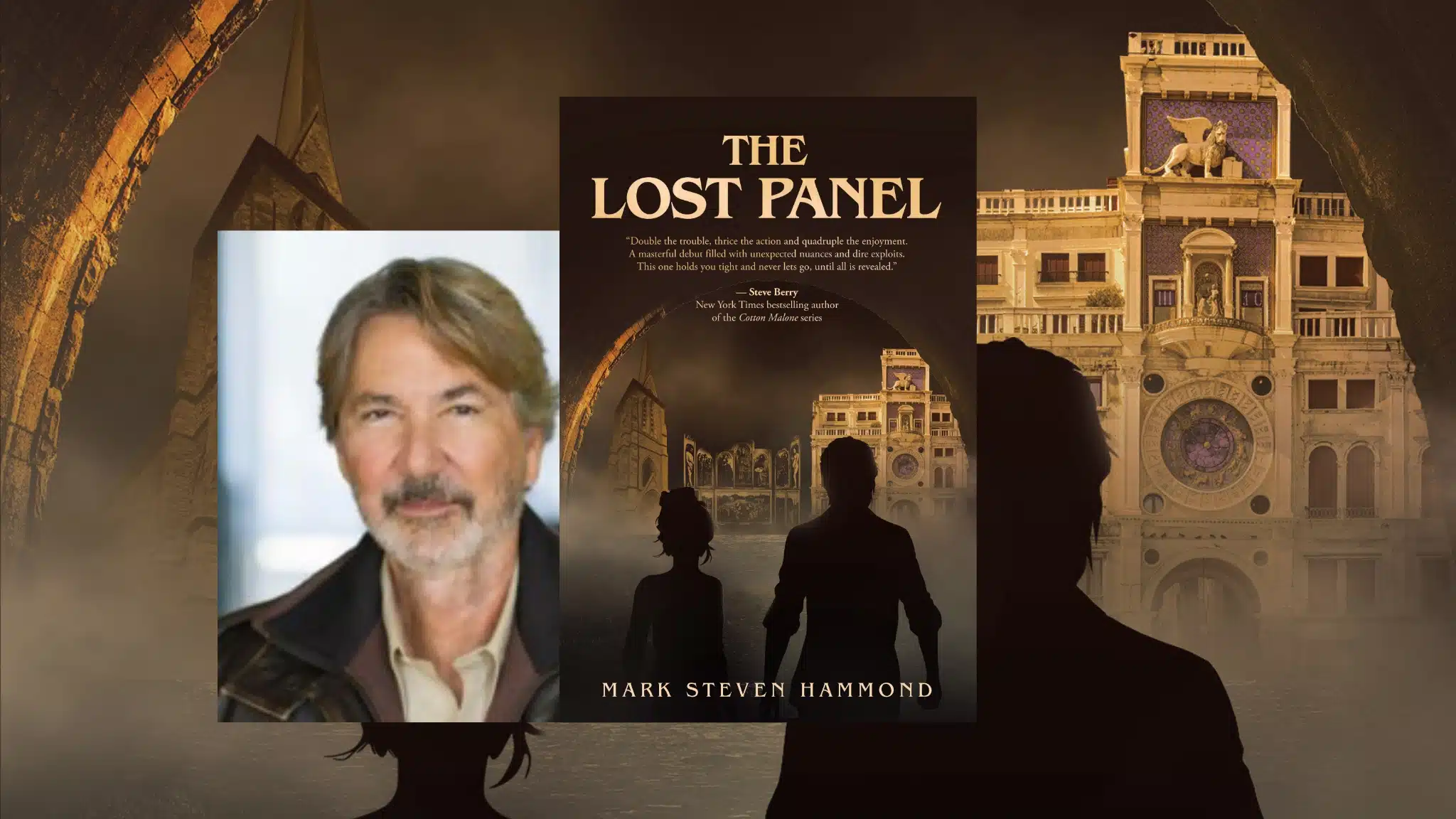
The 1934 theft of the Ghent Altarpiece — specifically The Just Judges panel — felt less like a crime and more like a question that had been left unanswered for nearly a century. What drew me in wasn’t just that it was unsolved, but that it remained relevant. The painting remains on display with a commissioned replacement that, quite frankly, doesn’t measure up to the rest of the altarpiece, which keeps the absence front and center and the mystery alive.
In terms of truth versus invention, I treated history as the spine — dates, locations, the ransom letters and the suspect Arsène Goedertier — all of that stayed intact. But where the historical record went silent, that’s where the novel begins. I wasn’t trying to rewrite history; I was trying to step into the gaps and ask what if the reason it was never found is because we’ve been asking the wrong question all along?
You open the novel in 1426 with Jan van Eyck as a spy for Duke Philip the Good. Was van Eyck involved in espionage? How did you develop that reimagining of him, and why was it important for the story that the mystery begin at the painting’s creation?
There is historical evidence that Jan van Eyck worked closely with Philip the Good in a role that extended beyond painting. He was sent on diplomatic missions, including a well-documented trip to Portugal, so while we don’t have proof he was a spy, he was clearly a trusted envoy operating at the highest levels of power.
From there, I leaned into the possibility. Artists in that era had extraordinary access to courts, private chambers and conversations others weren’t meant to hear. That made the idea of van Eyck as a covert observer, even a quiet operative, feel grounded rather than invented.
What pushed it further for me was something more personal. During my Church visit at the Basilica of the Holy Blood in Bruges, I saw how something profoundly sacred — a relic believed to contain the blood of Christ — could be preserved, displayed and protected in plain sight. That moment reframed how I thought about the past. It made me consider that people like van Eyck weren’t just creating art — they were potentially safeguarding something far more significant within it.
Starting the story in 1426 was essential because it shifts the origin of the mystery. It suggests the theft in 1934 wasn’t the beginning — it was the interruption of something much older, something deliberately set in motion at the moment of the painting’s creation.
Sophia Rossi — why her, and why that background?
Sophia came from two directions: intellect and inheritance.
I wanted someone who could plausibly decode layered historical clues, so an art historian made sense, but I didn’t want her motivation to be purely academic. By tying her to her father, I gave her a personal stake. She’s not just chasing a mystery; she’s trying to finish something that was left unresolved in her own life.
Her being Italian-American was intentional. Italy sits at the crossroads of art, faith, and power. That background gave her a natural fluency in the language of relics, church history, and artistic legacy, even while she’s chasing a Flemish mystery. It also creates contrast. She’s an outsider looking in, which lets the reader discover the world through her.
Just as important, Sophia is deeply scientific and PhD-driven, with very little reliance on faith. She trusts evidence, process and verifiable truth. That made her the perfect counterbalance to Ryan, who comes from less academic pedigree but operates with strong instinct and strong faith.
That tension between them — science versus belief, proof versus trust — became one of the core engines of the story. Because the deeper they go, the question isn’t just what is real, but what do you believe is real when the evidence can’t fully explain it?
The novel spans six centuries — 1426, 1934 and the present day. How did you manage those three timelines, and were there any moments where you had to sacrifice historical accuracy for narrative momentum?
The structure came down to restraint. Each timeline had to earn its place.
1426 establishes intent — what was created, and why.
1934 introduces disruption — the theft itself.
The present day is the pursuit — the attempt to finally understand it.
I treated each thread almost like a relay. One hands something to the next — an object, a clue, a consequence.
What grounded all of it was how I approached the material. I relied on three layers: the documented history, the rumored history — which is often what historians believe but can’t definitively prove — and then my fiction layered on top. That balance allowed me to stay anchored while still telling a story that could move.
What surprised me was how often those lines blurred. There were several times where I wrote a chapter thinking I was inventing something, only to later discover it actually existed.
One example was the use of astrolabes. I built a scene around the idea of placing them in a clocktower in Venice because the face felt like it should do more than just keep time. I assumed that was pure invention. After writing it, I discovered that historically, some clock towers incorporated astronomical instruments, and the openings around certain clock faces were once associated with those functions. It was one of those moments where fiction caught up to history, or maybe the other way around.
I also tried to physically connect the timelines wherever possible. There are moments in the book where I flash back into real locations, like the Champagne caves where Napoleon Bonaparte is believed to have celebrated after battles, and then bring it forward into the present, with Ryan and Sophia moving through those same spaces, following his footsteps. I actually walked those locations, which allowed me to write the transitions with a sense of continuity rather than separation.
There were moments where I compressed timelines or simplified certain historical details, but I never altered anything essential to the truth of the events. If I bent something, it was in service of clarity or momentum, not convenience.
The antagonist, Mr. W, is introduced as a collector who possesses art through unofficial channels. What were you exploring with that character — is he a villain, a collector or something more complicated?
Mr. W lives in that gray space where obsession starts to justify itself.
He’s not stealing art because he wants to sell it. He’s collecting it because he believes ownership is a form of preservation and control. In his mind, he’s protecting history from institutions that have failed to secure it.
So yes, he operates outside the law. But he doesn’t see himself as a villain. He sees himself as necessary.
That tension — between possession and stewardship — is what defines him. And in some ways, it mirrors the larger question of the book: who has the right to hold history?
The relics hidden inside the altarpiece — the idea that Jan van Eyck literally mixed something sacred into his paint — is a stunning invention. Where did that idea come from, and what does it say thematically about the relationship between art and faith?
That idea came from thinking about permanence.
Paintings last. Relics decay, disappear and get divided. So I started asking what if someone wanted to preserve something sacred in a way that couldn’t be separated from the art itself?
The notion that Jan van Eyck could incorporate a relic into the very medium, into the paint, felt both radical and plausible for the time. It turns the artwork into more than an image. It becomes a vessel.
That idea was reinforced during my Church visit at the Basilica of the Holy Blood in Bruges, where a small glass vial believed to contain a drop of Christ’s blood is displayed and venerated. It made me think differently about how sacred objects are preserved, not always hidden, but sometimes elevated and protected in plain sight.
Thematically, it blurs the line between art and faith. Is the power in what we see, or in what we believe is there?
Do you have a theory about where the missing panel is?
I think the most unsettling possibility is the simplest one: it was never meant to be found. Arsène Goedertier wanted to be paid, and when that didn’t happen for the amount he demanded, he created chaos.
There are strong theories — that it’s buried, that it’s hidden somewhere in Ghent, or that Arsène Goedertier took the secret to his grave. But what changed my perspective was actually being there. I personally walked the sites in Ghent that the clues have pointed to over the years — places connected to the ransom notes, the cathedral, and the suspected hiding zones.
One detail from the ransom correspondence always stood out to me: Goedertier claimed he could not retrieve the panel without being seen, and that if the Church paid, he would reveal its location, but would not physically return it himself.
That suggests something very specific. Not something buried. Not something easily movable.