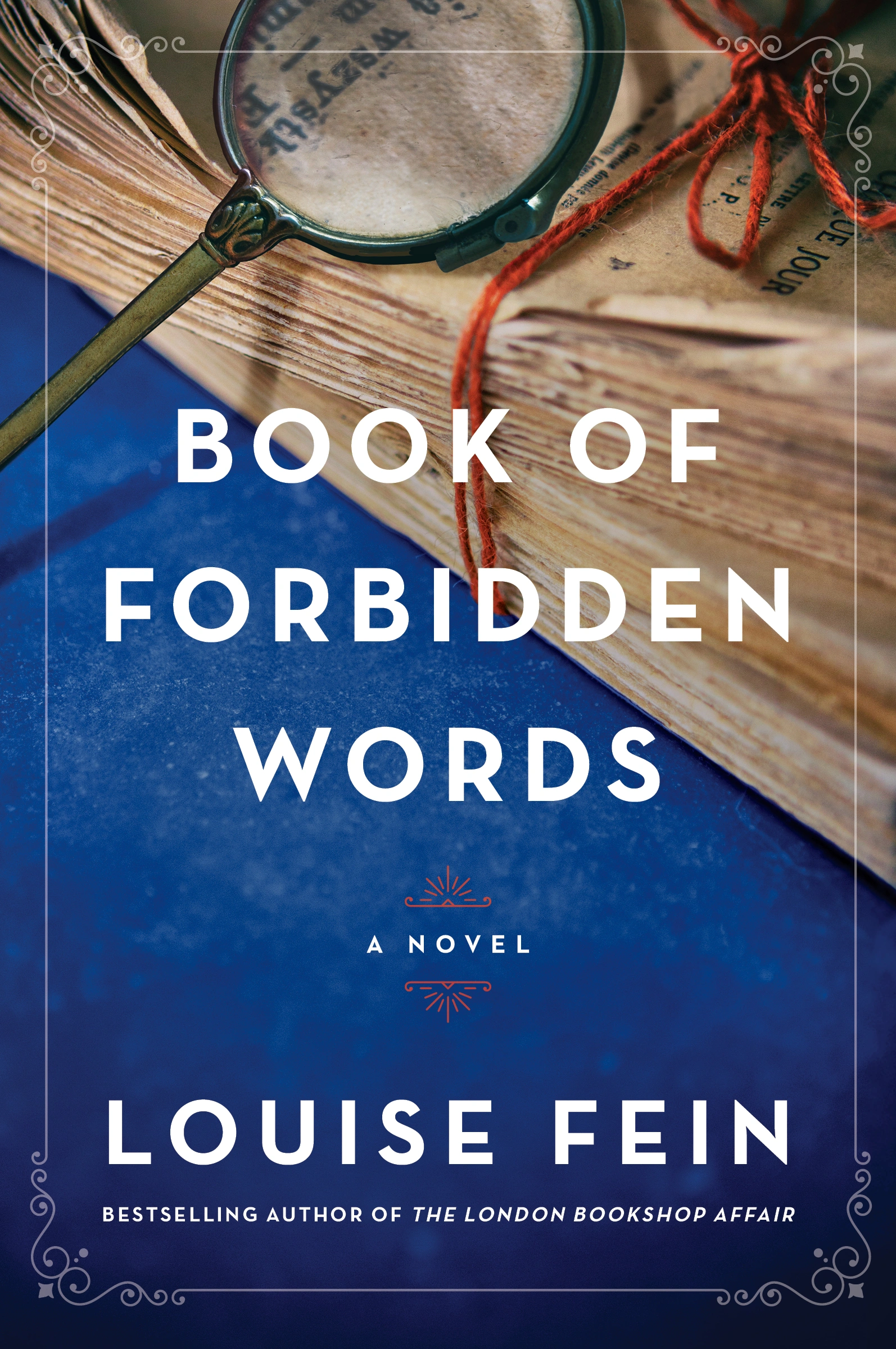
Book of Forbidden Words by Louise Fein
Has there ever been a time since the inception of printing that certain books have not been banned? Critically acclaimed, award-winning and bestselling author Louise Fein has a former practicing lawyer’s perspective on championing freedoms of expression in writing, speech, thoughts and ideas with differences of opinion respected. Her recently published fourth novel Book of Forbidden Words is an elegant, articulate work of historical fiction. A mysterious 16th century encrypted manuscript is placed in the hands of former Bletchley Park cryptographer Millie Bennett five hundred years after it was created with a faint hope that she might be capable of cracking the code. This manuscript was hidden for centuries suggesting it would have been considered heresy bringing great danger to the creator and printer. It contains illustrations of the zodiac, enigmatic symbols and text printed on vellum, costlier but more durable than paper. A colophon or faint printer’s mark bearing the initials “CG” signifies it was a product of the workshops of Charlotte Guillard, a real historical figure and successful typographer of mid-16th century Paris.
A Suburban Life with Secrets Beneath the Surface
The plotline of Book of Forbidden Words commences in November, 1952. George and Millicent (Millie) Bennett and their two young children Edward and Olive have recently moved into their new home in Nassau County, Long Island. The house is part of the residential Levittown development that was quickly built using assembly-line construction on concrete slabs to relieve post-WWII housing shortages facing returning Veterans and their young families. The newly instituted lower cost VA loans requiring no down payment made first-time homeownership possible for great numbers of Americans. The three most popular designs were split-level, Cape Cod and ranch style with two or three bedrooms and an open floor plan to maximize the compact spaces. Furnished with central heating, they came equipped with modern appliances, lawns and typically a fruit tree. Free of physical fencing, it was conceived as a modern day utopia but was nevertheless enclosed by restrictive covenants prohibiting sales to African Americans and Jews.
Millie Bennett is a British war bride, a fish-out-of water suburban housewife in desperate need of an intellectual challenge. Hailing from Oxford, England, she was an academician, University classics scholar trained in ancient and Modern Greek and Latin, able to converse in French and German and was additionally a capable mathematician. An only child, she has always felt socially awkward; enthralled more by her books and studies than people. During the war, Millie was an important asset to War Department Intelligence working long hours as a gifted cryptographer participating in the Bletchley Park efforts to break the German enigma code.
In good faith she had signed the Official Secrets Act (OSA) willingly accepting the severe punishments to be meted out should she reveal the stop secret work she had performed to anyone, including a husband. A cover story of secretarial work in a mental asylum aiding Great War patients had been assigned to her. Unable to secure a post-war job with the Secret Intelligence Services, she wrote and published five little books explaining mythology to children that are now out-of-print.
Born and raised on a Kentucky horse farm, George was eager to serve his country and see a bit of the world before settling down. As a soldier in the US Army-Air Force, he saw action in Germany before being transferred to England where he met and married Millie. He remained in military service in England for a few years after the war while Millie assisted her widowed, terminally ill mother and bore both of their children. After her mother died, they spent six uncomfortable months with George’s parents in Kentucky before George was hired by a New York bank. Levittown represented a new beginning for them on their road to attaining the American dream.
The neighbors are initially welcoming but become increasingly nosy and disdainful when Millie seems unwilling or unable to conform to their rigid social standards. Involvement with the PTA, women’s teas and luncheons while being forced to make idle chitchat were anathema to her. Worse is yet to come with pressure to join The Minute Women, a semi underground, anti-communist, extreme right wing women’s group trumpeting their version of the virtues of traditional values. The Bennetts are fictional but the organization was disturbingly real. At the height of the “Red Scare” in 1952 there were over 50,000 members in the United States firmly backing Senator Joe McCarthy. They supported letter-writing campaigns and book banning while covertly harassing people they suspected of being communist sympathizers or who simply appeared different to them. This trouble-making resulted in job firings, particularly in schools and libraries, political investigations and in some cases, deportations.
Contraband Books and Dangerous Curiosity
Longing for intelligent conversation and desiring to read contemporary American literature, Millie is befriended by librarian Susan Leesom who supplies her with contraband books; among them those by John Steinbeck, who is rumored to be a communist. The local public library only carries “suitable” books. Susan risks her job and reputation by keeping a small supply of her “banned books” which she covertly lends to people she trusts. Another threatening dark secret would not only brand her a pariah, but would be more than sufficient cause for dismissal; she is in a long-term same sex relationship with a women’s magazine editor.
The gossipmongers were thrown into high alert after observing a strange man who appeared on the Bennett’s doorstep and was invited in while George was at work! Mr. Winston Harvey-Jones, Millie’s old supervisor from Bletchley Park had traveled from England to bring her a rare 16th century encrypted manuscript he had purchased in 1947 at an auction. It had been found on a shelf in an Italian monastery, purchased by a German collector named Van Hal and sold for a sum Winston could afford. For five years, he consulted fellow code-breakers including Alan Turing but none were successful at decrypting it. He has tentatively concluded it was most likely written by a woman or a small group of women using Latin as its underlying language. Millicent Featherington Bennett is the only person he considers to possess the ability and tenacity to crack the formidable code.
Heresy and the Power of the Printed Word
There are two other protagonists who share the plot and narration with the more contemporary heroine. One is the fictional Lysbette Angiers, an orphaned ward of Sir Thomas More, the English scholar, statesman, lawyer and humanist who believed in education for women and whose most famous work was Utopia, published in 1516. More was opposed to the Protestant Reformation and martyred when he refused to condone King Henry VIII’s divorce from Catherine of Aragon which would allow him to wed Anne Boleyn. Lysbette became a nun and lived contentedly in her convent’s well-run matriarchal society until the King first looted, then shut down monasteries and convents. She is responsible for the creation of this almost mythical manuscript.
The second significant representative of the 16th century is a richly imagined version of Charlotte Guillard who had learned the art and trade of printing from two deceased husbands subsequently becoming a highly regarded printer in Paris. Catholic rulers, the Jesuits, the Inquisition in certain countries, bishops and clergy empowered by the Council of Trent all perceived an inherent threat by printers who published works supporting the Protestant Reformation. Information spread swiftly increasing dissent and diminishing the power of the Catholic Church resulting in investigations and retaliatory measures up to and including executions. The three women are linked through the manuscript and its concomitant danger in espousing freedoms and rights of women.
In Book of Forbidden Words, Louise Fein has brilliantly articulated the zeitgeist of the Protestant Reformation when perceived heresy could bring death. She also dramatizes the witch-hunts of mid-century America when HUAC, Senator Joe McCarthy and his cronies were at the zenith of their activities. The frenzied search for perceived communists brought accusations of subversion with scant or even no evidence and unethical investigation methods which resulted in careers and lives being destroyed. In interviews, the author has stated that her novel was inspired by the real Voynich manuscript in the Beinecke Rare Book and Manuscript Library at Yale University. This illustrated codex, hand-written on vellum dates to the early 15th century and remains a mystery as to language, origin and meaning. There are many theories but none have been proven. Book of Forbidden Words is a must-read, compelling warning of the necessity to preserve fairness, truth and justice.
Following the dedication, she quotes:
“If all printers were determined not to print anything till they were sure it would offend nobody, there would be very little printed.”
– Benjamin Franklin
About Louise Fein:
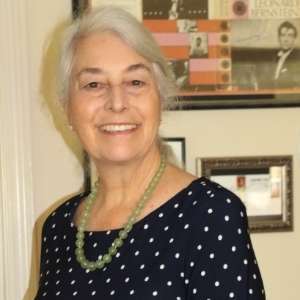
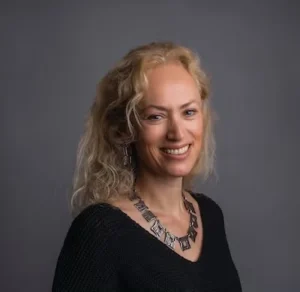 Louise Fein is the author of Daughter of the Reich, which has been published in thirteen territories, the international bestseller The Hidden Child, and The London Bookshop Affair. She holds an MA in Creative Writing from St Mary’s University. She lives in Surrey, UK, with her family.