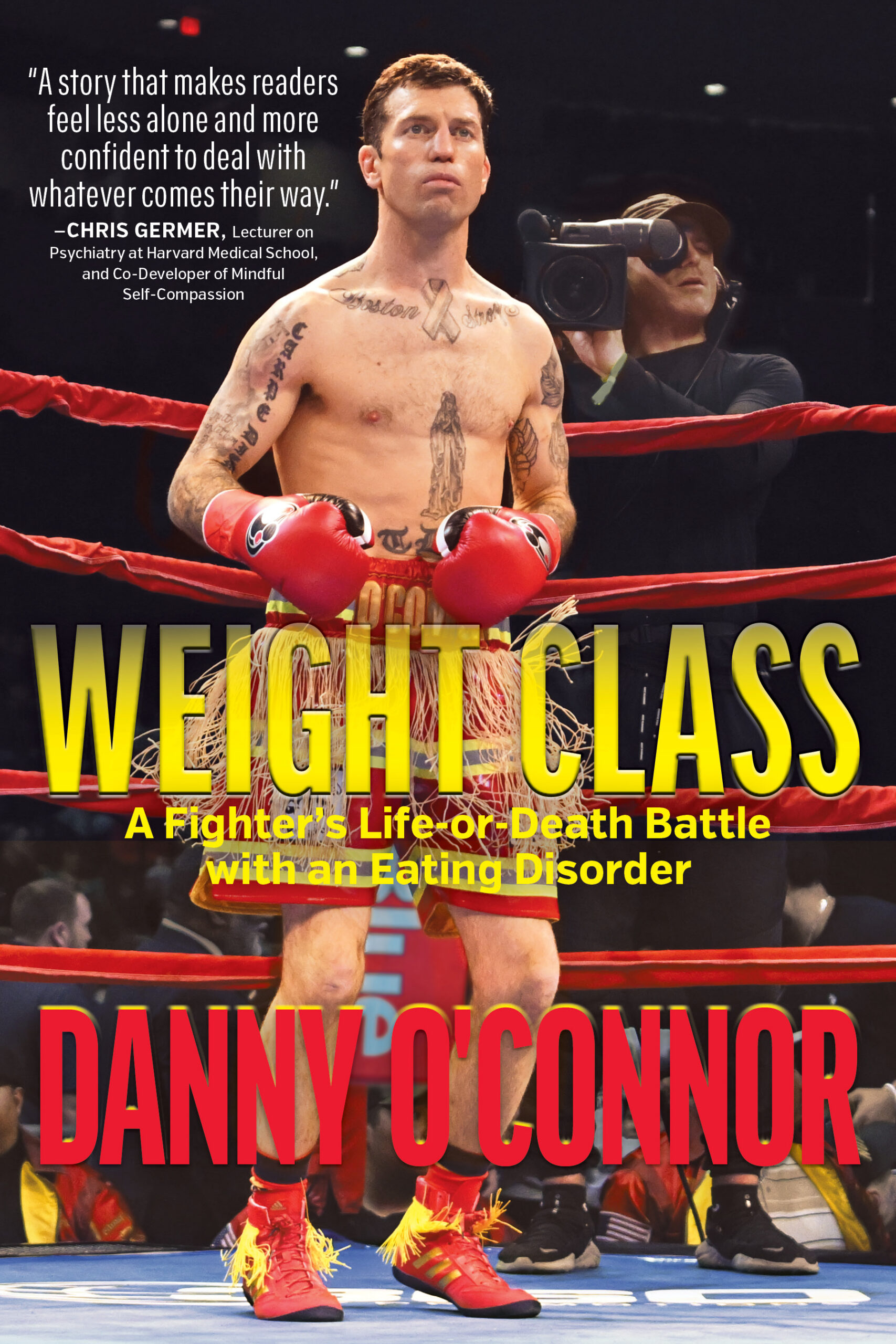

Weight Class: A Fighter's Life-or-Death Battle with an Eating Disorder by Danny O'Connor
Eating disorders have the second-highest mortality rate of any psychiatric illness, second only to opioid addiction. Yet despite their severity, they remain dangerously misunderstood — often associated with teenage girls, fashion culture or vanity. In reality, eating disorders affect people of every gender, age and background. An estimated 10 million men in the United States will struggle with one in their lifetime, according to the National Eating Disorders Association. Many will never be diagnosed.
Even less recognized is a population where disordered eating can hide in plain sight: athletes.
In weight-class sports like wrestling, boxing and MMA, extreme weight-cutting is often normalized as discipline. For Danny O’Connor, author of the memoir Weight Class: A Fighter’s Life-or-Death Battle with an Eating Disorder, member of the 2008 U.S. Olympic Boxing Team and former WBC International Silver Super Lightweight Champion, that normalization nearly cost him his life.
When Discipline Turns Destructive
From the time he joined his high school wrestling team in Massachusetts, O’Connor learned to shrink his body to fit a number on a scale. As his boxing career advanced — national titles, Olympic trials, televised professional fights — so did the behaviors. Starving. Dehydrating. Water-loading. Bingeing. Repeating the cycle.
To outsiders, it looked like commitment. Inside, it was something else entirely.
The breaking point came in July 2018. Scheduled to fight José Ramírez for the WBC Super Lightweight Championship on ESPN, O’Connor found himself more than 10 pounds over the 140-pound limit less than a day before the weigh-in. He had spent years oscillating between extreme restriction and uncontrollable binge episodes. This time, his body shut down.
He tried to sweat off twelve pounds in roughly ten hours. Instead, he landed in the hospital with abnormal liver enzymes and severe dehydration. The fight was canceled. Viewers saw only a boxer who “failed to make weight.” What they didn’t see was a man in the grip of an eating disorder that had silently escalated for more than two decades.
“I was fighting an eating disorder that was always a bigger opponent than the man standing across from me in the ring,” he writes in Weight Class. For years, he believed he was alone. Male eating disorders were rarely discussed. In locker rooms and training camps, the suffering hid behind sweat suits and sauna sessions.
O’Connor’s story underscores a broader truth: behaviors that are applauded in certain sports — rapid weight loss, extreme restriction, punishing exercise — can mirror clinical eating disorder patterns. When those behaviors spiral, they are often mistaken for a lack of discipline rather than a mental health crisis.
The Road to Recovery — and Giving Back
Recovery did not come quickly, nor through a single method. O’Connor sought traditional outpatient treatment, immersed himself in mindfulness-based practices, studied stress-reduction techniques and remained open to approaches both conventional and unconventional. He describes it as a 26-year journey of trial, error and relentless self-examination. What ultimately shifted was not just his eating patterns but his identity — disentangling self-worth from the scale.
Today, O’Connor is no longer fighting for titles. He is fighting for awareness.
Through his organization Bite Like a Man and the DO Boxing Academy, he works with schools and youth-serving organizations to integrate non-contact boxing with mindfulness practices, helping young people build emotional regulation, resilience and self-awareness. The goal is not to produce champions in the ring, but to prevent silent battles from taking root in the first place.
He also offers speaking engagements, mentorship and community spaces specifically designed to address men’s mental health and eating disorders — a population he says often struggles to find language, let alone support.
Eating Disorders Awareness Week is often a time to spotlight warning signs and resources. O’Connor’s story adds another layer: reconsidering what we think an eating disorder looks like. It may not always appear fragile. It may look strong, elite, televised. It may look like discipline.
Sometimes the most dangerous fight happens long before the bell rings.
 DANNY O’CONNOR is a former elite professional boxer who grew up outside of Boston and was a member of the 2008 United States Olympic Boxing Team. As an accomplished amateur, he captured multiple national titles, including the US National Championships and the National Golden Gloves, establishing himself as one of the top fighters of his generation.
O’Connor turned professional in 2008 and competed at the highest levels of the sport for more than a decade. He compiled a professional record of thirty-one wins and held the WBC International Silver Super Lightweight Championship. Over the course of his career, he fought on major televised platforms including ESPN, Showtime, CBS Sports, and Fox Sports 1, and competed in prominent venues across the United States.
Following his professional career, O’Connor became a vocal advocate for weight-class sports and eating disorders in men. Through his book, Weight Class, he gives a voice to the millions of men who suffer in silence, drawing directly from his career in boxing and his firsthand experience battling an eating disorder in and out of the ring.