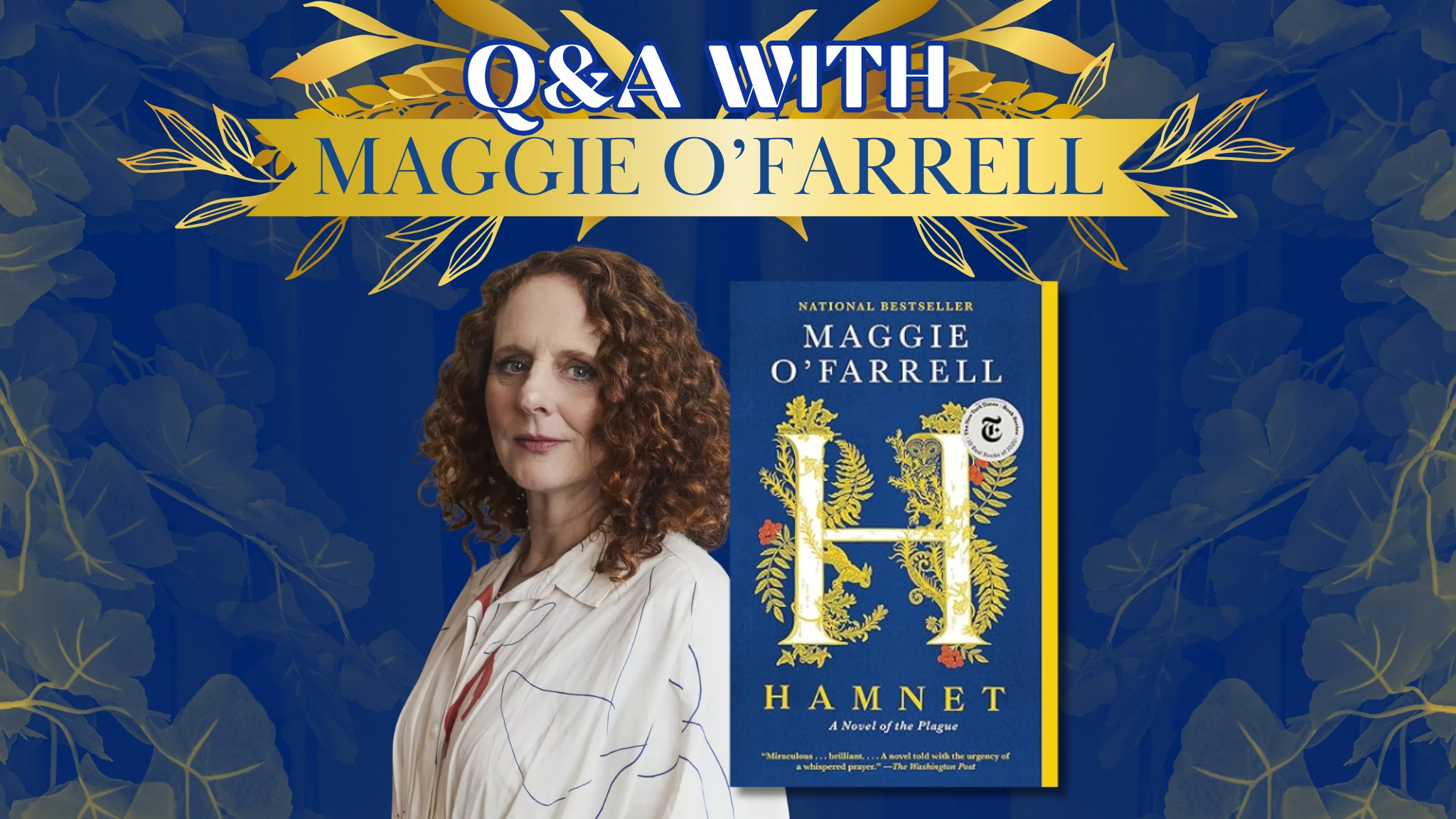
Every once in a while, a novel filled with love, loss and pathos crosses our path. I knew this in the summer of 2020 when I read Hamnet by Maggie O’Farrell. We all knew it, and the book was published to great acclaim.
In this historical drama about Anne Hathaway (Agnes) and William Shakespeare and the death of their young son Hamnet, we are transported to the sights, sounds, mores and beliefs of sixteenth-century England.
And then in November of 2025, Hamnet, the film, co-written by Maggie O’Farrell and Chloe Zhao, was released — again to highest praise. A flurry of awards and nominations, including two Golden Globes and eight Oscar nods, followed. The adaptation to screen captures the essence of the book with Agnes at the center, as she is in the novel. We see her as a wife, mother, herbalist, a grief-stricken woman enduring a family tragedy.
I was fortunate to interview Maggie O’Farrell recently about Hamnet, the film. Below, she shares her journey from book to screenplay, the impressive casting of Jessie Buckley and Paul Mescal, and what it was like on location. An unforgettable story.
Q&A With Maggie O’Farrell
Susan: Congratulations on everything! I know you co-wrote the screenplay for Hamnet with Chloe Zhao. How was it adapting your book and paring down the material to hone it for the screen?
Maggie: It was a really interesting process, and it taught me an awful lot. And obviously, I had a very experienced co-writer, Chloe. Chloe knows how to put together a narrative for the screen. Our first task was to cut it down, because the novel is 360 pages, and the screenplay needs to be about 90. So that was the first task ahead of us.
Chloe arrived at the process with a very clear idea of what she wanted to keep. I was able to say, “If we take out this element, then several beats down the line, this character’s motivation is no longer clear,” so it was all about cutting and rebalancing the novel for the screen. I learned about economy, the difference between the written language and the cinematic language.
Susan: So much of the novel comes from your imagination. Did that make it easier to adapt?
Maggie: It was an advantage because I know the story quite well. If there was something we needed to alter or add, I was able to say so. One day, we were writing a scene between Hamnet and his mother, which doesn’t appear in the novel. Chloe said that if Hamnet had grown up and worked in the theatre, what would he have wanted to do? I could immediately say he’d want to be a sword fighter. He’d want to play with swords because he’s an 11-year-old boy.
It was strange to go back inside the story and to realize I still knew all these characters and what made them tick.
Susan: How did you do the research for the novel? And what informs the film?
Maggie: In the first instance, the research was library-based. There is no shortage of books about Shakespeare. You could spend your whole life reading them, and some people do. Luckily, I love reading lots of books in the library.
In the scholarship about Shakespeare or biographies of Shakespeare, the characters who don’t appear much are mostly women and children. Hamnet and his sisters and his mother are very much footnotes. I did more hands-on research for them. I had to expend effort in trying to collapse down the time between my life as a woman in the 21st century, and women and children in the 16th century.
I don’t think humans change much, but the world is unrecognizable — my world and our world — to them. In order to collapse down that gap, I got my hands really dirty. I planted and cultivated an Elizabethan medicinal garden, because I’ve read that every household would have had one. And I learned to fly a hawk, which was literally the most fun thing I’ve ever done in the name of work. I met a falconer, this incredibly cool young woman in the Scottish borders, who kept hawks, and she taught me how to do it. And I made bread according to a Tudor recipe. I learned how to make the plants that I’d grown into medicines. That was my way of trying to connect with those people and what their lives would have been like.
Susan: Having investigated Shakespeare and the family for the book, would you say that the myths, the ones we’ve all heard about Shakespeare not authoring his plays, are just myths?
Maggie: Shakespeare’s body of work is enormous, and luckily, we still have it, although no thanks to him. He published his stories and poems in his life, but he didn’t publish his plays. That was done by his friends and colleagues after he died. There’s an awful lot we don’t know about his life, despite the efforts of the world’s best scholars. There are still gaps in his story.
I think the whole theory, or myth, or idea out there that Shakespeare didn’t write plays, is rooted in snobbery and classism. It’s predicated on the idea that Shakespeare, the son of a glove merchant, who only went to school till he was probably 15, wasn’t able to do it. He didn’t have a university degree, like Ben Jonson and Christopher Marlowe.
Susan: The themes of the film are touching — love, marriage, loss, grief, healing, family — they are shown to us beautifully. What was it like for you to see it come to life on screen, portrayed in another form?
Maggie: It was really incredible. One of the hardest things I found, being a novelist, was naturally wanting to put detail and nuance into the written page. A screenplay is very stripped back, much more so than a novel. It’s about location, then dialogue, action, direction. You realize when you’re on set, watching a take and the characters say the lines that you’ve written, that all that nuance and description are put back in, but by other people.
You’ve got to trust your collaborators. I found that most fascinating about the process. You trust the actors to use the right inflection for the line, the set designers to make sure everything looks perfect, the cinematographer for the lighting and the atmosphere, and the costume designer to put in the right costume. It’s amazing seeing that collaborative process come together.
Susan: I’m sure you’ve been asked, if your book were to become a film, who do you imagine would play this character and that character? How did the pairing of the actors with the characters go?
Maggie: Chloe was very sure right from the start that she wanted Agnes to be Jessie (Buckley). And I think it was a brilliant piece of casting. Jessie gives such an incredible performance and just pours herself, her heart and blood and bone and soul, into that role every single day, every single take. It’s really hard to see where Jessie ends, and Agnes begins. She just inhabits that role so beautifully.
Whenever we started talking about a screen adaptation of Hamnet, I always felt that Shakespeare should be Paul Mescal. He was always in my mind, not when I was writing the book, but later when I was thinking about translating it to the screen. I saw Paul on stage in Dublin in an adaptation of A Portrait of the Artist as A Young Man. He was playing Stephen Dedalus. I think he was either a student or he’d just graduated. He was very young anyway. And even then, he stood out as truly brilliant. I was thrilled when he agreed to accept the role.
Susan: We see so much through Agnes’ eyes. What was the prevailing quality that you saw in writing her both in the novel and in the adaptation for the film?
Maggie: I originally planned the novel to be about fathers and sons, as of course the play Hamlet is. But I got sort of sidetracked, I suppose, by how history has treated Shakespeare’s wife. We are only ever being taught one narrative about her. Which is that she was an illiterate peasant and that she trapped him into marriage by getting pregnant, that he hated her, that he ran away to London to get away from her.
I’ve never found any evidence of that. I don’t think it’s true at all. In fact, I think quite the opposite. I wanted to reinstate her in the story, give her a voice and a presence, and ask readers to forget everything they know about Anne Hathaway and to meet Agnes Shakespeare.
Susan: How long did it take to film? And what was it like on set?
Maggie: I think we started shooting in June and then we finished end of September. It was amazing. I wasn’t on set the whole time from start to finish, but I visited every single location. And it was amazing in a beautiful, beautiful way. At the beginning, when we were filming the outdoor scenes in Wales, the weather was incredible. It was warm and sunny. And then we went all the way to Elstree Studios in London. That was where, on the back lot, they built a replica of the Globe Theatre. And that was pretty cool.
Susan: How many locations were there?
Maggie: There was a forest on the border of Wales. And there was a town called Weobley near the border of Wales. That’s the town where you see the exterior of Stratford-upon-Avon. Then there was a house for the farmhouse, the Hathaway Farm. Everything else was an interior set built on the lot in Elstree Studios in London.
Susan: Any surprises? Any particular challenges along the way?
Maggie: I think all artistic endeavors have surprises and challenges, don’t they? That’s the nature of them. It teaches you something. Any kind of knotty problem always has a way to work things out. Chloe and I were in very close contact throughout. Chloe, as a director, is very responsive to everybody on set. She encourages a culture where everybody is able to give an opinion, and their ideas are taken into account. I was always very intrigued by the way she often let the camera roll after a scripted scene had ended to see what might happen. The actors were encouraged to improvise a bit and bring as much of themselves as they could to the role.