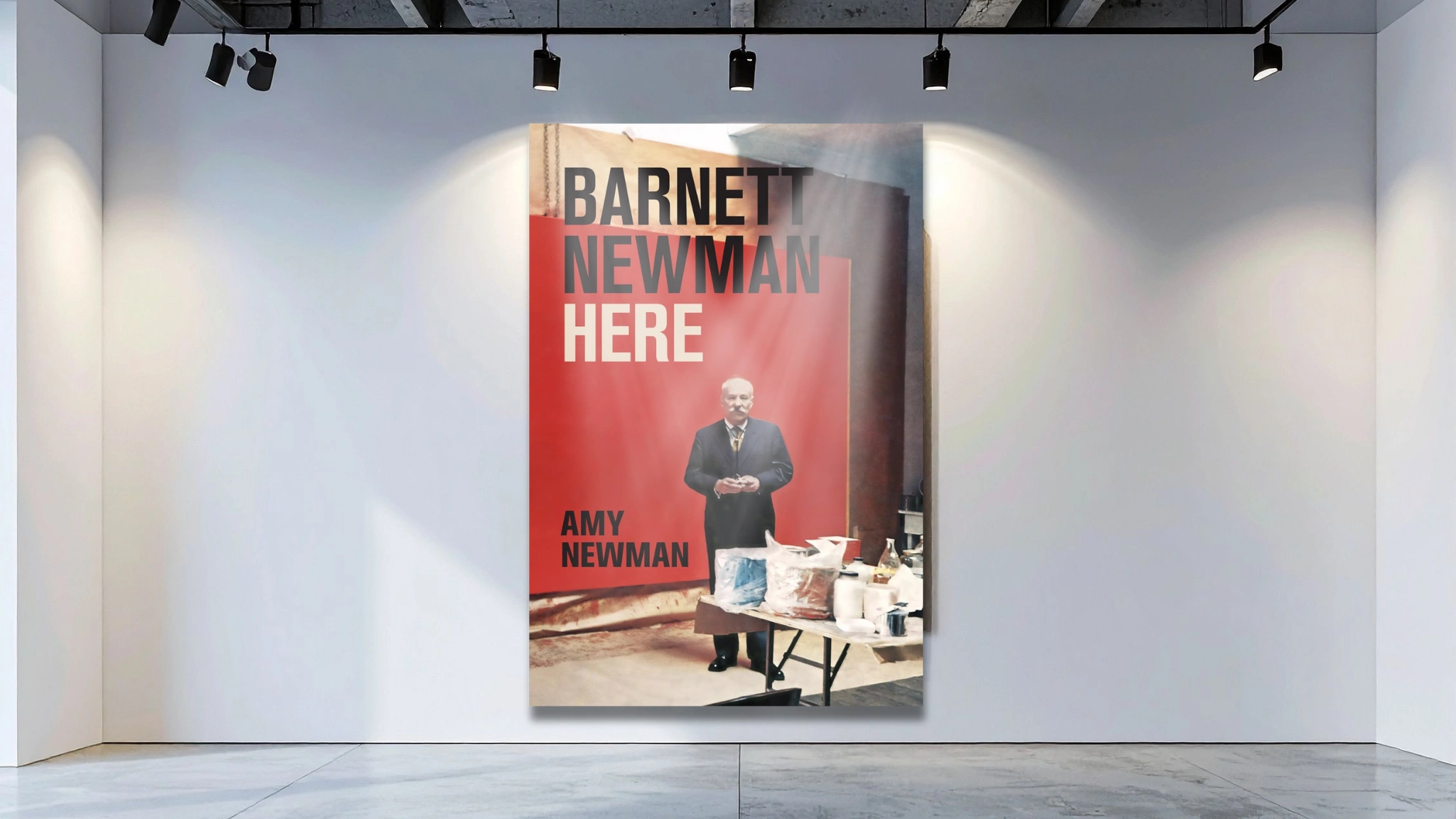
Barnett Newman: Here by Amy Newman
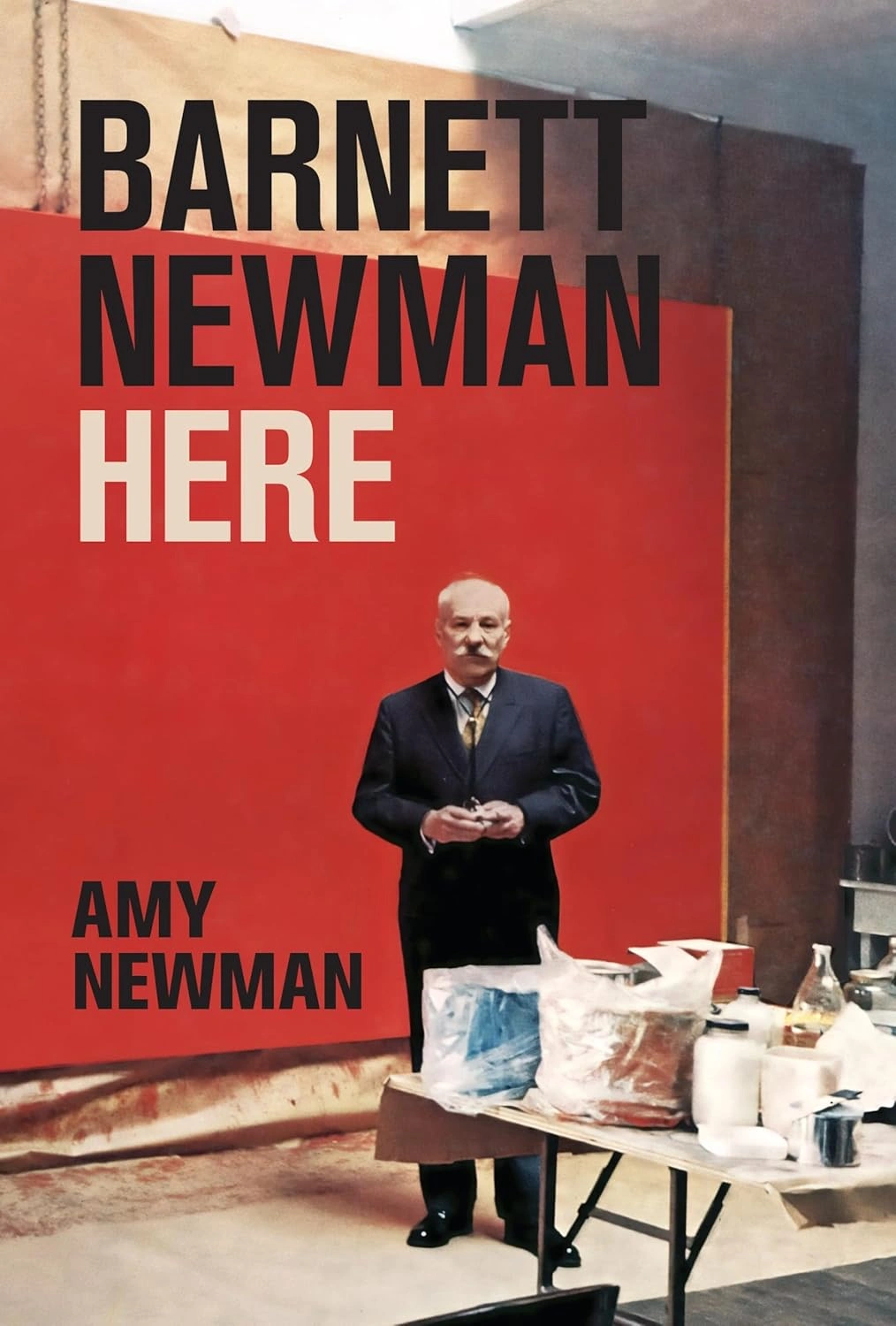
Art historian, journalist and author Amy Newman (no relation to her subject) has written the definitive biography Barnett Newman: Here, about one of the founding members of the Abstract Expressionist movement. Newman sometimes referred to their works as “Abstract Sublime”. Beginning in the early 1940’s, these artists primarily based in New York City and only later grouped together by critics and art historians formed the vanguard of individuals whose work was distinctive, stylistically diverse and radically different in imagery, subject matter, techniques and execution than previously known. The monumental scale of some painting and sculpture stretched the limits of exhibition spaces. Works were highly abstract, dynamic and full of motion while reflecting inner thoughts and vision, displaying spontaneity and improvisation. Contemporary Jackson Pollock was the quintessential “action painter” whose drip technique of flinging paint on large canvases placed on the floor is well documented. Other “energetic” artists of the era included Pollock’s wife Lee Krasner, Willem de Kooning and Franz Kline.
The Rise of Abstract Expressionism and Color Field Painting
While the very nature of abstract expressionism rejects categorization, the second widely recognized style is Color Field Blocks which concentrates on fields of color in geometric shapes, patterns and stripes. Barnett Newman is among the foremost in this field, closely associated with this grouping of artists including his decade’s long personal friends Adolph Gottlieb and his wife Esther, Mark Rothko, and Clyfford Still among others. Beginning early in their careers, these contemporaries were supportive of each other, including helping to install their respective works for exhibitions. Imagine Mark Rothko schlepping large canvasses of his own or those of friends to hang on the walls of the avant-garde galleries that promoted Abstract Expressionist art. These included Betty Parsons, Leo Castelli, Sidney Janis, Charles Egan, Tibor de Nagy Galleries and others. Art critics Harold Rosenberg and Clement Greenberg were pivotal influences in promoting these artists.
An Intellectual Maverick and Late-Blooming Artist
Barnett Newman (1905-1970) was a New York City native son and lifelong resident, born to Polish Jewish immigrant parents. He immersed himself in politics, once running as a write-in candidate for mayor against Fiorello La Guardia, was active in improving civil and social services, taught, wrote poetry and criticism, produced plays and promoted contemporaries’ art before painting his first major work in middle age. He was an intellectual maverick, an autodidact with a voracious appetite for learning and endless curiosity about a vast variety of subjects. Religious questions were tackled with the fervor he later devoted to creating enduring works of art. Although he took drawing classes at the Art Students League in high school and later while a student at City College of New York where he majored in philosophy, he was not formally trained yet would set the art world ablaze. His first solo exhibition was at the Betty Parsons Gallery in New York in January, 1950. Critics were harsh and it was far from a financial success with net proceeds earning less than $85. The vast majority of his critically acclaimed gallery and museum exhibitions occurred posthumously.
In 1934, Newman met his wife Annalee Greenhouse at the high school where both were substitute teaching. She was born in 1909 in Palestine to Russian Jewish parents who were enroute to America. He was strikingly handsome with thick dark hair and a characteristic walrus moustache he wore his entire adult life; as the son of a haberdasher, he was style conscious and wore impeccably tailored clothing. They were married in 1936 during summer vacation from teaching and spent their honeymoon in Maine. Annalee earned a Master’s Degree in Education and continued teaching to support her husband’s goals in becoming an artist. She was always his biggest booster. In 1979, nine years after his death, she established The Barnett Newman Foundation with the stated principal mission: “to encourage the study and understanding of Barnett Newman’s life and work.” It has published comprehensive studies of his drawings, graphics, writings, and interviews as well as compiled the catalogue raisonne.
A Lasting Legacy in Museums and Memory
Barney, as nearly everyone called him, completed only 118 paintings, six sculptures and 83 drawings in his career as an artist. His large scale paintings are characterized by flat color intersected by thin vertical lines that he called “zips”. His unifying series The Stations of the Cross executed from 1958 to 1966 consists of 14 black-and-white paintings that explore religious themes. Anna’s Light, named for his mother, is his largest painting at 28’ high by 9’ wide.
His works are displayed in collections of key art museums, public and private collections throughout the world including MOMA (The Museum of Modern Art) in New York, the Tate Gallery in London, the Centre Georges Pompidou in Paris, the Art Institute of Chicago, the National Gallery of Art and the Hirschhorn Museum and Sculpture Garden in Washington, D.C. The Jewish Museum in New York houses a significant collection of Newman’s works, including 70 pieces donated by the Barnett Newman Foundation. There are four multiples of his best known sculpture Broken Obelisk fabricated from three tons of Cor-Ten steel that acquired a rust-colored patina over time. An homage to Ancient Egyptian pyramids, it stands 25’ high with a four-sided tapering obelisk which comes to a precarious point balanced atop a pyramid. One is installed in University of Washington’s brick inlaid Red Square. Currently valued at approximately ten million dollars, it was the generous gift of Virginia Bloedel Wright, an heiress, gallery owner, astute collector and philanthropist who personally knew the artist and his wife Annalee. The Menil Collection in Houston also owns another casting of this instantly recognizable work that is dedicated to Martin Luther King, Jr. It’s the personal favorite of this reviewer who was entranced by it when it was positioned for several years outside the entrance to the Corcoran Gallery of Art in Washington, DC.
Barnett Newman was a monumental artist whose influence extends well beyond his lifetime. He died much too soon of a heart attack on July 4, 1970 in New York. Throughout his lifetime, he was a vital presence who loved music, was a regular, frequent patron of the New York Public Library and attended parties and cultural events with his cherished wife Annalee. He was such a bon vivant and recognizable man about town, Andy Warhol once drily quipped, “Barney would attend the opening of an envelope.” Barnett Newman: Here author Amy Newman, with full access to the archives of The Barnett Newman Foundation, has written a thoroughly researched, captivating account of this charismatic man and his art. It is essential reading for art students and historians and should fascinate and educate the more casual reader.
About Amy Newman:
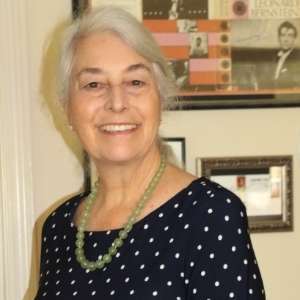
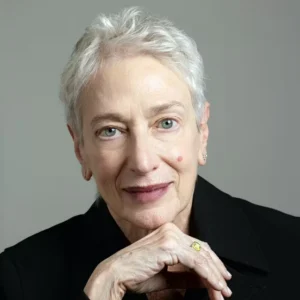 Amy Newman is an art historian and journalist. She is the author of Challenging Art: Artforum 1962–1974 and the editor (with Irving Sandler) of Defining Modern Art: Selected Writings of Alfred H. Barr, Jr. She is not related to Barnett Newman.