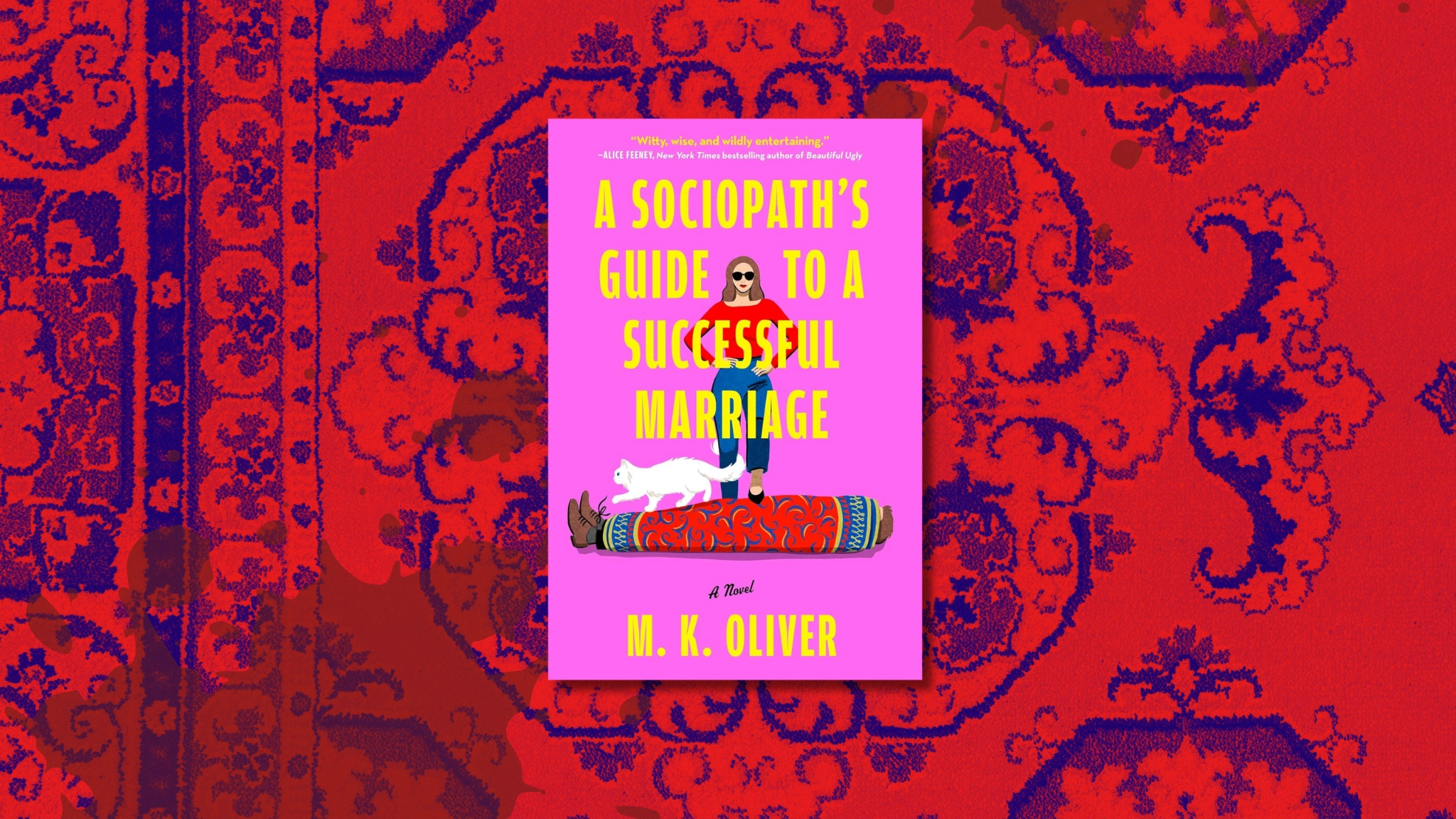
A Sociopath’s Guide to a Successful Marriage by M.K. Oliver
Domestic Bliss, with a Body
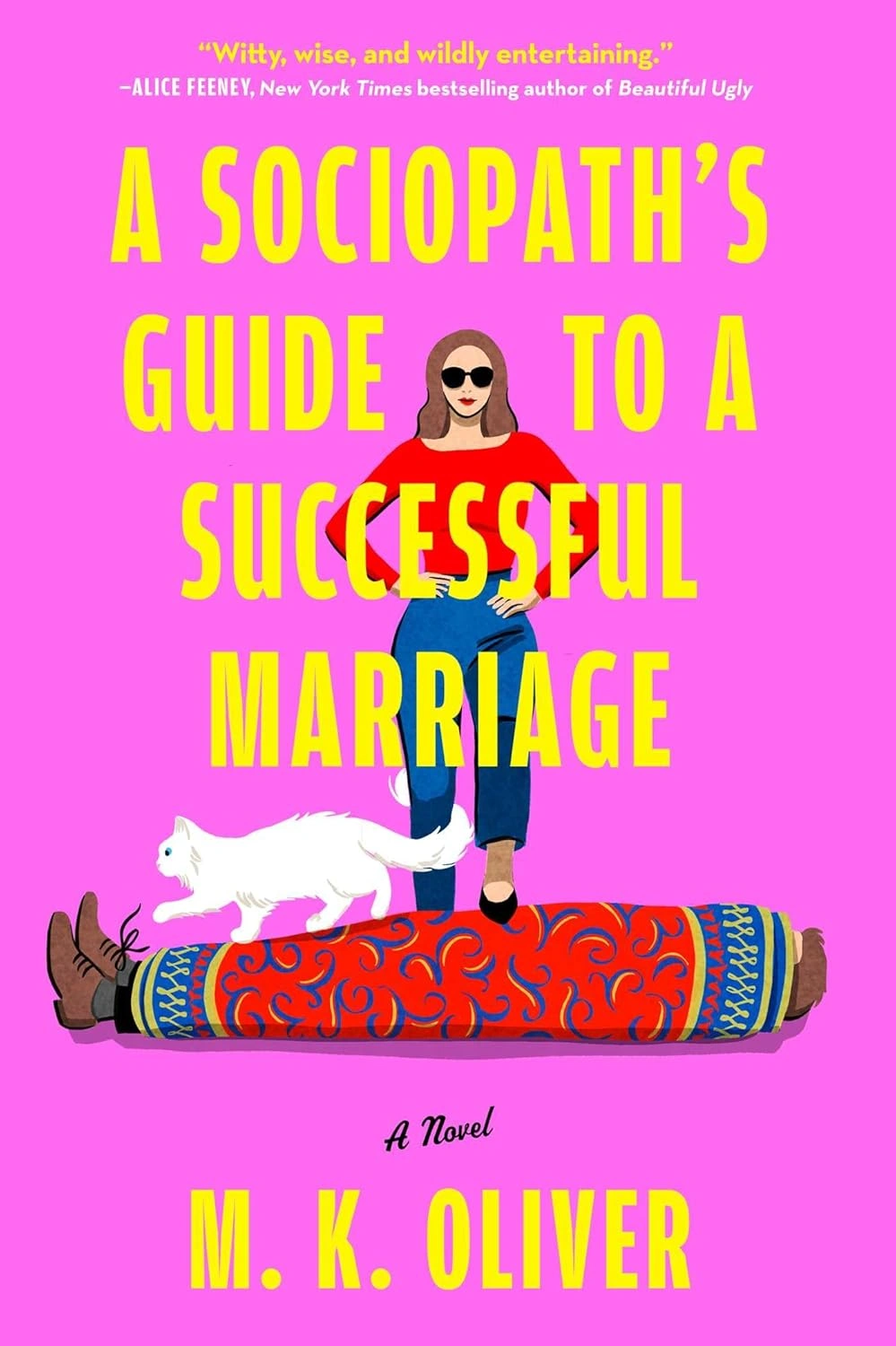
“The truth is, it’s surprisingly difficult to kill someone with a vegetable knife. But as I was preparing carrot sticks at the time, it’s all I had.”
That’s Lalla Rook talking. In M.K. Oliver’s A Sociopath’s Guide to a Successful Marriage (and doesn’t that tell you everything you really need to know?), she lives with her husband and two children in a leafy suburb on a hill overlooking North London. She usually has quite a bit on her to-do list. Right now, for instance, these are just a few of the items:
Help Stephen make partner. Secure dream house in Hampstead. Get Nelly into Adams Prep. Remove dead body from living room. Buy cake for Nathan’s fourth birthday party.
She hadn’t meant to kill the man (not this one, anyway), but he’d snuck up on her, so what was she to do? Nothing derails Lalla Rook from her goals, be it her unfortunate past, her over-inquisitive mother-in-law, Stephen’s uncooperative boss (a little blackmail might help there) and Adams’ snooty headmistress (a claw hammer should just fit into Lalla’s purse) (and, really, the class hamster that Nelly drowned – it’s hardly the fault of a child if a hamster can’t swim, is it?).
Of course, the police keep sniffing around, her friend Cait did see her wrapping the body in plastic (“He fell on his own knife.” “Seven times?”), and there’s the disturbing fact that someone hand-delivered a note to her husband that said, Your wife is not who she says she is.
“I do not, as a rule, look backwards,” Lalla tells us. “I like the past to be past, and the dead to be dead.”
But sometimes the dead just won’t cooperate.
A Heroine You Can’t Help Rooting For
A wildly entertaining novel, A Sociopath’s Guide to a Successful Marriage will have you alternately gasping and laughing – and shocking yourself by how much you actually want Lalla to succeed.
What’s on your to-do list?
In Conversation with M.K. Oliver
“It’s always tricky to pinpoint where an idea comes from,” says M. K. Oliver, “but on one cold autumn morning I was in the kitchen making a coffee as my wife was buttering toast.
“’I want to write something serial killer-ish…but what serial killers haven’t been done yet?’ I say, in the way you do at breakfast.
“’Muswell Hill mummies,’ she says, quick as a flash. Not sure if she was referencing any of her friends, or even her own personal feelings.
“My eyes widened a little and I left the room, sat at my computer and immediately wrote Chapter 1 of the book, almost as it now appears (minus a few typos).
“The idea of combining a serial killer with suburban mummies just brought a smile to my face. All the darkness and domestic detail, along with the rich comic potential. The wonderful contrast in tone between the day-to-day domesticity of husband-managing, children-organizing, work-balancing, and general life-plate-spinning, and the single-minded, mask-wearing, ruthless efficiency of the parasitical killer. It felt like a lot of delicious things to keep spinning and colliding.
“The story evolved really quickly as I imagined what would happen if a mother was cut off from shame and guilt, and allowed all her darker impulses and desires to dictate her behavior.”
Has Oliver ever known someone himself who was as single-mindedly hellbent on his or her goals (murder optional)?
“Have you ever noticed how many media stories focus on that idea of the sociopath living within us or amongst us in our workplaces, in our beds or even in our own heads? The idea is everywhere in the form of tests, quizzes, books and articles asking if we’re living or working with a sociopath.
“We’re obsessed with this idea, and maybe that’s because most of us have come up against someone in their home or workplace who is so narcissistic or egotistical that it begs the question of what else they might do to get what they want.
“Surely, there’s a bit of the sociopathic in most people. We all know how well-behaved people can, when dealing with things like divorce, parking issues, house moving, or school admissions, become monsters for a time, bursting out of their normal constraints.
“The internet teaches us what can happen when you take away social conditioning and consequences. Anonymity seems to allow something dark and very harmful to emerge, and people who may be lovely to their family and friends can act without any empathy at all.
“But there’s a difference with Lalla. Her impulses lead to harm, but that’s not their purpose. She’s much more pragmatic than sadistic, which is why people like her while being shocked by her actions.
“I have been amazed at how many readers have related to Lalla and felt empowered by her, and I’m pretty sure none of those people mirror her murderous or deeply manipulative character.
“Maybe we identify with someone finding it difficult to fit in, having to wear a mask in social situations, seeking a perfect façade when their inner world is a mushy mess, fighting their way up just on their own wits, and having to deal with emotions or feelings (or the lack of them) that don’t fit social expectations at all times.
“Lalla is someone who says or thinks things that we enjoy because she breaks the rules and crosses lines. We’re all so bound by self-censorship that her lack of inhibition can delight and amuse. After a frustrating day at work, it can be fun to immerse ourselves in an unhinged and selfish approach to problem-solving.”
How Far Is Too Far?
As Lalla’s actions grew increasingly appalling, was there ever a part at which Oliver thought: Is this too much?
“Oh, my, you should see the outtakes. There are so many things that Lalla did that were too much and had to be removed. My agent and editors helped to ensure it was crazy but also believable.
“But that also comes from Lalla. There’s an element of control that she exerts, which means she can think something wicked, but not necessarily go through with the deed. If she killed every person that she was minded to, it would look a little like that last scene of Hamlet – a great pile of corpses.
“I also think the most shocking thing she does is the way she betrays her friends. I definitely thought, this is too much, but it just conveyed her approach to life so well that it had to stay.”
From First Draft to Hulu
Speaking of his agent and editors, how did that come about? It’s never easy these days for a first-time author.
“Like most writers, I’ve enjoyed many rejections over the years, from the very generous and polite letter to the simpler approach of ghosting. Joining different writing communities really helped improve my writing, as you get others to read and respond to extracts, as well as realizing that you’re on the same journey as very many people. The secret is to keep going, and never give up.
“When I gave up my full-time job, and took on a part time job [Oliver is a former English teacher and headteacher], I had a little more time to edit and re-edit, which was useful. I sent out my query letter and chapters, and this time, I had several requests for the full manuscript. It was such a surprise to me that they wanted to know more about Lalla.
“I got my first offer of representation as I was doing a weekly shop in the supermarket. The last thing you expect is for an agent to call you. It was a wonderfully surreal moment.
“Several edits followed before it went out to publishers, and I was very lucky that it sold quickly via pre-empts and auctions. And that’s the dream, but then a different journey begins, which is demanding, slightly opaque, but very exciting.”
That journey includes not only the book’s actual publication, but television. Enter Hulu!
“Selling TV/film rights on a book that hasn’t been published wasn’t even part of my dream. I didn’t even think to imagine that happening, so this was a part of the whole process that was most alien and surprising. The publishing process seems quite simple in comparison. Once you get an offer, there’s a publishing date set. With TV, although an option has been taken out, there are so many different stages and people to go through, that it’s never certain that it will end up getting made. You just have to keep your fingers crossed and enjoy the process as much as possible.
“Working with Liz Tigelaar, the showrunner and writer, has been a brilliant process, as she is very collaborative and communicative. We had great conversations about the style, tone and underlying themes. We talked often as she worked out how to reshape the story into a pilot, and I read the different versions as this was refined and rewritten. But I was only one of several voices, as the studio and streamer also gave notes on each draft.”
And now…he waits. When interviewed last fall, the publication was still months away, and he was still keeping his fingers crossed about the television show. But not so crossed he couldn’t type. “I’ve just completed the first draft of Book 2!”
His dreams have come true. No murders necessary.
About M.K. Oliver:
 M.K. Oliver is a former English teacher and headteacher originally from Liverpool. He long dreamed of becoming a writer and after many years of working in schools, he took the exciting decision to put down the whiteboard marker, take up the keyboard and give it a go. He enjoyed writing courses at Curtis Brown, Faber & Faber and the Royal Court Theatre and now lives with his family and talkative cat in North London.