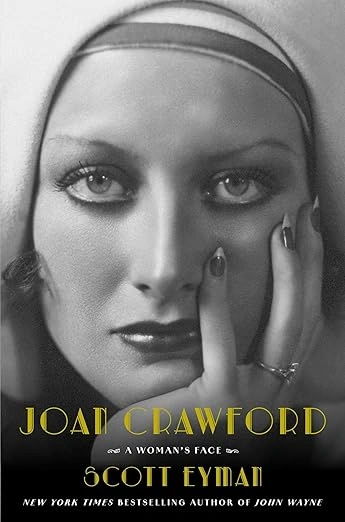
Joan Crawford: A Woman's Face by Scott Eyman
Actress Joan Crawford had one of the most striking and memorable faces of the Golden Age of Hollywood and managed to camouflage her true nature behind an artfully constructed movie star persona. At last, film historian and acclaimed New York Times bestselling author Scott Eyman has authored Joan Crawford: A Woman’s Face, a comprehensive and engrossing biography of this enduring legend who lit up the silver screen for five decades. The book reveals a much shyer, insecure woman who was troubled by her lack of formal education, didn’t trust her own talent and doubted her abilities.
A number of previous biographies ostensibly relied more on movie magazine gossip and studio issued promotional material than primary sourcing, and also there was the scurrilous, vengeful hatchet job Mommie Dearest poison penned by her eldest adopted daughter Christina Crawford. Eyman has made a lifelong study of movie history and specializes in the legendary era of studio controlled and manipulated Hollywood. He has written or co-authored 18 books about film stars, directors and cinematographers including Charlie Chaplin, Cary Grant, John Ford, John Wayne, Ernst Lubitsch, Mary Pickford, Cecil B. DeMille, Louis B. Mayer, Darryl F. Zanuck and more. For Joan Crawford, he conducted exhaustive primary research interviewing her friends and relatives, extensively combing through previously unseen documents along with film screenings in a significant attempt to set the record straight about her life and career. Photos from the late actress’s estate enhance the narrative which concludes with source and chapter notes, filmography, bibliography and index. What a superb book it is indeed!
From Billie to Joan: Reinventing a Life for the Silver Screen
Lucille Fay LeSueur was born in San Antonio, Texas on March 23, probably in 1905 as the 1910 census indicates she was then five years old in the household of her mother Anna and stepfather Henry Cassin. Her birth father had deserted his wife Anna, young son and baby Lucille when she was 10 months old. This birthdate was changed to 1908 either by Metro-Goldwyn-Mayer Studios or perhaps by the up-and-coming starlet herself. Until her older brother Hal revealed the truth, she believed Henry Cassin whose surname she used was her biological father. She discarded the name Lucille in early childhood, preferring the nickname “Billie” which was used by family and friends throughout her lifetime. The Cassins lived for a time in Lawton, Oklahoma where her parents ran the local opera house which featured performances of the luminaries of the era. However, like many other occupations held by Henry, this didn’t last long resulting in another of their frequent relocations. On one occasion in Missouri, Henry was fired for suspicion of embezzlement.
Although she enjoyed reading and loved dancing lessons, there was a great deal of instability during Billie’s formative years and a distinct lack of formal education. Inconsistency in dance training and an early severe foot injury made her better suited for eventual roles in the chorus than headlining dancer. Despite her sketchy schooling, she did complete one semester at Stephens College in Columbia, Missouri, industriously waitressing in their in their cafeteria for tuition. Much later in life, in 1972, she was honored there as a “distinguished alumna”.
In 1923, she landed her first job in Chicago touring as a dancer in the Schubert Theatre review Innocent Eyes thanks in part to her friendship with chorus boy Jack Oakie who had encouraged the director to hire her. They danced together in a number called “Organdy Days” at the show’s New York Winter Garden opening and, characteristically, Jack remained a lifelong friend. By the time the tour reached Detroit, she had graduated to a larger role. Another close friend of those days was fellow chorine Ruby Stevens, an orphan determined to succeed who was dancing in a Ziegfeld show. Ruby became Barbara Stanwyck about the same time the stage name Joan Crawford was created. Professional breaks for the hopeful young Billie came quickly. Publicist and producer Nils Granlund who worked for theater chain mogul Marcus Lowe described the future Miss Crawford as “a gorgeous girl, with huge blue eyes, perfect features and ripe, voluptuous lips”. He suggested she might have possibilities with MGM and helped to arrange a screen test made in New York City. A telegram arrived for Miss Lucille LeSueur while visiting her mother over the Christmas holidays in 1924 offering a six month contract at $75 per week with MGM Studios with instructions to leave immediately for Hollywood.
Manufacturing Stardom
Her first screen appearance came in 1925 as a body double for Canadian born star Norma Shearer, whom she detested, followed by several other uncredited roles. The luminescence projected on film by the young starlet prompted MGM Studios to groom and rename their new acquisition. Larger than life and made for the silver screen, her visage, unfailing preparedness and dutiful acceptance of any roles assigned fostered her career, and soon bit parts grew into starring vehicles. Studio headLouis B. Mayer valued her professionalism, grit, determination to excel and even more significantly the box office receipts from the ticket buying public which made her a star. MGM head costumer Adrian, later renowned as a couturier credited with creating “the American Look” in fashion and ready-to-wear clothing, worked closely to cultivate the glamorous mystique of Joan Crawford. In the black and white films of the era, her fair skin lightly dusted with freckles and russet hair didn’t stand out. She was a slim 5’4.5” tall, broad shouldered with a triangularly wide back, and rather short legs. What could have been perceived as figure flaws were transformed into perfection in tailored suits and flowing evening gowns. Other actresses and fashion conscious women in every stratum were soon adopting clothing with shoulder pads to emulate what came naturally to the actress.
It wasn’t long before Joan was the third highest paid actress behind the wife of MGM’s “Boy Wonder” film producer Irving Thalberg, Norma Shearer, and Marion Davies. Mayer additionally rewarded her successes with lucrative bonuses but after 20 years of stardom at his studio, her popularity began to wane, and Joan Crawford was released from her contract in late June, 1943. The years with MGM were the happiest in her long career. She signed a 3-movie deal contract for $500,000 with Warner Brothers beginning July 1, 1943. Unlike Mayer, studio head executive Jack Warner did not offer bonuses or interesting roles, and, like many in the WB stable of stars, her relationship with him was contentious. After the titular role in Mildred Pierce was declined by friend Barbara Stanwyck, and only after a screen test, Director Michael Curtiz approved casting Joan in the part which subsequently garnered her the 1946 Best Actress Academy Award. She was nominated in this same category for Warner Brothers’ 1947 Daisy Kenyon (with Henry Fonda) and RKO’s 1952 Sudden Fear (with Jack Palance) but Mildred Pierce remained her sole win.
Joan Crawford was always prepared, on-time, gracious and generous with gifts; the consummate professional. She was consistently known for speaking with every member of cast and crew, greeting regulars and getting to know newcomers on each project. Similarly to Marlene Dietrich, she learned the intricacies of lighting design ensuring her stunning face was lit to enhance her features to their best advantage. Her care and concern for others were amply demonstrated by seemingly never forgetting a name and frequently, without any fanfare, paying for the medical treatment and hospitalization of needy crew members and their families. Five-time co-star William ‘Billy’ Haines, who was weary of playing the college boy roles he was famous for, was given an ultimatum to drop his relationship with long-time partner Jimmie Shields or be fired; he responded by changing careers and becoming a successful interior designer. Illustrating her loyalty to friends, Joan, or “Cranberry” as he affectionately called her, became his first and most loyal champion in his new profession.
Under the sheltering protection of the studio system and assisted by her friendship with gossip columnists, Joan Crawford’s many affairs were cloaked from rather than paraded before the movie going public. At the beginning of her primarily dancing career, her dalliances were frequently with musicians. In Hollywood, the list was long and included Spencer Tracy, Clark Gable and a youthful Jackie Cooper among many others. She married and divorced actors Douglas Fairbanks, Jr., Franchot Tone, and Phillip Terry. The most successful marriage was to President and later Chairman of the Board of Pepsi-Cola, Albert Steele. They wed in Las Vegas in May, 1955 and this seemingly well-matched union lasted until his sudden death from a heart attack four years later. Joan became a paid board member of Pepsi-Cola for a period of five years which she undertook as meticulously as her film work.
Although by nearly all accounts she was lacking in maternal instincts and ill-suited for parenthood, Joan Crawford adopted four children, the first was Christina in 1940 while she was single, followed by Christopher in 1942 and twins Cathy and Cindy in 1947. Her strained relationships with Christina and Christopher have been well documented. The twins considered her to be warm, wise and caring though a rather rigid and controlling disciplinarian.
The Cost of Being Joan Crawford
Achieving stardom and maintaining her movie career were the motivating factors for Joan Crawford. Everything else in her life was subordinate and of much less consequence. Her tremendous insecurity born of childhood instability kindled fears of inadequacy and not belonging. The concept that a film star must be carefully made up, hair styled, immaculately and appropriately dressed in public was deeply engrained. In later life, “Billie” would cook or clean her own apartment comfortably clad in an inexpensive housedress and wearing flip flops. However, it would be unthinkable to venture anywhere in public without radiating the persona of the star that was Joan Crawford. As she aged, this assumed obligation strongly restricted her movements becoming too onerous to recreate.
In Joan Crawford: A Woman’s Face, Scott Eyman masterfully balances her many facets, examining the personal life, marriages and affairs, issues with her children and her lengthy career. Here was a woman who arose from an impoverished childhood to not only achieve top movie star status but to maintain it for decades. Joan Crawford was a sponge who absorbed good manners, fashion and style as eagerly as she learned to dance and master the craft of acting. Written with care and respect for the woman and the artist and grounded in thorough research. Scott Eyman has restored Joan Crawford to her rightful place in the dazzling sun of Hollywood and produced a must read for any movie lover or film historian.
About Scott Eyman:
 Scott Eyman is the author or coauthor of eighteen books, including the bestseller John Wayne and Pieces of My Heart and You Must Remember This with actor Robert Wagner. Eyman, formerly the literary critic at The Palm Beach Post, also writes book reviews for The Wall Street Journal, and has written for The New York Times, The Washington Post, and the Chicago Tribune. He and his wife, Lynn, live in West Palm Beach.