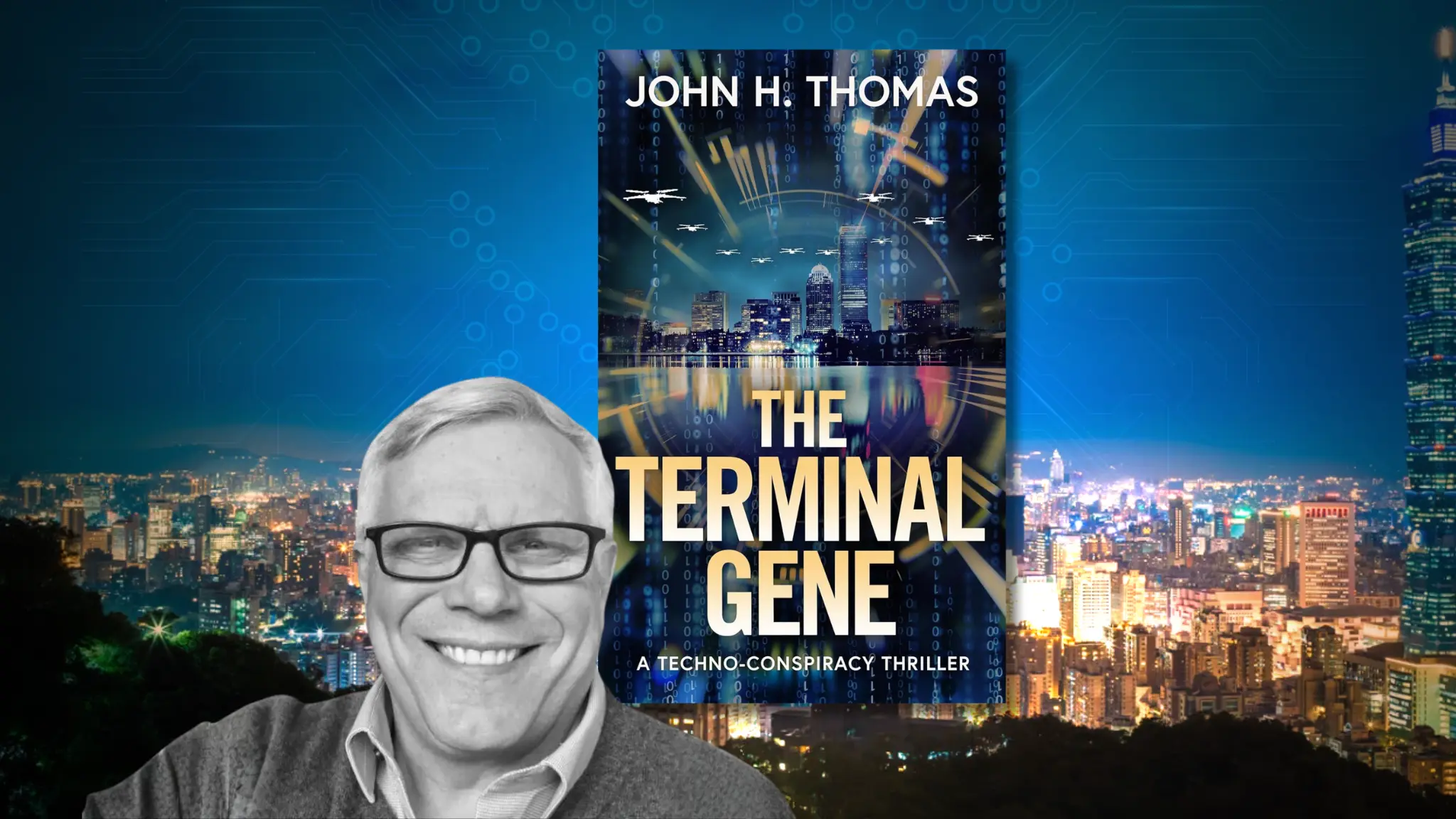
- Your novel explores the discovery of a terminal gene that predicts the exact moment of death. What inspired you to center a techno-thriller around such a profound scientific breakthrough?
It all started with a question I couldn’t shake: What if death wasn’t random? What if our final moment was already determined? I’ve always been intrigued by how biotechnology intersects with existential fear, and the idea of a “terminal gene” seemed like the perfect mix of scientific accuracy and human vulnerability. The real catalyst came during a dinner with my wife shortly after her father passed away. We talked about uncertainty, grief and the helplessness he felt in those last months, not knowing how much time he had left. That conversation stayed with me. It made me wonder how people would react if they knew their death date with certainty—and how far institutions might go to control that kind of knowledge. The moment I envisioned a world where this data could be mapped, used, exploited or hidden, the narrative truly came alive.
2. Dr. Emily Harper faces immense ethical dilemmas and corporate pressures throughout the book. How did you develop her character to balance scientific curiosity with moral responsibility?
Emily came to me as someone brilliant but not jaded, and not fully prepared for the competitive business world, someone who deeply believes in the power of knowledge but also recognizes its importance. I built her from the inside out—her working-class upbringing, her insecurity about failure, relationship experience and her stubborn streak all shape the way she responds under pressure. She never aimed to be a whistleblower or a public figure; she just wanted the science to be managed responsibly. As the world around her grows more dangerous, and the conspiracy tightens, her arc becomes about choosing responsibility over safety. Her curiosity drives the plot, but her conscience gives the story its heart.
3. The book delves into themes of surveillance, corporate espionage and privacy. Were there real-world events or technologies that influenced your portrayal of these issues?
Absolutely. We live in a world where our biological and medical data are becoming just as valuable—and as vulnerable—as our financial data. The rise of consumer DNA testing, predictive health analytics and corporate data collection all contribute to the atmosphere of quiet surveillance in the book. Real-world whistleblower cases and the way powerful institutions often operate behind closed doors also inspired me. The novel’s technology, like biometric security, AI monitoring and gene sequencing, isn’t some far-off fantasy; it’s a logical progression from what we have now. This approach makes the book’s paranoia and possibilities seem justified and credible.
4. The concept of fate versus free will is a recurring motif in the novel. How do you integrate this philosophical debate into the narrative without detracting from the thriller elements?
For me, the philosophical questions are the suspense. Knowing the exact moment of death heightens every decision a character makes, making every argument, risk and hesitation feel crucial. The typical thriller elements—the chases, betrayals and conspiracies—become even more intense because the characters are struggling against what they believe to be a preordained fate. Just as they, and the reader, start to accept that fate, I introduce the idea that it was designed or can be altered. This tension keeps the philosophical questions relevant without slowing the story down.
5. You created a detailed corporate conspiracy involving Helix Innovations and Project Chronos. How did you approach blending cutting-edge genetic science with suspenseful storytelling?
I treated the science with respect and approached the conspiracy with caution. I wanted the genetic mechanisms and research processes to feel authentic—credible enough that readers can easily believe in the world. But the conspiracy had to escalate gradually: subtle red flags, missing files, cryptic messages, someone sabotaging lab access. The sense of danger builds as Emily realizes the science she loves has been co-opted by people who see it as a means of power and profit, not a responsibility. Grounding the thriller in a real scientific framework makes the suspense hit harder because the stakes seem believable, and that belief, combined with the emotional stakes, keeps readers turning pages.
6. Tyler Reed’s storyline adds emotional depth and personal stakes to the plot. How important was it for you to include a personal relationship to ground the high-stakes scientific drama?
It was essential and a core reason I wrote the story. Without Tyler, the story would be intellectually compelling but emotionally empty. He and Emily embody what the kill switch threatens on a personal level: love, shared dreams and a future. His tragic arc anchors the entire narrative in vulnerability. His sacrifice fuels Emily’s transformation and turns the extinction event from an abstract threat into a deeply personal one. Science is the spark, but the arc of their relationship is the fuse.
7. The novel ends on a note that suggests ongoing conflict and unresolved mysteries. Can readers expect a sequel or continuation of Emily’s story? What can you share about your plans for the future of this series?
Yes, Emily’s story is far from over. The sequel follows the discovery into much more unstable territory. Without revealing any plot details, the second book places Emily in a world where truth is harder to recognize, technology is more invasive and the conspiracy she uncovered turns out to be just a small part of a bigger threat. Emily’s time is limited, but what she does with it will decide the fate of everyone else. The series will continue to develop, and the following book will introduce future conflicts and more profound mysteries in both Emily’s world and our own.
About John H. Thomas:
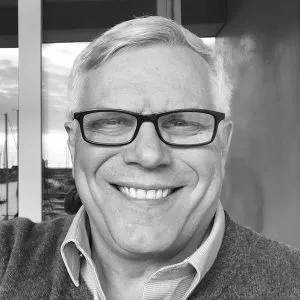
John lives in the Seattle area with his wife and the world’s sweetest cat: Karmann. Raised in a nomadic military family, he is annoyingly curious, a consumer of whiskey, and a political junky at heart, but his greatest interests are his family and their collective shenanigans.