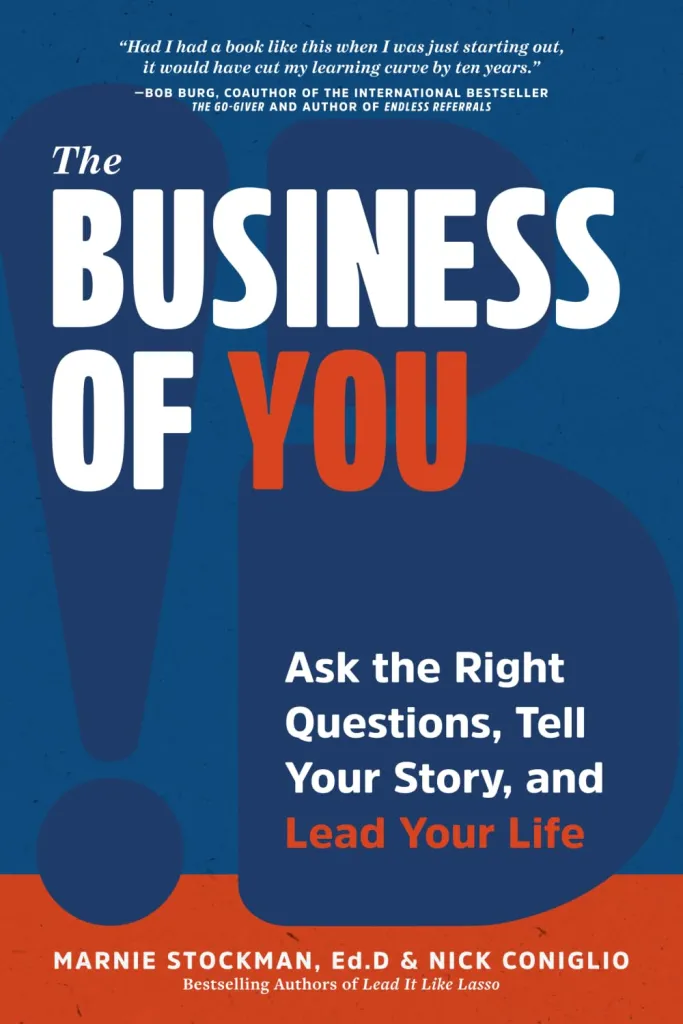
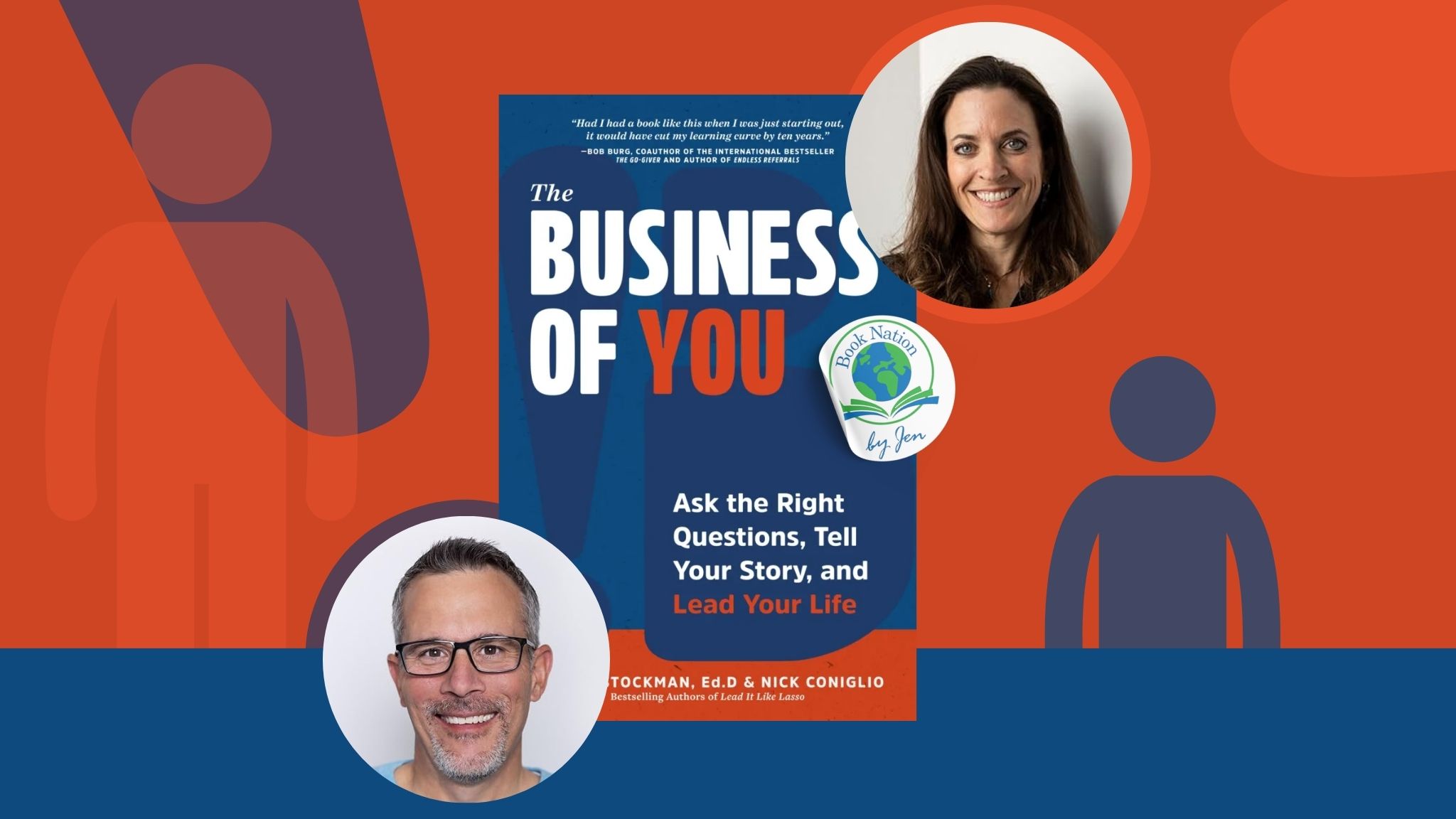
The Business of You: Ask the Right Questions, Tell Your Story, and Lead Your Life by Marnie Stockman, Ed.D and Nick Coniglio
I am thrilled to have read this valuable book and hope you will pick up a copy, too! In The Business of You, authors Marnie Stockman and Nick Coniglio introduce us to a refreshing perspective when it comes to career opportunities through the eyes of Sydney, a young woman looking for a job. Understanding one’s own core values, having personal agency and being proactive takes a bit of work, introspection and can be challenging.
Sydney’s job hunt takes us on a journey, providing key takeaways and journal questions along the way. Doing the necessary personal work in order to develop a strong foundation of self, and learning the right questions to ask helps to define a clearer path towards finding appropriate employment, life joy and contributes to self-confidence.
If you were a business, would anyone invest in you? Personal branding, similar to corporate branding, allows each of us to create a unique, positive identity that differentiates you from others and gives you the ability to sell yourself in a way that employers can see your intrinsic value beyond your ability to just accomplish a necessary task. The Business of You provides actionable strategies and is the perfect book for anyone looking for a job, changing careers or just needing a reboot to restructure their approach to work, life and relationships. Buy this one for yourself and your kids!
Authors Q & A
How did the two of you (authors Marnie and Nick) meet, what do you do for a living and what inspired you both to write The Business of You?
We met in EdTech; Nick ran technical teams and support, and Marnie ran customer success. That company was eventually acquired three times in 18 months. That whirlwind taught us what we loved (values, people, growth) and what we didn’t (toxic cultures, short-term wins over long-term impact). So we left, started our own SaaS company for IT business owners, and sold it for eight figures in 3 years.
Along the way, we realized our success wasn’t about the software. It was about leadership and character. The Business of You grew out of that realization: everyone is the CEO of their life, but most people never get the playbook. We wanted to write it — so we did. And now we are building the app that the main character in the book is given so students can follow along with their own journey.
Changing your mindset is not easy … what concrete steps can help someone who feels stuck?
Think like a CEO doing a turnaround. Step one: audit your “company.” What are your core values, strengths and goals? Step two: reset your strategy. Pick one small, winnable action that aligns with those values. Step three: build your board; start with one person who will cheer you on and hold you accountable. Small wins compound fast when you stop trying to do it alone.
How can we prepare for interactions so new thinking becomes intuitive?
Before any meeting, ask yourself two questions:
- What’s the story I want to tell about myself here?
- What do I hope they’ll remember when I leave?
That prep flips you from “reactive” to “intentional.” It’s less about memorizing talking points and more about reminding yourself of your core values so they show up naturally in your words and body language.
What do you see as AI’s impact — and how can we use it?
AI is like hiring a really smart intern: it’s fast, tireless and surprisingly helpful … but it has zero judgment. The trick is using it to handle the heavy lifting (drafting, research, organization) so you can focus on the irreplaceably human skills: connection, empathy, storytelling. In a world where everyone has AI, character becomes the differentiator. We often quote Adam Grant’s Hidden Potential where he says that in a world of automation and digital transformation, it is the character (or human) skills that help people stand out and succeed.
Do you have a mentor? How does someone find or become one?
We’re mentors to each other first. That’s the secret; your best mentor doesn’t have to be a “famous name,” it can be the person who knows your blind spots and isn’t afraid to call you out (with love).
Beyond that, we believe in building a Board of Advisors. Think less “one guru with all the answers” and more “a team of people who see different parts of you and sharpen you in different ways.” That mix of perspectives is way more powerful than one single Yoda. We think students need to find not just their hype squad but a mentor, a challenger and a connector. Looking around at folks who have taken a path they admire or who have similar passions are a great place to start. (Office hours are the cheat code for college students.)
Where do I begin if I want to up my game like Sydney in your book?
Start by designing your Personal Operating System. Every great company has one. It’s the playbook that drives decisions and keeps everyone aligned. For you, it’s clarifying your values, the habits that move you forward and the rules you want to live by. That Operating System becomes the filter for everything else: what opportunities you chase, who you invite onto your Board of Advisors and how you measure progress. Once you’ve got that foundation, everything else gets easier because you’re not winging it anymore. You are running your life like the CEO of You, Inc.
What are the biggest mistakes people make when job hunting?
Two big ones:
- They lead with their résumé instead of their story. Employers hire humans, not bullet points.
- They network like collectors, not connectors. Throwing out business cards is forgettable. Asking great questions and showing curiosity make you magnetic.
If The Business of You became a college course … where would it live?
Everywhere. But that might not be helpful, so let’s talk about some of the conversations we have had with colleges. Freshmen seminars or the “College 101” course are the first obvious answers. We have also talked with career centers, business fraternities and leadership/entrepreneurship programs. By the end of sophomore year, students really need to have a strategy for applying for internships, so we have seen a ton of growth for students who have done the work before their junior year.
The one skill we’d want students to walk away with? Self-awareness. It’s the #1 predictor of leadership success, and yet no one’s really teaching it.
Would you say this book is helpful for anyone, regardless of career stage?
Absolutely. We’ve had college students use it to land internships, mid-career professionals use it to pivot and retirees use it to reimagine their next chapter (and then hand it to their grandchildren — haha). If you’re a human with a story, this book is for you.
Any tools to help readers understand their values and identity?
We’ve tried all the classics (CliftonStrengths, Myers-Briggs, Enneagram — even our own Lead it Like Lasso character assessment), but we wanted something more actionable. That is why we are building the Blue app.
It does not just hand you a label. It helps you design your Personal Operating System. In Blue, you pick your values, identify your strengths and work through interactive challenges. Instead of “Here’s your type, good luck,” it is “Here’s who you are, here’s how it shows up in the real world and here’s how to grow it.” Think of it as personality discovery that does not stop at insight. It pushes you toward action.
Should we tailor our story to others while staying authentic?
Yes, but think of it as “translation,” not “performance.” You don’t change who you are; you frame your story in the language the other person understands. If you’re authentic, it won’t feel like spin — it’ll feel like connection.
How do you suggest readers organize their takeaways?
Treat the book like a playbook, not a novel. Do the journaling questions. Circle the takeaways that hit you. And take action — we really tried to write this so folks could see themselves and understand the step they needed to take next.
Did you consider creating a workbook?
Even better. We are working with several school systems and colleges to create lesson plans so they can add The Business of You directly into their curriculum. Instead of just a companion workbook, we are helping teachers and professors build activities that let students practice designing their Personal Operating System, building a Board of Advisors and developing the character skills that will carry them into careers and relationships. Our goal is to make this framework part of classrooms, not just bookshelves.
Is it too late for middle-aged readers to benefit?
Not at all. Your company (a.k.a. your life) doesn’t have an IPO date. In fact, midlife is often when people finally have the perspective and courage to run their business their way. The best time to start was yesterday. The second-best time is right now.
This article originally appeared in Book Nation by Jen.
About the Authors:

Marnie Stockman, Ed.D
Marnie Stockman, Ed.D., started her career teaching high school math. Her passion for education and using data and humor to help others grow and succeed took her from the classroom to Sr. Director of Customer Success of a leading Ed Tech company, and now to Co-Founder and former CEO of Lifecycle Insights. Now, Marnie is working on a new project as well as mentoring and advising software startups in the IT and EdTech space.
Marnie can talk to a wall, but she would rather talk to a crowd. You can often see her at IT or Ed Tech industry events. She has podcasted with many and participates on an advisory council for CompTIA. She hosts the monthly Bits and Books open book club for MSP Media Network to drive conversations around leadership and business.
When she isn’t walking and writing books, she can be found playing pickleball or working on projects with her husband, Frank, and two 20-something kids, David and Josie, in Greensboro, Maryland.

Nick Coniglio
Nick Coniglio is a seasoned technology veteran with over three decades of experience in the ever-evolving world of IT. Nick has donned numerous hats, transitioning from programmer to team lead/manager and from corporate executive to tech startup entrepreneur. His expertise spans diverse technologies and experiences, yet his greatest successes are rooted in his ability to bridge the gap between business and technology stakeholders. Nick’s most recent venture was co-founding Lifecycle Insights.
Nick’s problem-solving mindset carries over into his personal life. He’s continually puzzled by two persistent mysteries: why his golf game hasn’t improved despite playing for four decades, and the unwavering devotion and passion he holds for the New York Jets.
Nick and his wife, Susan, call Suwanee, Georgia, their home. When they’re not busy, you’ll often find them indulging in binge-watching shows like Ted Lasso — a shared endeavor to avoid micromanaging their nineteen-year-old son Connor, who is currently a sophomore at the University of Georgia.