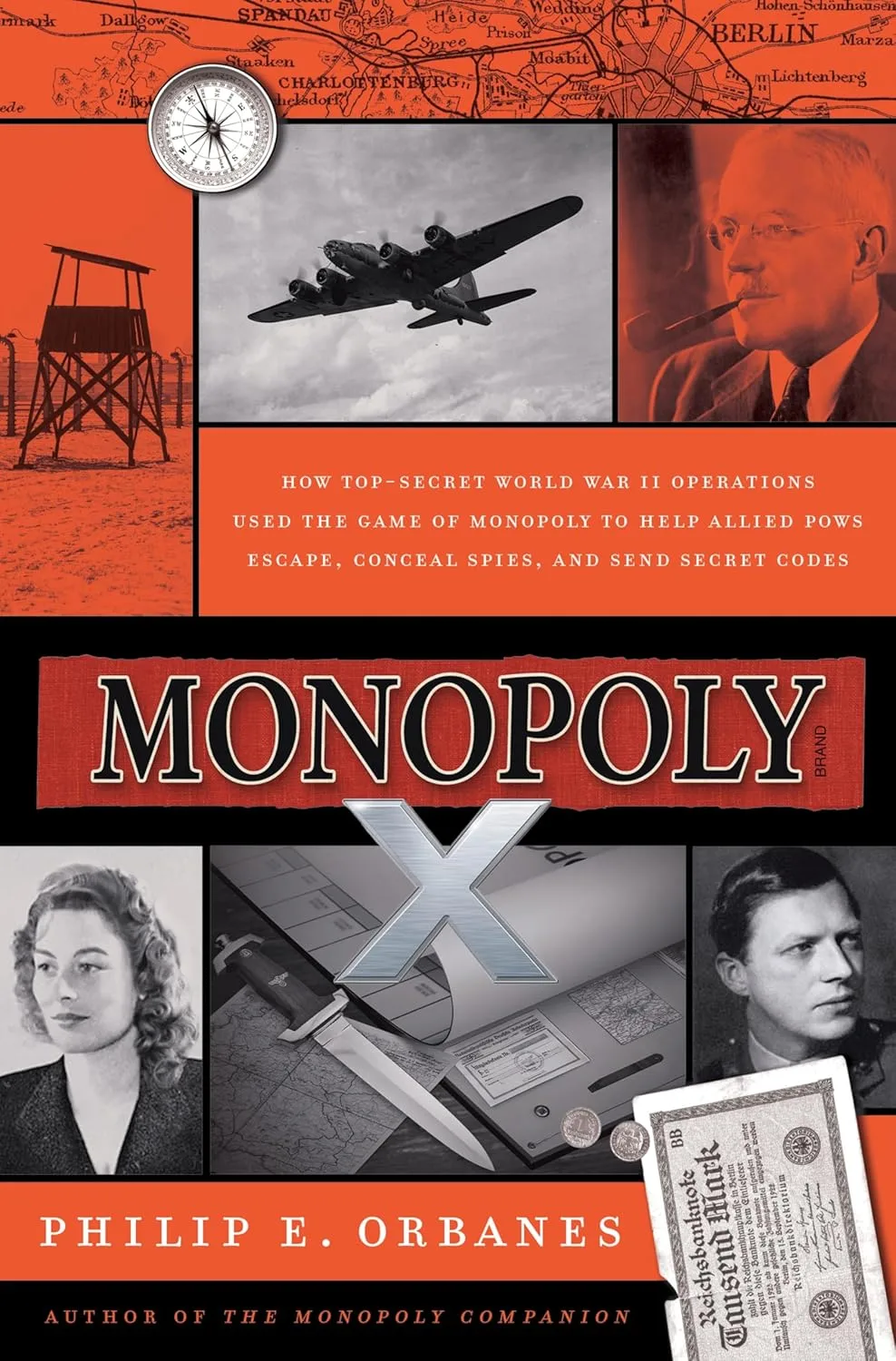
Monopoly X by Philip E. Orbanes
Philip E. Orbanes is an American Board Game designer, former senior vice president for research and development at Parker Brothers and the world’s foremost authority on the history of the board game Monopoly. His latest book on the game, Monopoly X, is aptly subtitled: How Top Secret World War Two Operations Used the Game of Monopoly to Help Allied POWs Escape, Conceal Spies, and Send Secret Codes.
Until 1985, its manufacturers were bound by Great Britain’s Official Secrets Act not to reveal the clandestine role and contributions made to the Allied war effort by this enduringly popular game. Similarly, in 1990, the Pentagon also partially disclosed information about the United States military participation in this deception.
This gripping true story illuminates at last one of the most ingenious and daring secret operations of WWII, which successfully thwarted detection by Nazi Germany. Orbanes’ work of non-fiction is as edge-of-your-seat exciting as any spy thriller written by such masters of the craft as John le Carré, Ian Fleming, Alan Furst and a score of others.
History of Monopoly
If you have never played a game of Monopoly, you are missing out on a challenging, long-lasting afternoon or evening of fun. Parker Brothers began marketing it in late 1935 with streets named for real ones in Atlantic City, New Jersey, with apologies to Marven Gardens, which is misspelled in the yellow square as “Marvin Gardens”.
They began licensing the game for use in other countries the following year with John Waddington Ltd., a printing company in Leeds, which obtained the manufacturing rights for the United Kingdom. Parker Brothers had presumed the board locations would be derived from seaside Brighton. However, Victor Watson, Waddington’s managing director, with his secretary, criss-crossed London scouting for suitably appealing street names such as Mayfair in place of Boardwalk for the premium property.
Hasbro, which now owns Parker Brothers, states on its website the game, published in 41 different languages, is sold in over 103 countries with specially licensed versions for numerous cities.
Before beginning a game, players choose their favorite representative token, which sometimes results in hot contention between participants and is resolved by a throw of the dice. The base metal tokens in use in 1940 were: Battleship, Boot, Cannon, Horse and Rider, Iron, Racecar, Scottie Dog, Thimble, Top Hat and Wheelbarrow. During the war years, the tokens were temporarily made of wood or heavy colored cardboard discs.
The dastardly, self-serving, traitorous double agent, cockney deserter Sergeant Harold Cole, responsible for the deaths of many Allied POWs, agents and Resistance fighters, sullied one of these by dubbing himself “Top Hat” after his favorite token.
Secret WWII Operations
The Dunkirk Evacuation, code-named “Operation Dynamo,” which involved many heroic private citizens, took place between May 26 and June 4, 1940, rescuing over 338,000 Allied soldiers from the harbor and beaches in Dunkirk, France. When the operation concluded, approximately 40,000 British soldiers remained behind, with the vast majority taken prisoner by Nazi Germany.
Enter MI 9, the British Directorate of Military Intelligence, a top-secret department of the War Office that was in existence between 1939 and 1945. It operated independently of MI 6, the Secret Intelligence Service (SIS), with communication and cooperation between the two agencies strictly limited and sometimes antagonistic.
MI 9 was tasked with assisting in the escape of Allied POWs held by the Axis nations and helping British, Canadian, American and other Allied military personnel shot down behind enemy lines to avoid capture. They are credited with assisting over 5,000 downed airmen evade imprisonment with routes south to Switzerland or to southern France, then across the Pyrenees to neutral Spain and Portugal by using coded communications, providing escape devices and working with resistance groups.
Altogether, over 11,000 Allied soldiers made their way to freedom. Sadly, it is also estimated that nearly an equal number of resistance fighters, field agents and good citizens sacrificed their lives in the process.
The American counterpart to MI 9 was MIS-X, Military Intelligence Service-Department X, simply designated P.O. Box 1142. It was located during WWII at Fort Hunt, VA, a top-secret military intelligence installation, south of Alexandria, VA, along the George Washington Memorial Parkway, not far from Mount Vernon. The buildings were razed in 1947, and all personnel and servicemen who worked there were sworn to secrecy.
The National Park Service maintains the concrete gun emplacements as part of Fort Hunt Park, today a popular picnic area. The aim of MIS-X was to smuggle vital aid to POWs imprisoned in Stalags by providing the means to escape.
POWs “Get Out of Jail”
During WWII, MI-9 contracted Waddington’s to make Monopoly X, a special version of the game designed for POWs, which contained a thin false bottom that encased escape maps printed on silk, travel passes, Reich marks sometimes mixed in with the game’s play money, a tiny compass, file, saw blades and other aids.
These ingeniously outfitted escape kits weighed the same as the regular board game and were the same thickness. A tiny “X” in the center of Free Parking signaled the difference. The games were sent by phony POW charities through the unsuspecting and uninformed Red Cross, which delivered food and care packages.
Three or four games would arrive at the many Stalags. Informed through coded messages, a handful of imprisoned officers would retrieve the escape aids and burn the remnants of the fake game while the regular Monopoly games would be openly enjoyed by the prisoners.
Preferring the intellectual game of chess, the German guards were dismissive of these games and consequently never discovered the contraband. MIS-X in Virginia also assembled large numbers of these games.
Far More Than Just a Game
How many thousand were so equipped has not yet been disclosed. Many Allied POWs were able to literally “get out of jail” and flee the Axis-held territories through a network of safe houses along secret routes.
Philip E. Orbanes has provided a detailed explanation of this unorthodox, highly effective method of aiding imprisoned Allies and presents well-documented research about the many heroic men and women involved, as well as some loathsome villains, by including shocking evidence of four prominent traitors in the White House.
Monopoly X: How Top Secret World War Two Operations Used the Game of Monopoly to Help Allied POWs Escape, Conceal Spies, and Send Secret Codes is an eye-opening, fascinating account of derring-do in the midst of World War II in Europe. It is a must-read for anyone interested in history and true espionage, as well as fans of spy thrillers.
Parker Brothers Monopoly has proven to be much more than a craze, well-earning its designation as the world’s most popular board game.
About Philip E. Orbanes:
 Philip E. Orbanes is an American author, former president of Winning Moves Games, and game historian. Prior to founding Winning Moves Games, he worked as a Senior Vice President for Research and Development at Parker Brothers. He is considered the foremost expert on the history of Monopoly, writing several books about the board game, including Monopoly: The World’s Most Famous Game—And How it Got that Way. He lives in Massachusetts.