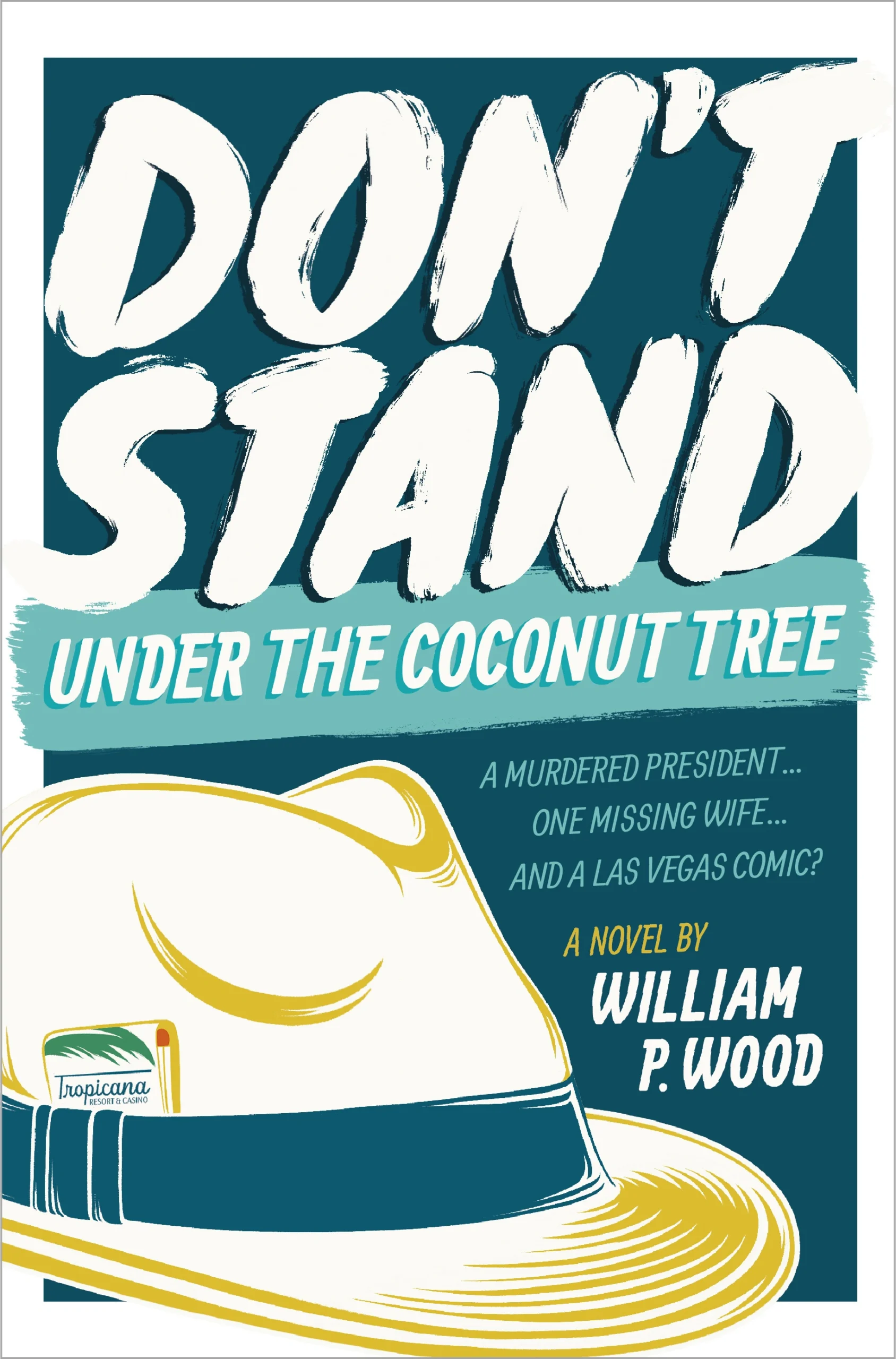
Don’t Stand Under the Coconut Tree by William P. Wood
A Las Vegas comic billed as “The Man of a Thousand Voices,” Lonny Day has built his career around impressions, especially a dead-on imitation of the President. Then the President is assassinated, Lonny’s signature act becomes unthinkable and almost everything else in his life starts coming apart.
His wife, Doris, is devastated and reaches the bizarre conclusion that Lonny’s jokes may somehow have distracted the President at the fatal moment. Before long, she is gone. Lonny loses his job, gets badly beaten after attempting his presidential impression for a grieving crowd and wakes up in the care of an eccentric veterinarian who becomes far too interested in how quickly his injuries are healing.
From there, William P. Wood‘s Don’t Stand Under the Coconut Tree gets even wilder.
A Story That Gets Stranger as It Goes
Wood sends Lonny through a succession of encounters that grow progressively more improbable: there are mysterious, otherworldly twins who seem to have an uncanny way with animals. A former rodeo queen with a gun. A telepathic would-be seducer. A longevity guru. A ventriloquist whose relationship with his dummy becomes increasingly hard to explain. And eventually, there is the Amrit Center for Better Living, a peculiar Hawaiian retreat where wellness, scientific research and the pursuit of immortality have begun to blur together.
Wood piles one oddity on top of another, but Lonny’s search for Doris gives the book a destination even when the route there looks completely unpredictable. Just when you think you have figured out what kind of novel you are reading, it swerves again.
That unpredictability isn’t just in the plot; it’s inherent to Lonny’s narrative voice and personality. Lonny simply cannot see a person, place or disaster without turning it into a bit. He thinks in punchlines, exaggerated comparisons, show-business slang and riffs that wander wherever his mind takes them. He is vain, impulsive and often hilariously unaware of how other people see him. When he reads his own premature obituary, he becomes emotional over what a wonderful fellow he apparently was, then explains that a healthy opinion of yourself is practically a requirement in show business. Lonny rarely takes a straight line to anything, and neither does the story.
Beneath the Comic Surface
For all the silliness, death and loss are never very far away. The President’s assassination sets everything in motion. Doris becomes consumed with longevity. Amrit promises answers to the oldest human problem of all. Lonny loses not only Doris but also the identity he had built around being funny and famous. Even his ability to do impressions deserts him for a time.
That makes the novel stranger, and much more interesting, than its comic surface initially suggests. Lonny keeps joking because joking is how he makes sense of the world. Sometimes it helps him survive. Sometimes it keeps him from seeing what is right in front of him.
The title finally becomes the perfect image for all of it. At Amrit, visitors are warned not to stand beneath coconut trees because a falling coconut can kill. Lonny eventually understands the larger lesson: avoiding one danger does not mean life cannot find another way to clobber you.
Don’t Stand Under the Coconut Tree is funny, unruly and frequently bizarre, a comic road adventure in which every apparent detour opens onto another. And Lonny Day is exactly the kind of narrator such a story needs: a man who can lose his career, his wife, his teeth and possibly his grip on reality — and still keep looking for the punchline.
 William P. Wood is the author of nine thrillers and one nonfiction book. As a deputy district attorney in California, he handled thousands of criminal cases ranging from disturbing the peace to murder. He served as chief counsel to the Secretary of State of California, the Commissioner of the California Department of Corporations, and the Undersecretary of the Office of Secretary of State.
Wood’s literary works include Rampage (1985), Gangland (1988), Fugitive City (1989), Court of Honor (1991), Stay of Execution (1994), Quicksand (1998), Pressure Point (2004), The Bribe (2006) and Sudden Impact (2014). Don’t Stand Under the Coconut Tree is his latest novel.
A nonfiction book, The Bone Garden (1994), is the definitive account of serial killer Dorothea Puente, who was the subject of a nationwide hunt after nine bodies were dug up from her Sacramento, California yard. Wood earlier sent Puente to prison for drugging and robbing the elderly. On her release from prison, she began killing her victims. The Bone Garden has been referenced in multiple books and featured on TV.
Many of Wood’s novels have been optioned for motion pictures, two of which were produced. The first, Rampage, was directed by Academy Award-winner William Friedkin (The French Connection and The Exorcist). Court of Honor was adapted into the TNT movie Broken Trust by Jane Fonda Films. It starred Tom Selleck and Elizabeth McGovern. The screenplay was written by Joan Didion and her husband John Gregory Dunne.
To date, Wood’s books have been translated into French, Spanish, Japanese, German, Greek, and Polish.
He is currently at work on his next book. For more details, visit www.williampwoodbooks.com.