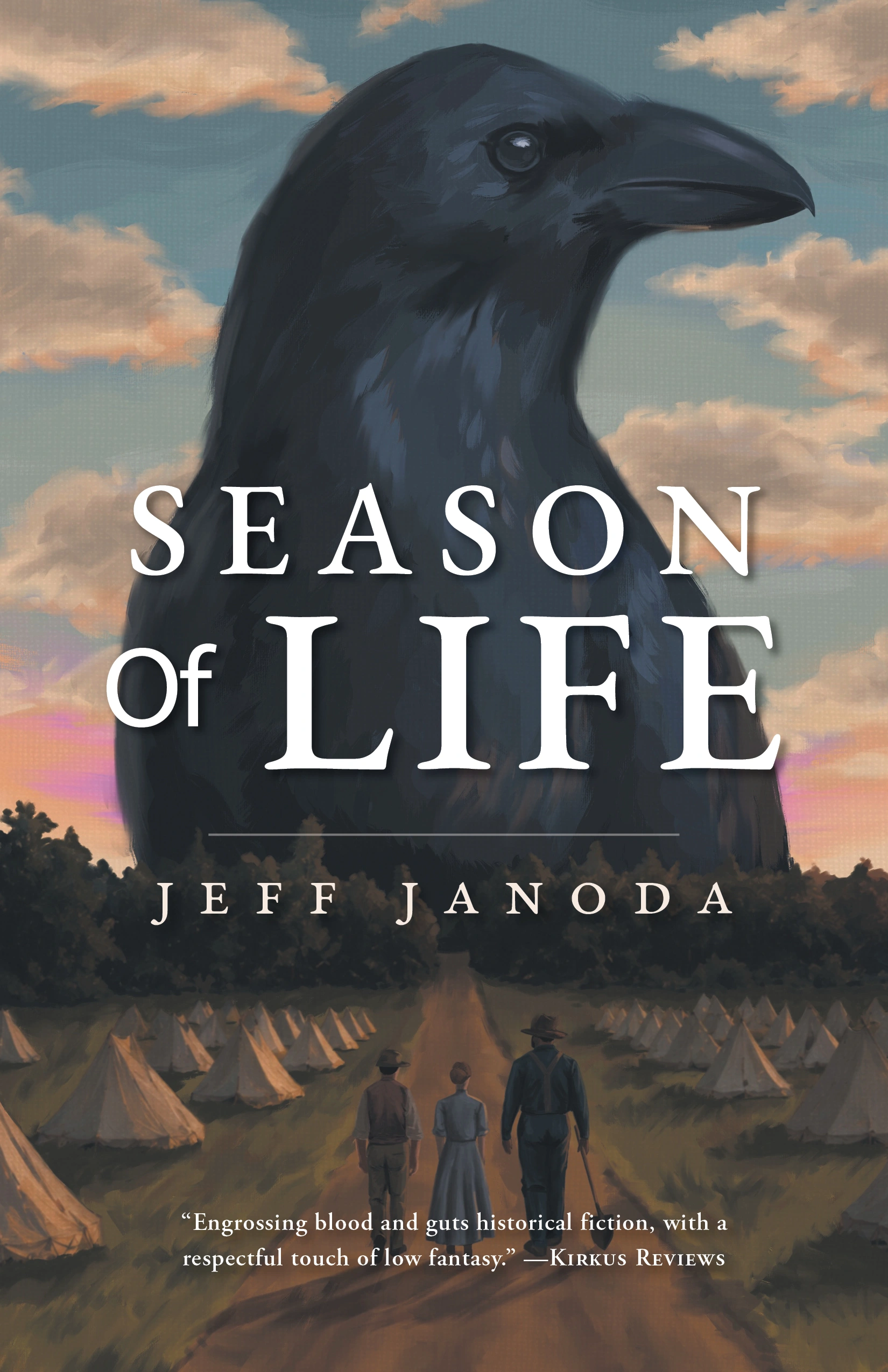
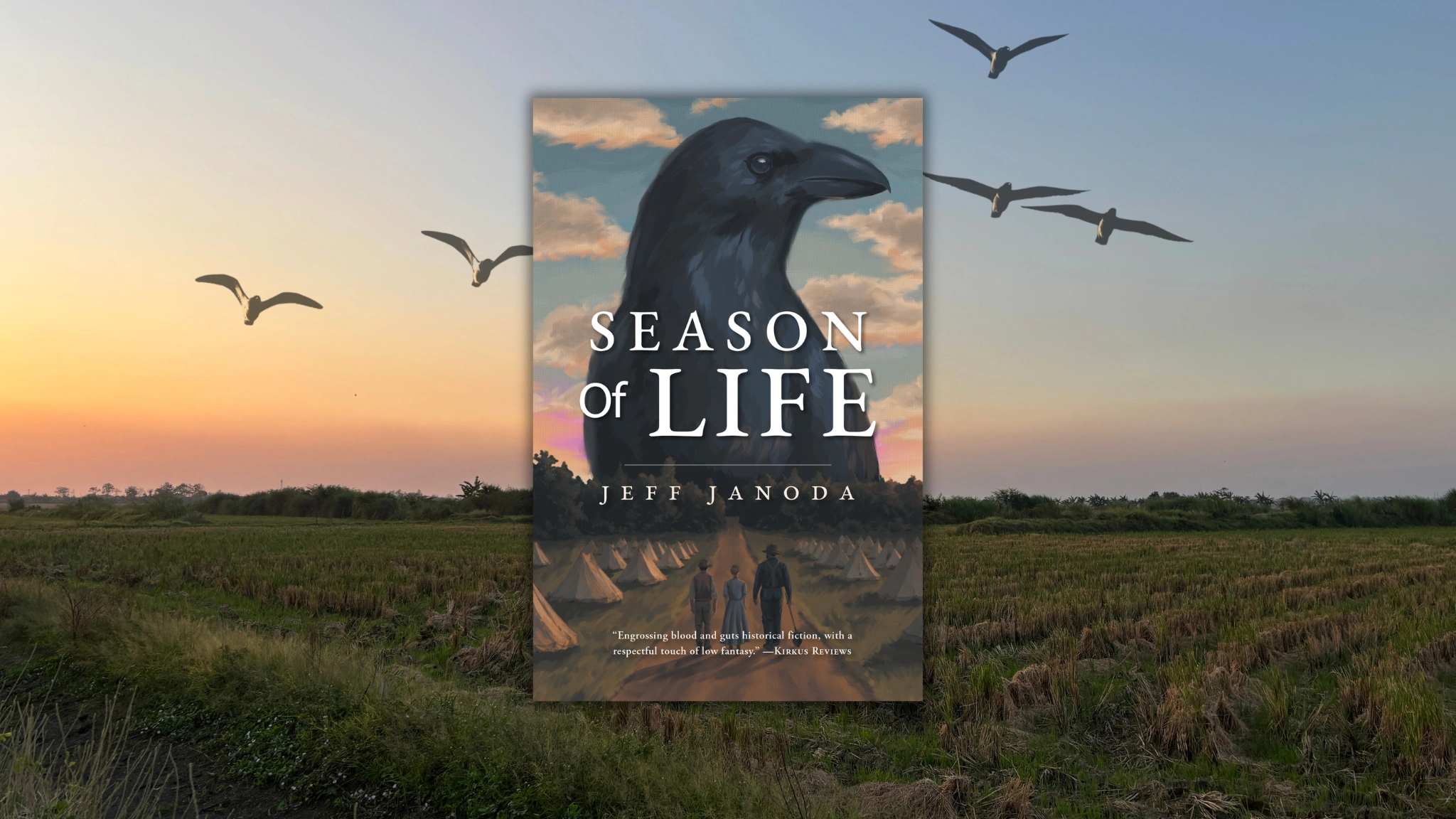
Season of Life by Jeff Janoda
Most Civil War novels about Gettysburg focus on the battle itself. Jeff Janoda’s Season of Life begins where many of them end: with the dead sprawled in the fields, the wounded packed into churches and barns, farms stripped bare, and civilians trying to piece together whatever can be salvaged after three days of slaughter.
But that’s not the only thing that makes this novel unusual. Janoda introduces something unexpected into his meticulously grounded historical setting: the supernatural. Basil Biggs, a free Black farmer returning to his devastated property, encounters a wounded Confederate soldier, Wesley Culp, who asks for his help in delivering some items to loved ones. Just afterward, Biggs learns the impossible: Culp has already been dead for days.
From there, Season of Life becomes both an immersive Civil War novel and something stranger, a tale haunted by a central question: What gives a human life meaning?
Lives Transformed in the Aftermath of Battle
Biggs is one of the novel’s central figures. After hiding from Confederate troops abducting Black Pennsylvanians and sending them south into slavery, he returns to find Gettysburg transformed by suffering and death. His farm has been ravaged, but his family, having fled the area, has survived. That is enough to begin again.
Another major strand follows Cornelia Hancock, a 23-year-old Quaker from New Jersey who travels to Gettysburg to nurse the wounded despite being rejected by Dorothea Dix, the Union Army’s powerful Superintendent of Female Nurses, for being too young and attractive for the work. Cornelia quickly proves otherwise. She writes letters for dying soldiers, feeds men who have gone without proper care and gradually becomes one of Camp Letterman’s most capable nurses.
Connecting their stories is John Babcock, an intelligence officer with the Union’s Bureau of Military Information. His work draws Biggs into a dangerous mission behind Confederate lines, while a badly infected wound eventually lands Babcock in Cornelia’s care. Witty, irreverent and increasingly drawn to Cornelia, he becomes both a link between the novel’s historical storylines and another witness to its supernatural mystery.
Biggs, Hancock and Babcock were real people, and Janoda builds much of the surrounding cast from history as well. Charlie Wright, a formerly enslaved teenager who supplied Union intelligence, is among the many historical figures woven into the story. Samuel Weaver connects Biggs to the grim work of recovering Union bodies for reburial in the new national cemetery.
Along with bringing historical figures to life, Janoda excels at immersing the reader in sensory details that viscerally convey what happens after battle: the stench of decay, the agonized cries of the injured, the festering of infected wounds. Practical details like ruined farms, improvised hospitals, methods of intelligence gathering, and the slow work of identifying the dead give the novel the texture of lived history rather than a backdrop assembled around the plot.
When History Turns Supernatural
Biggs’s encounter with Culp is only the beginning of the supernatural events. Cornelia later sees the specter of Peter Granger, a wounded soldier she had cared for and later found dead, only to discover that the real Peter had been killed at Antietam nearly a year earlier. Babcock, too, encounters things he cannot explain.
Eventually, we learn these events are linked to one source — an ancient entity, a “Changer of Forms” known by different names and appearances across human history. It doesn’t fit neatly into good or evil; the Changer can be cruel, helpful, frightening and playful, often in the same breath.
Immortality has left the being with a problem the mortals around it do not share in quite the same way: how to live when existence has no natural ending. It watches humans struggle with loss, violence, sacrifice, love and survival, and in doing so begins to understand what it lacks.
Cornelia finds purpose in caring for strangers. Charlie turns knowledge acquired under slavery into an instrument of freedom. Biggs and his crew dig up soldiers who might otherwise disappear into anonymous graves and restore their names when they can.
The supernatural thread also makes the aftermath of Gettysburg feel literally haunted. The dead are everywhere, sometimes in graves, sometimes in memory, sometimes walking back into the lives of those who survived them. The emotional toll, such as Cornelia’s growing anger and Biggs’s grief, is very much a part of that haunting.
A Season Defined by Resilience Amid Change
The title gathers meaning as the novel progresses. A season ends, and another begins.
That idea carries into the dedication of Gettysburg’s national cemetery. Lincoln’s words about a “new birth of freedom” resonate not only with the nation but with the people Janoda has followed through the wreckage. By then, Biggs, Cornelia and Charlie are no longer the people they were just months ago.
Combining historical figures, espionage, battlefield medicine, racial history and the supernatural, Season of Life covers a lot of ground. But each of these threads converges on the same question: After so much destruction and death, how do we find meaning and purpose again? What do we do with the life that remains?
About Jeff Janoda
 Jeff Janoda worked as a fisheries science technician and then as an educator for 31 years, during which he published several science fiction short stories and two novels. Now retired, he focuses on writing, fitness, travel and reading. Season of Life is his third novel. His lifelong passion is history, with a military and political focus, but really in all its aspects. His fiction has been described as historical fiction with a surreal twist. Deeply researched and engaging, his writing often incorporates “otherworldly” or paranormal elements that enhance the story he tells. Janoda lives in Toronto, Ontario, Canada, with his wife, Susan and dog, Tulip.