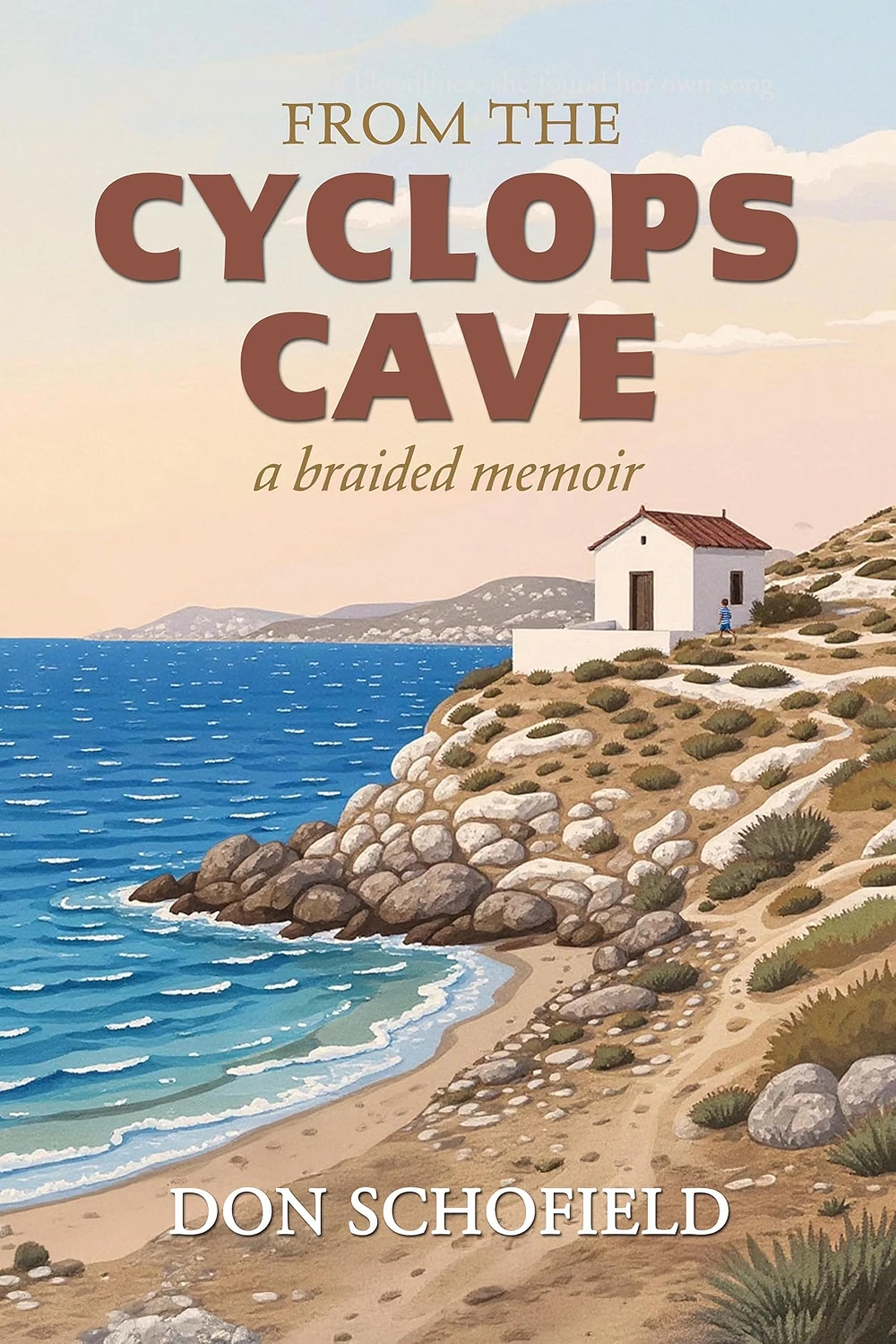
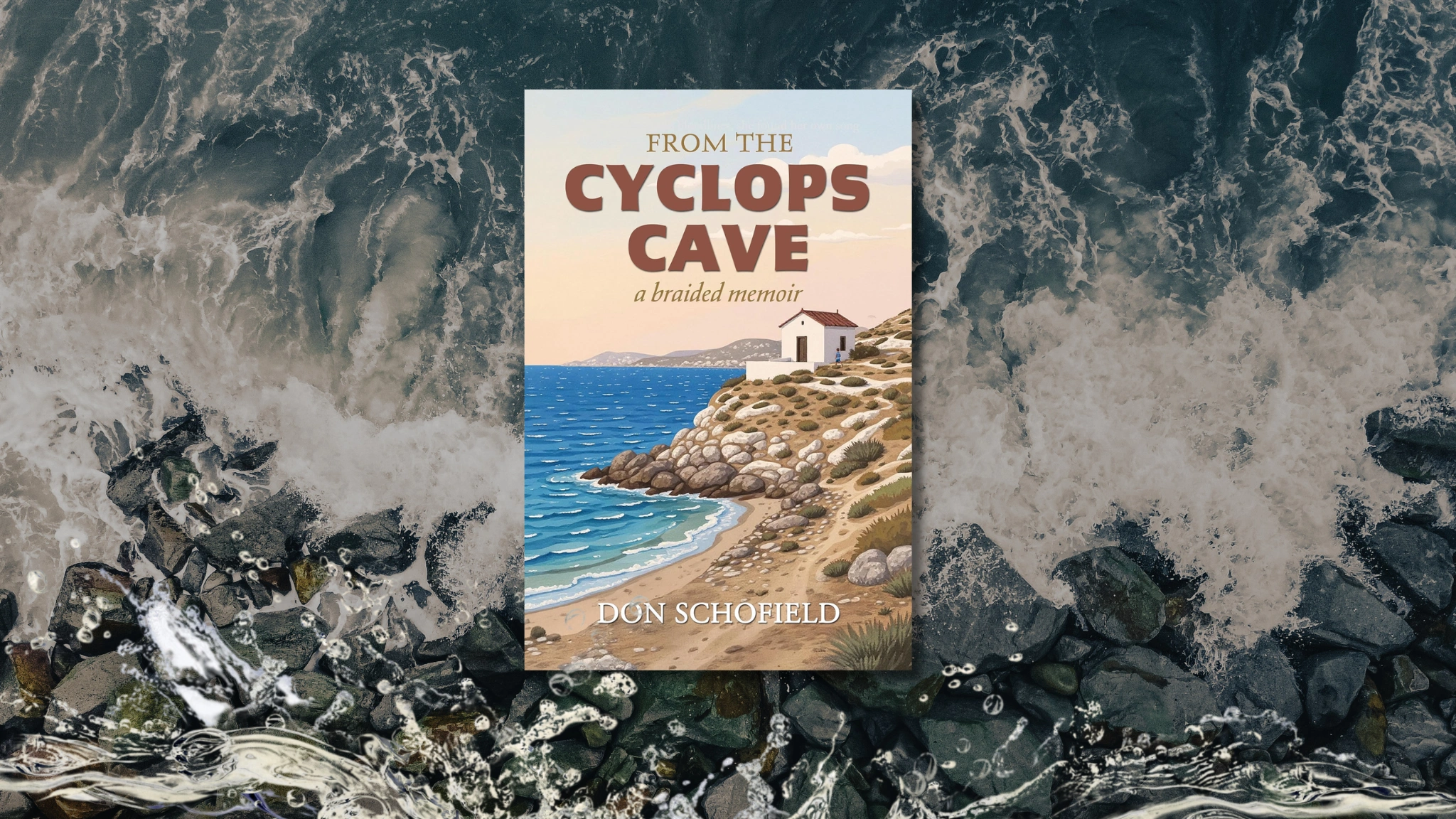
From the Cyclops Cave by Don Schofield
From the Cyclops Cave is a memoir written by Don Schofield where an American poet, long settled in Greece, rents a house on the island of Kýthnos that the locals call “the Cyclops Cave.” Alone there for a summer, gazing out at the Aegean, he lets his mind do what he says the local goats do along the hillside: leap, thought to thought, memory to memory. What emerges from that leaping is a book that moves fluidly between the present-tense island idyll and the unresolved terrain of a boyhood spent bouncing between an itinerant Greyhound-bus-driving father, a series of unstable households and a hunger for love that never quite finds steady ground.
The book has a braided structure. Schofield alternates chapters set in Greece with chapters that plunge straight back into scenes from Fresno, Sacramento and Reno: a four-year-old on a barstool while his father flirts with a stranger; a terrifying mountain drive with a father who won’t slow down; a cruel stepmother’s house where a boy isn’t allowed to set foot on the lawn. The effect is cumulative, almost musical. Each return to the Cyclops Cave feels like a breath taken before the next dive. Short poems open every section like tuning forks, setting the emotional key before the prose takes over.
A Poet’s Eye for Memory and Place
Schofield writes in close, sensory detail when describing the smell of aftershave in a steamed-up hotel bathroom, the clatter of a redhead’s dog leashes on tile and the plash of oars from fishermen who row facing forward, toward whatever is coming. He allows feelings to be carries by physical details. A boy pressing his face to a mirror to find the small nose and dimpled chin his father won’t mention says more about longing and self-scrutiny than pages of introspection could. This is the work of a poet: every scene is composed with an eye for the telling image, and the language never calls attention to itself at the expense of the story.
The mystery of what happened to the narrator’s mother, the shifting cast of father figures, and the slow, present-day reckoning with a drinking problem and a pattern of self-sabotage all give the book narrative momentum. Schofield doesn’t spare himself in the contemporary sections, either; the adult narrator’s blackouts and moments of recklessness are rendered with the same unsparing honesty he brings to his father’s failures, which keeps the book from ever feeling like score-settling.
The narrator’s decision to imagine his childhood self as a living presence, a boy he can finally listen to, protect, and parent in the way he was not parented is incredibly moving. By the closing pages, as the narrator returns by ferry to his adult life in Athens with that inner boy “riding along,” there’s warmth without the surrender of honesty about how hard-won that warmth was. The redemption arc doesn’t erase the damage it grew out of.
Opening a Second Eye to the Past
Schofield has a gift for evoking place, whether the dusty roads of the Central Valley or the whitewashed hush of a Cycladic cove, and From the Cyclops Cave becomes something more than a personal history. It’s a meditation on how memory, distance, and the discipline of writing can turn even the most painful material into something luminous.
A cyclops is a figure of both menace and isolation. It is a giant whose single eye limits how much of the world he can truly see. Schofield’s memoir suggests that childhood trauma can leave a person similarly one-eyed, stuck seeing an old wound from only one angle. Writing this book, it seems, was his way of opening a second eye, and he does so with grace, emotional precision and compassion for his younger self, his flawed father and the parts of himself still struggling in the present. That makes From the Cyclops Cave a memoir well worth seeking out, especially for readers drawn to books that trust them with complexity rather than tidy resolution.
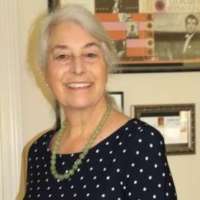
About Don Schofield:
 Born in Nevada and raised in California, Don Schofield is a graduate of CSU, Sacramento (MA, 1978) and University of Montana (MFA, 1980). A resident of Greece for over four decades, he has taught literature and creative writing at American, British and Greek universities, and traveled extensively throughout Europe, the Middle East and farther afield. Fluent in Greek, a citizen of both his homeland and his adopted country, he is the editor of the anthology Kindled Terraces: American Poets in Greece (Truman State University Press), and has published six books of poetry in the U.S., the first of which, Approximately Paradise (University Press of Florida), was a finalist for the Walt Whitman Award, and a more recent collection, In Lands Imagination Favors (Dos Madres Press), reached the final round for the Rubery Book Award (UK). His poems and translations have been nominated for a Pushcart Prize and shortlisted for the Greek National Translation Award. He is a recipient of, among other accolades, the Allen Ginsberg Award (U.S.) and the John D. Criticos Prize (UK). His most recent books are A Different Heaven: New and Selected Poems (Dos Madres Press), Wherever the Sweet Breeze Blows (Kelsay Books), a translation of a recent work by the noted Greek poet Liana Sakelliou, and From the Cyclops Cave: A Braided Memoir (Open Books). He lives with his companion Aleka in both Athens and Thessaloniki.