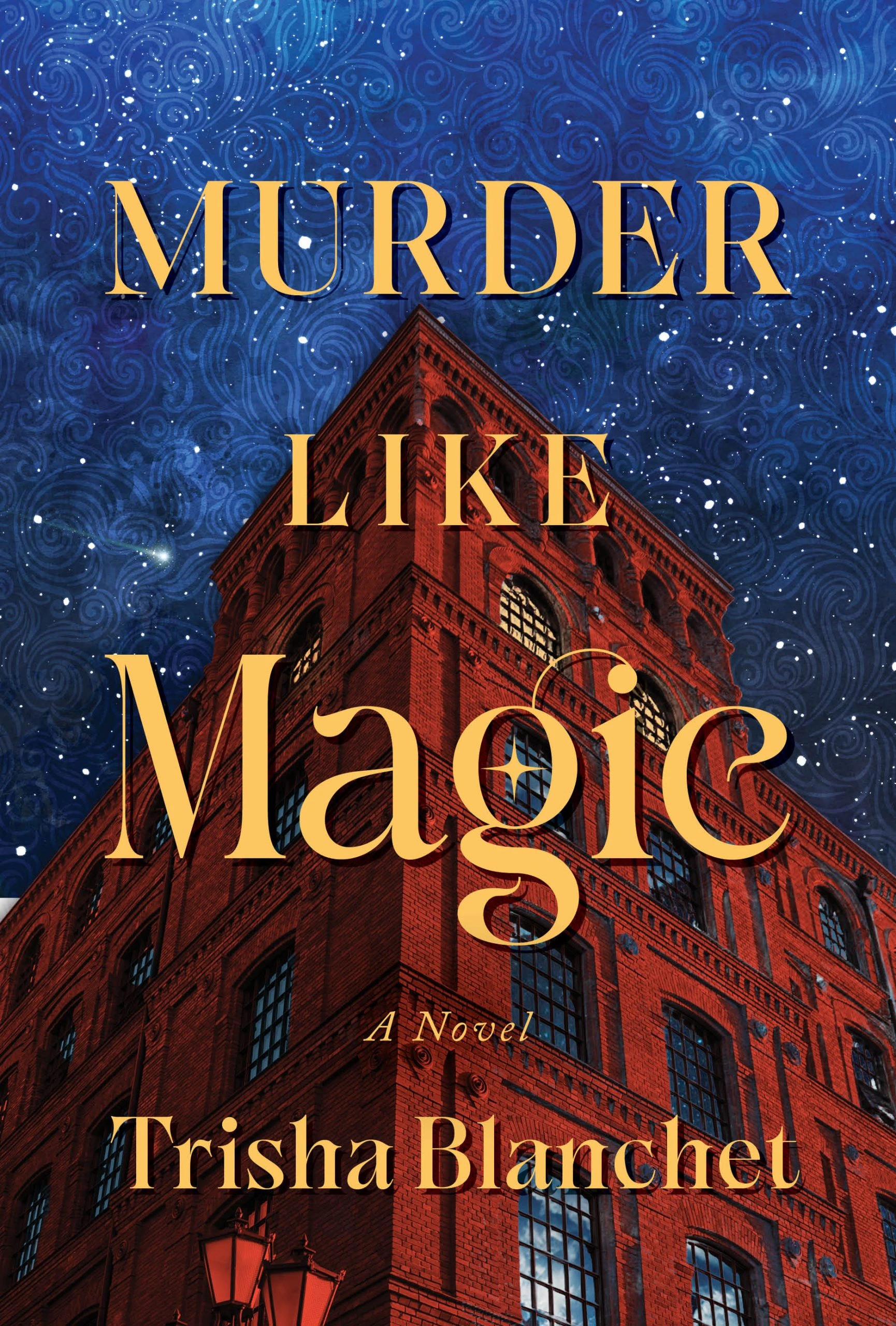
Murder Like Magic by Trisha Blanchet
One fateful Saturday morning in May of 2023, I found myself staring out the window at the rain and sighing pathetically. I did not yet know it was fateful day, of course. I only knew it was a stormy day, the third that week, and I was dying to get out of the house.
My husband and I debated our few options — movies? Mall? Lunch? Again? — until I suddenly snapped my fingers.
“How about the Boott Cotton Mills Museum?” I asked.
He looked at me like I was nuts.
Fair enough. Despite having lived near the city of Lowell, Massachusetts, for most of our lives, we’d never taken the time to visit the National Historical Park museums that commemorated the mills and people who had birthed America’s Industrial Revolution. So off we went on that day, umbrellas in hand, to rectify our oversight. What we found entertained and fascinated me in equal measure. I loved watching the deafening looms spin (yep, they’re still running), browsing the examples of clothing and fabrics created and learning more about the revolutionary history of our region.
Mostly, though, I fell hard for the Mill Girls.
Groundbreaking Girls
Before visiting the museum, I’d had no idea that roughly three-quarters of the 1800s Lowell mill workforce had been made up of young women — some of them teenagers. Nearly all of them came from farming communities in New England, and most had jumped at the rare opportunity to gain independence and earn their own wages. They called themselves “Mill Girls.” They worked grueling 13-hour days in deplorable, dangerous conditions while living in nearby boardinghouses under the watchful eyes of “keepers.” In their rare free time, the young women created a literary magazine called the Lowell Offering, formed a union to fight for better working conditions, attended lectures by visitors such as Ralph Waldo Emerson and John Quincy Adams, and edited labor newspapers like The Voice of Industry.
The Mill Girls had also been commonly referred to as “female operatives” (because they operated machinery, not because they regularly joined Jason Bourne on undercover missions). Still, it’s a pretty cool nickname. As if they weren’t already cool enough.
All in all, our visit to the museum had made for a pretty great day. And that, I thought, was that.
Snowy Inspiration Strikes
Fast forward six months or so, and I found myself staring out the window on yet another fateful day, stewing about a different kind of bad weather. This time, it was snow. Flurries, then inches, then feet.
For weeks, I’d been trying (and failing) to work out the details of a story that had been brewing in my mind. A murder mystery, of all things. But none of the pieces seemed to want to coalesce. As I gazed out at the snow that morning, the whiteness and silence were mesmerizing. Before long, my mind went white, too. And that’s when the idea came swirling in like yet another flurry of flakes.
The Mill Girls.
Not any one of them, in particular, but their overall audacity. And not in the past, but the present. I would create a modern young woman with the moxie of those Mill Girls. A woman who was just as capable, determined, and courageous as her predecessors. Who was inspired and shaped by the history all around her. A private eye who had a mountain of obstacles to climb and no one but herself to lean on. Where would this maverick live and work? In Mill City, of course. And her sole-proprietor company, run out of the top floor of a creaky-floored former cotton mill, would be called Mill City Investigations.
A Main Character Who Doesn’t Quit
Tess Tully, P.I., came to me that morning as clearly as if she had walked through the snow and tapped on the windowpane. She sat next to me as I typed and typed and typed until the winter sun had set and the entire outline for the story had been drafted: what happened, whodunnit and why.
Each morning after that, Tess would tug on my sleeve, lead me to the keyboard and insist that I get back to work on her story. Six months later, the book had been written. I called it Mill City Murder.
Now, after several rounds of revisions and invaluable editing from the team at Crooked Lane Books in New York, Tess’s story is called Murder Like Magic. It released out into the world last week, almost exactly 3 years after that impromptu, rainy-day museum visit.
I dedicated the novel to the Mill Girls, “America’s first female operatives.” I hope I did them justice. And I hope mystery lovers enjoy reading it as much as I enjoyed being forced to write it by a fictional character with a few bad habits, a hatred of injustice and a mostly wonky ability to read minds. And yes, she’s already on my case to write her next case — as soon as the next bout of bad weather rolls in.