

As much as I would love to be in Bath right now, dancing the quadrille in the Assembly Rooms to celebrate Jane Austen’s 250th birthday, or wandering through Chatsworth House in Derbyshire, believed (for good reason) to be Austen’s inspiration for Pemberley, my real-life plans to honor Miss Austen this summer are more modest. I’m reading her novels again and re-appreciating movie adaptations of her work. Only this time, I’m noticing some themes I didn’t spot on the first read or watch—namely, Austen’s use of houses to reveal the inner lives of her characters and to tell truths about the cultures they inhabit.
Take, for example, Jane Austen’s beloved novel, Pride and Prejudice. It’s set within the period spanning the late 1700s to the early 1800s. In the novel, Jane Austen uses a series of houses to do double duty. The houses reveal character, and they also create a picture of the world that the characters inhabit. Unlike film, of course, a novel relies on written description to paint a picture of its world. So unless the author provides us with enough detail to envision that world, we just don’t see it.
Jane Austen also used these houses to make her satiric observations with the semblance of tact. Austen was commenting on the world she lived in. She used houses to show the contrast between different characters and their values and tastes and to reveal the customs, vanities, restrictions, and foolishness—the seamy underbelly—of the culture she wrote about. Austen was a member of the worlds she pilloried – social groups that demanded decorum. But her powers of observation were not as mannerly. They were penetrating, and her wit was rapier-sharp. Using houses to illuminate characters and the foibles of their worlds lets her train her keen eye on her social world and use her sharp wit to reveal it while handling these truths with the velvet glove of indirection. Jane Austen used houses to say, indirectly, what she chose not to say directly and with far more deadly precision.
We know Jane Austen as a master of world creation. She was born on December 16, 1775, in the village of Steventon, Hampshire. She completed six novels during her lifetime. Persuasion was published after her death in 1817 at the age of 42. Austen’s novels are set during the final third of the reign of George III, known as the Regency Era.
Longbourn and the Bennet Family
“It is a truth universally acknowledged that
a single man in possession of a good fortune,
must be in want of a wife.”
With the first line of Pride and Prejudice, Jane Austen, tongue in cheek, channels the thoughts of one of her characters. That character is probably Mrs. Bennet, mother of five unmarried daughters.
But the Bennets have no son. And because Longbourn, the family home, is entailed in the male line, Longbourn will pass to distant cousin Mr. Collins upon Mr. Bennet’s death.
In Regency England, a suitable marriage was virtually the only route open to a woman to ensure her social and economic security. It follows, then, that the drawing room in the Bennets’ house is where Mrs. Bennet and her daughters would spend time waiting to receive suitors. Jane Austen does not offer a description of the room. But I think the depiction of the Bennets’ drawing room in the 2005 movie telling of Pride and Prejudice, directed by Joe Wright, captures what we do know about the Bennet family and the period in which they lived.
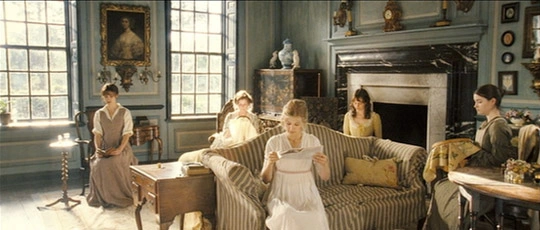
The Bennet Family Drawing Room in Pride and Prejudice (2005)
Production design by Sarah Greenwood
Set decoration by Katie Spencer
Regency style was more decorative than earlier Georgian style. Regency style welcomed bolder patterns, which were often stripes. Window treatments during the Regency Era were growing more elaborate. But the Bennet family lived in the country and not in London, so we don’t really expect them to stay abreast of the latest fashions. In fact, this room would have delivered a different message about this family if it did have curtains.
We might also suspect that, with the exception of the striped fabric on the sofa (which looks more like a rumpled slipcover than an on-trend Regency upholstery treatment), the Bennet family did not keep up with the Regency trend to more elaborate, gilded, bold, and more decorative furniture and that the design style of their furniture was more consistent with earlier styles of the Georgian period.
The set design team of the 2005 film adaptation seems to agree. To illustrate how well the 2005 movie captures this, note the cabriole legs on the two tables, which were consistent with the earlier Georgian style. Table legs during the late Georgian and Regency periods were straighter.
As for the color on the walls, while the earlier Georgians opted for the dramatic colors you see on the walls of the Bennet house, the Regency Era’s trend leaders used lighter shades. But trends aside, let’s look at the other design elements. The family portrait indicates some wealth, history, and property. This is the home of a gentleman and his family, although we know it’s not on the cutting edge of Regency interior design.
Another thing you don’t see in this drawing room is evidence of travel. In the Regency period, travel was seen as a signal of refinement and high social status. Travel and education were emblems of broadened minds, and the furnishings of the period reflected the wonders of Europe experienced through the Grand Tour. Influences from Greece and ancient Rome were displayed in houses of the wealthy and educated.
But we see no evidence of these influences in the Bennet drawing room. The drawing room depicted in the 2005 film treatment shows us that the members of this family may have traveled locally, but they are not worldly. No daughter in the Bennet household would have taken the “Grand Tour.”
Rosings Park and Lady Catherine de Bourgh
The obsequious cousin and cleric Mr. Collins is the comedic gift that keeps on giving. When Elizabeth visits her friend Charlotte after Charlotte marries Mr. Collins, Mr. Collins boasts of the supreme honor his esteemed mistress Lady Catherine de Bourgh has bestowed on Elizabeth with an invitation to take tea at the grand residence of Rosings Park.
The visit to Rosings and the meeting with Lady Catherine are important to advance the story because Lady Catherine’s subsequent meddling plays a pivotal role in breaking down the last remaining tensions between Elizabeth and Mr. Darcy and in bringing them together in marriage.
But the invitation also captures the comedy of Mr. Collins’ profound servility, and his remarks about the invitation foreshadow Lady Catherine’s objection to Elizabeth. Here, Jane Austen offers what may be two of the most deliciously lethal sentences ever written:
“Mr. Collins’ triumph, in consequence of this invitation, was complete. The power of displaying the grandeur of his patroness to his wondering visitors, and of letting them see her civility toward himself and his wife, was exactly what he had wished for; and that an opportunity of doing it should be given so soon was such an instance of Lady Catherine’s condescension as he knew not how to admire enough.”
And here’s the foreshadowing: Mr. Collins says, on the subject of what Elizabeth should wear to tea with Lady Catherine: Don’t trouble yourself with your lack of fine dress.” [Lady Catherine] likes to have the distinction of rank preserved.”
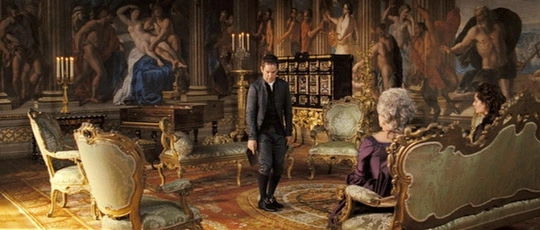
The Drawing Room at Rosings Park
Pride and Prejudice (2005)
Production design by Sarah Greenwood
Set decoration by Katie Spencer
You may recognize the sumptuous murals on the walls of the drawing room at Rosings Park in the 2005 film adaptation as features of the Heaven Room at Burghley House in Lincolnshire. Burghley House is the most imposing of all the great houses built during the Elizabethan period, and the murals in the Heaven Room were famously created by Italian painter Antonio Verrio in the late 1600s. In the next section, we’ll read Elizabeth’s musings about the natural beauty and lack of pretension of Mr. Darcy’s house, Pemberley. Those thoughts make clear why Pride and Prejudice director Joe Wright chose the even grander Burghley House as a stand-in for Rosings Park: It is a perfect representation of Lady Catherine’s high opinion of her rank and a foil to the more restrained elegance of Pemberley and Mr. Darcy.
Pemberley
Pemberley House is a fictional country estate based in Derbyshire near the town of Lambton. Elizabeth visits Pemberley with her aunt and uncle on their trip to the Peak District. There’s good reason to believe that the fictional Pemberley was inspired by the real-life Chatsworth House, the historic seat of the Dukes of Devonshire.
When Jane Austen visited the Peak District in Derbyshire in 1811, she stayed in the nearby town of Bakewell at the Rutland Arms and visited Chatsworth House on a tour. Austen even mentions Chatsworth House by name in Pride and Prejudice as an estate that Elizabeth visits with her aunt and uncle before their tour of Pemberley. You can find Austen’s seemingly offhand reference yourself in Chapter 42, where our author buries the name Chatsworth inside a short list of great houses that Elizabeth and her aunt and uncle visit in Derbyshire. Austen even describes Elizabeth’s disappointment at the news that she and her aunt and uncle would not be able to continue further north and visit the Lake District, as planned. Austen’s tone suggests (probably playfully) that the visit to Chatsworth and the other great houses in Derbyshire would have to suffice as compensation for the change in plans. I would bet an Easter egg that Taylor Swift is an Austen lover.
So the great Jane Austen took a tour of Chatsworth as any tourist might do today. The image is enchanting: 250 years after her birth, everything associated with Jane Austen herself – including her birthday– draws tourists and scholars from around the world.
Austen wrote most of Pride and Prejudice while staying at Bakewell, and her description of Pemberley mirrors the exterior features of Chatsworth House:
“It was a large, handsome, stone building standing well on rising ground, and
backed by a ridge of high woody hills; and in front, a stream of some natural
importance was swelled into greater, but without any artificial appearance.
Its banks were neither formal, nor falsely adorned.”
By the time Elizabeth visits Pemberley, she has already rejected Mr. Darcy’s first proposal, which he bungled when he insulted her and her family while professing his love. But Elizabeth’s visit to Pemberley coaxes her to reconsider her judgement. Darcy’s gallantry and his love letter to Elizabeth play on her mind.
We see Elizabeth’s attitude towards Mr Darcy softening as she ponders Pemberley:
“They gradually ascended for half a mile, and then found themselves
at the top of a considerable eminence, where the wood ceased,
and the eye was instantly caught by Pemberley House, situated on
the opposite side of a valley, into which the road with some
abruptness wound….Elizabeth was delighted…at that moment
she felt that to be mistress of Pemberley might be something!”
Jane Austen uses houses to show us how social rank, inheritance, and gender conspire to shape the prospects of her characters in the worlds they inhabit. Yet against these forces, Austen’s protagonists triumph. They’re optimistic, resilient and unimpressed by status. In short, they’re grounded. Two hundred and fifty years after her birth, Austen’s message is all the more remarkable for its resistance to the cultural teachings of Regency England. On the contrary, as Austen tells us, it’s character that shapes a life.