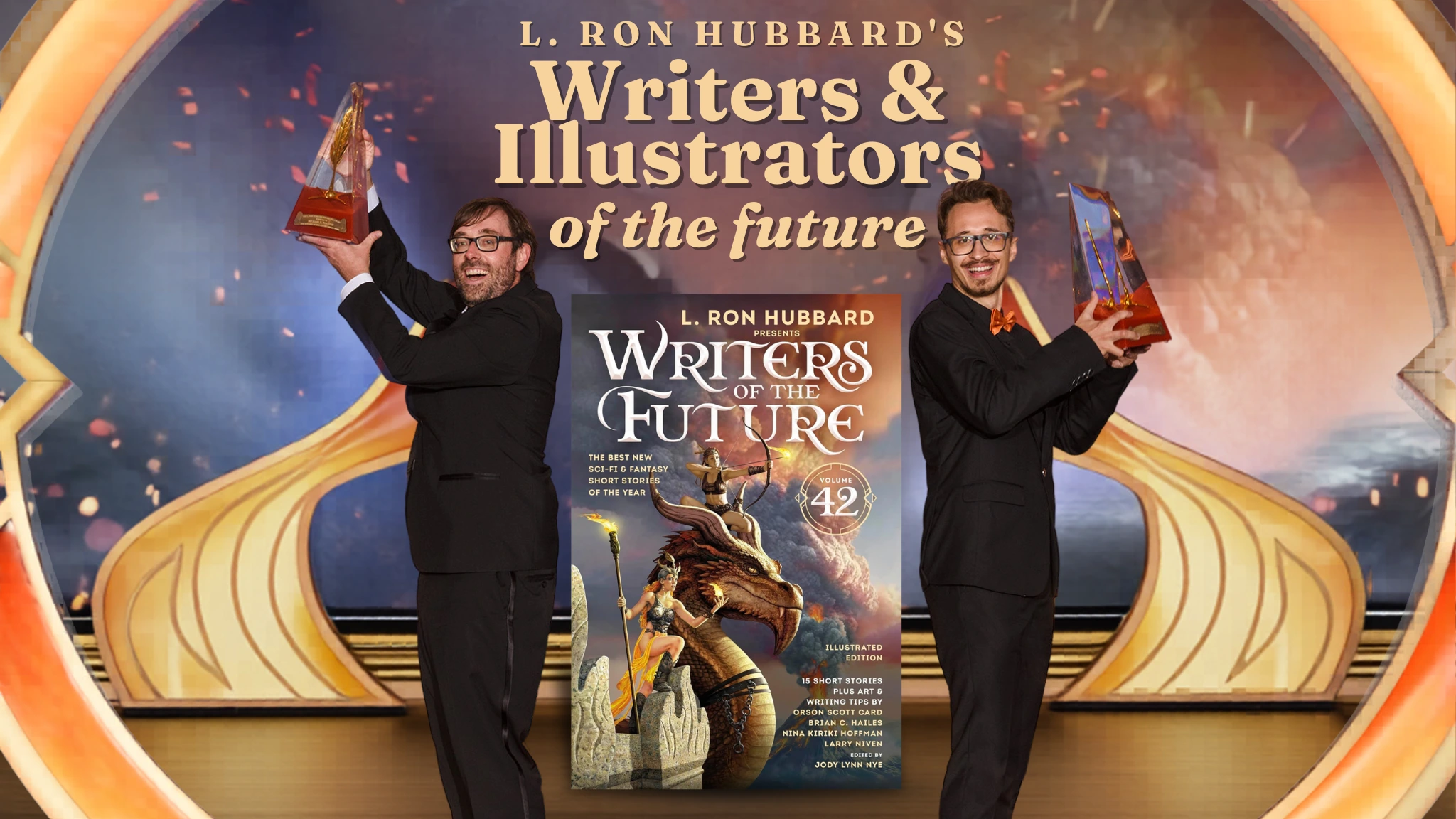
If science fiction and fantasy have always been about imagining what comes next, then the L. Ron Hubbard Writers and Illustrators of the Future Contest offers something rarer: a glimpse of who will be imagining it.
Each year, the contest gathers emerging voices from around the world and gives them something few new creators ever receive — serious attention, professional mentorship and a global stage.
More Than Just a Contest
What sets these contests apart from others isn’t just its longevity, but its structure. Open exclusively to amateur creators and free to enter, the competition is designed as a true entry point into the professional world. Winners don’t simply receive recognition; they are flown to Los Angeles for an intensive, weeklong workshop led by established authors and artists, where they receive hands-on instruction in craft, publishing and the realities of building a creative career. Their work is then published in the annual anthology, placing them alongside both their peers and some of the most respected names in the field.
Just as important, though less visible at first glance, is the community that forms around the contest. Winners become part of an ongoing network of writers and illustrators who continue to support one another long after the workshop ends — through forums, collaborations and shared opportunities. Over time, that cycle deepens: some past winners return as instructors and judges, helping to guide the next generation. It’s a model built not just on discovery, but on continuity; one that turns a single win into the beginning of a much longer creative trajectory.
The winners are also presented in an annual anthology that doesn’t just reflect the genre as it is, but quietly reshapes where it might go. This year’s volume of L. Ron Hubbard Presents Writers of the Future arrives on the heels of a milestone moment. With the release of Volume 42, the program has now published more than 1,000 writers and illustrators — an achievement that speaks not just to longevity, but to influence. For over four decades, the contest has served as a proving ground for new talent, many of whom have gone on to build lasting careers in speculative fiction and beyond.
A Global Stage for New Voices
The 2026 cohort reflects that reach. Winners hail from across the United States as well as the United Kingdom, Japan, Australia, South Africa, Slovakia and beyond — bringing with them a wide range of perspectives, styles and storytelling traditions.
At the center of this year’s group are the Grand Prize winners: writer Michael T. Kuester, whose story “In Living Color” anchors the collection with a tense, character-driven mystery, and illustrator Bafu, whose illustration work on “Saffron and Marigolds” captures the warmth and whimsy of that story’s found-family dynamic.
But one of the annual anthology’s defining strengths is that it resists hierarchy. While the contest names top winners, the collection itself reads as a mosaic — each story distinct, each voice emerging on its own terms. Across its fifteen stories, Volume 42 returns again and again to one core impulse: the speculative “what if.” But the range of those questions — and the emotional registers they open up — is what gives the collection its depth.
Where Words and Images Meet
Inside, the collection moves fluidly across a wide emotional and conceptual range — exploring identity and consciousness in engineered worlds, slipping into mysteries shaped by fractured perception, and lingering in quieter stories where reality itself feels subtly unmoored. We move through destabilized worlds both familiar and strange, as well as richly imagined landscapes of fantasy and folklore. The collection doesn’t shy away from darker transformations of the body and self, but balances them with moments of humor, surprise and imaginative play.
Alongside the emerging voices are contributions from established authors, including Orson Scott Card and Hubbard himself, reinforcing the anthology’s sense of continuity. Rather than overshadowing the newer writers, these stories create a dialogue across generations — linking past, present and future within the genre.
A defining feature of the Writers of the Future series is its commitment to pairing each story with original illustration. Here, the illustrators are not simply visual interpreters but collaborators, expanding the narrative space of each piece. From intricate conceptual work to expressive, character-driven imagery, the visual dimension adds another layer of discovery — one that reinforces the anthology’s role as a showcase for emerging talent across disciplines.
Volume 42 also includes essays on craft and creativity, with contributions from Hubbard, Larry Niven and Brian C. Hailes. These pieces offer insight into the discipline behind the imagination — reminding readers that even the most visionary stories are built through practice, persistence and collaboration.
The Start of Something Big
What makes Writers of the Future Volume 42 compelling isn’t just the range of stories it contains, but the sense of momentum behind them.
These are writers and illustrators at the beginning of their careers — experimenting, taking risks, asking difficult questions. Some will go on to become major voices in the field. Others will chart different paths. But taken together, they represent a snapshot of speculative fiction in motion.
And if the genre has always been about exploring possibility, then this collection does more than imagine the future.
It introduces the people who will write it.
L. Ron Hubbard Presents Writers of the Future Volume 42 is available for pre-order here.