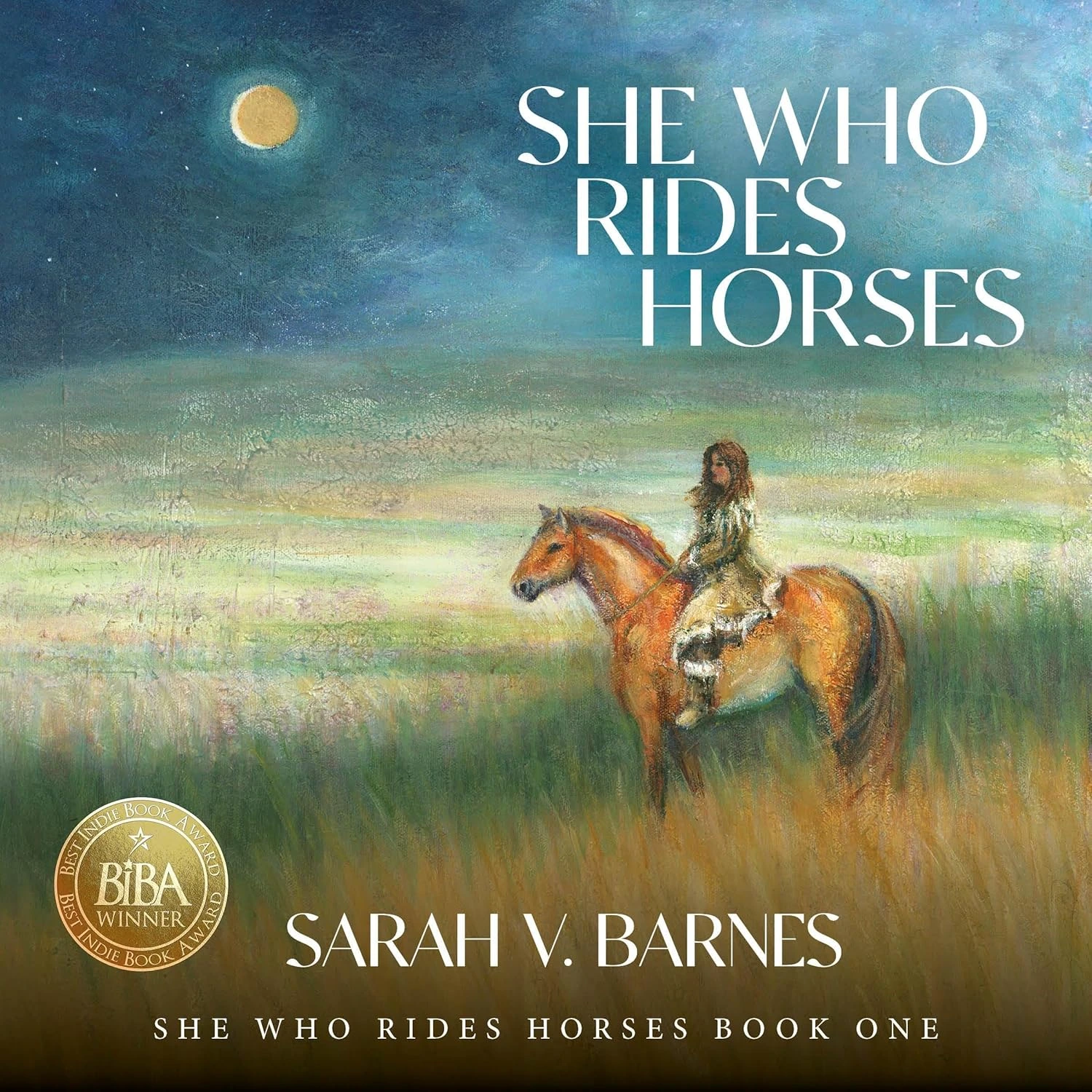
She Who Rides Horses, Book One: A Saga of the Ancient Steppe by Sarah V. Barnes
For most of human history, horses have carried us farther than our own legs ever could. They have borne us across continents, through wars and migrations, and into stories and mythologies that define entire cultures. The partnership between horse and rider feels so natural today that it is easy to forget it had a beginning.
But on the ancient Pontic-Caspian Steppe — a vast sea of grass stretching across modern Eastern Europe into Central Asia — horses were once simply another animal in the landscape, hunted for meat like any other game. In She Who Rides Horses, Book One: A Saga of the Ancient Steppe, Sarah V. Barnes imagines the moment when that relationship changed forever.
The story follows 14-year-old Naya, the daughter of a clan chief, who dares to imagine something no one around her believes possible: that a human might one day ride a horse. Rebelling against the social expectations of her clan, Naya shirks her duties as a young woman, preferring to spend her time out on the open steppe observing the herds of horses. Soon, her dreams of getting closer to the animals begin to coalesce into a strong desire to sit astride their backs and fly like the wind across the grasslands — a bizarre idea, initially met by her family’s disapproval.
The Stray Arrow of Fate
Nevertheless, with the aid of Naya’s grandmother and mother, she finds convenient excuses to wander the landscape. She begins the slow, patient work of closing the distance between herself and one particular creature that captures her fancy — a beautiful filly she names Réhda. Drawn to the filly by their shared attribute of chestnut-red hair, Naya follows the herd as they wander the plains and the waterways near her clan’s summer encampment.
One day, just as she is making significant progress in inching closer to the horses, she is struck by an arrow shot by a 16-year-old hunter, Aytal, who mistakes her for a member of the herd. From that moment on, her life will never be the same again.
As her clan makes preparations to migrate south to their winter camp, Naya is forced to stay behind and recover in the company of her mother, Sata, and two strangers from a different clan — the young archer and his father, Oyuun. The winter will be harsh, food will be scarce, Naya’s recovery will be harrowing and long, but the hardships come with a gift: time with the horses.
A Coming-of-Age Tale Narrated by the Author
The newly released audiobook version of She Who Rides Horses, Book One: A Saga of the Ancient Steppe turns this epic coming-of-age tale into a compelling and evocative listen. Author Sarah V. Barnes does a remarkable job narrating her own book — no small feat when you consider what is required: a varied, situationally appropriate tone, clarity and pacing, representations of multiple characters, and the kind of emotional nuance that keeps listeners absorbed in their own imaginations as the story unfolds.
One of the great joys of Barnes’ writing is her poetic rendering of the steppes — at once a magical, sacred place and a harsh environment of predators and ill weather. This wonder extends to the spiritual aspects of Naya’s story: her dreams and visions and mystical bond with the horses. As in the archetypal vision quest, apart from her home, among nature, in deprived circumstances, Naya discovers who she is meant to become.
Alongside Naya, we follow the parallel coming of age of the young archer, Aytal. Troubled by having nearly killed Naya, Aytal strives to make amends, sacrificing much of himself in the process. As the two youngsters draw closer in confidence, the seeds of love begin to take root, a romance handled by Barnes with deft and delicate hand.
The Interlinked Fates of Humans and Horses
The horses also undergo transformation, from wild and skittish to trusting and even tame. It’s a long road before we arrive at this moment, but well worth the journey. Along the way, the development of the characters — human and animal alike — becomes inextricably intertwined. With Naya and her filly Réhda, it is sometimes difficult to ascertain who is taming whom. Aytal and his own favorite horse, Myräkkä, a young gray stallion who attempts to join the herd, are echoes of each other: both yearning for acceptance amid potentially hostile circumstances.
But She Who Rides Horses is something larger than a simple coming-of-age story. It is a meditation on patience, trust and the quiet revolutions that begin with a single daring idea. The bond that grows between Naya and Réhda feels less like conquest than partnership — a moment when two species begin to understand each other in a new way.
Barnes’ story reminds us that many of the turning points in human history likely began just like this: not with grand declarations or bold actions, but with curiosity, courage and the willingness of someone young enough to imagine a different world.
Long before horses carried warriors, traders and explorers across the steppes and beyond, there may well have been a girl standing in the tall grass, reaching out a cautious hand — and a horse willing, at last, to meet it.
CHECK OUT THE AUDIOBOOK TRAILER
About Sarah V. Barnes
 Critically acclaimed, award-winning novelist Sarah V. Barnes is both a historian and a horsewoman. Her first novel, She Who Rides Horses: A Saga of the Ancient Steppe, received the 2022 Best Indie Book Award for Historical Fiction, among other prizes. A Clan Chief’s Daughter represents the second installment in the She Who Rides Horses trilogy. When not writing stories, Sarah practices and teaches riding as a meditative art. She also offers equine-facilitated coaching and wellness workshops. Sarah holds a Ph.D. in history from Northwestern University and spent many years as a college professor before turning full-time to riding and writing. She has two grown daughters and lives with her husband, her dogs, and her horses near Boulder, CO.
Buy this Book!
Amazon