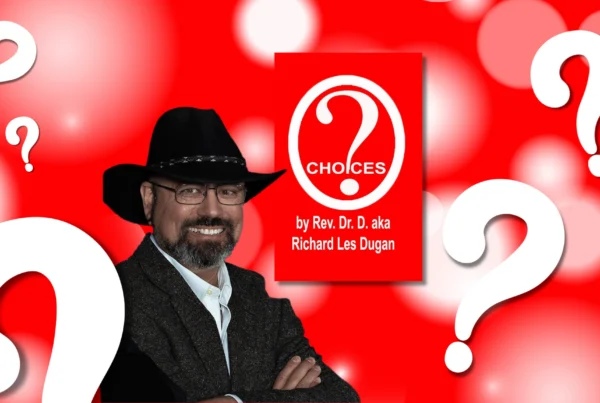

What inspired you to write Choosing Emotions, and how did your personal experiences shape the insights you included in the book?
When my daughter was in 8th grade, she had shown that she was a good student, and so instead of my simply giving her an allowance, I gave her an opportunity to earn an even bigger allowance by answering prepared questions that I brought to dinner. The questions could be about any topic — music, science, math, literature, geography or history. For every right answer, she earned a $2 bill. It became a game we came to revere as ‘College Bowl.’ We laughed a lot, and we each looked forward to it. One night when she was in 10th grade, she turned the tables on me and asked if she could ask the questions, starting with ‘What is depression?’ I swallowed hard because I recognized that she was asking something serious, and as her dad, I did not know the first thing about depression. So, I promised to do some research and dug in for two solid weeks to get some usable answers. The best answers I found were from writers who described what depression felt like in their own words and how they got through it. These quotes and phrases developed into what later became the ‘subjective’ experiences and phrases used in the book to describe not only ‘depression’ but all emotions. We were on to something meaningful by taking this approach, and nine years later the book had expanded from one emotion — depression — to over 250 different emotions. This ‘subjective explanation + experts’ approach had not been taken before, and the book has resonated widely about emotions across the full spectrum – from emotional challenges like depression, anxiety and OCD to upbeat and happy emotions too. Writers and content creators really love it too. P.S — My daughter has thrived and is now a registered nurse in high-risk obstetrics at a major hospital.
Can you explain the importance of emotional understanding in navigating life’s challenges, as discussed in your book?
There is major agreement in mainstream science (the top voices in psychology, neuroscience, linguistics, engineering and psychiatry all agree) that we can deal with problems and life far better when we have the right words to describe how we feel. But oddly, this agreement has not quite reached mainstream awareness. The implication is that by expanding our emotional vocabulary even a little, we can better tackle our problems and live happier lives. A case in point is that the average American believes there are fewer than 30 emotions — and yet there are easily a few hundred of them. So, the book has emerged as the most comprehensive reference on emotions — as expressed in everyday language — in the English language. And it is fun to see how expressing complex emotions can be reduced to simple everyday terms. There is great relief in cutting problems down to size. As one of America’s greatest engineers described it, “A problem well-stated is a problem half-solved.” And as one of America’s top best-selling MDs said it even more simply in just 5 words: “Name it to tame it.” The book has been described as ‘like an old friend who helps you spot what you’re thinking.’
What methods or strategies do you recommend for readers to better connect with their emotions and those of others?
Historically, dictionaries have always described emotions in scientific or so-called objective terms — that is, what the emotion looks like to other people, or how it can be measured by someone else. But emotions are subjective — they are your own experience, not what they look like to someone else. An emotion to you is what you feel inside, not what a scientist might be able to see or measure from across the room. So, for the first time we have introduced in Choosing Emotions also what emotions feel like from the inside, along with what veteran experts who have actually experienced that emotion have said it felt like to them. This has been something very new and different. Seeing how others have dealt with what you are feeling can be very big. This goes for both challenges and uplifting situations too. Here are a few simple examples of the difference between the traditional objective definitions of how emotions are seen by others and the new subjective emotions of how they feel inside to you:
- Objectively, a person’s behavior might be described as ‘tightly constrained,’ while subjectively that person could feel they have ‘no wiggle room.’
- Objectively, a person might be said to have a ‘tendency to create upsets,’ while subjectively they might feel an urge to ‘rock the boat.’
- Objectively, a person might demonstrate ‘tentativeness or caution,’ while subjectively, they might describe their behavior as ‘walking on eggshells.’
Choosing Emotions is the first book to document thousands of these subjective alternates alongside standard objective emotional descriptions, and the book can be an enormous help in therapy (and in content creativity) because subjective phrases more closely mimic a person’s internal ‘soundtrack’ or the voice in their head.
How do you believe that reflection and connection play roles in a person’s emotional growth, based on your findings?
The use of subjective/experiential phrases (as compared to traditional objective/scientific terms) can go a very long way in helping you enjoy your emotions and your life. Surprisingly, William Shakespeare is now acknowledged as the most influential originator of using subjective emotional phrases to communicate clearly and powerfully. Four hundred years later, hundreds of his subjective emotional phrases are still used every day across America, such as ‘cold-blooded,’ ‘wild goose chase,’ ‘break the ice,’ ‘it’s Greek to me,’ ‘swagger’ and ‘good riddance.’ These are fun, powerful and memorable emotional phrases, and their surviving over 400 years shows how beautifully they reduce complex concepts to ‘nailed it’ smaller phrases. He was even the first to introduce the word ‘lonely’ in one of his dramas named Coriolanus. His audiences — and now the whole world — have adored him. Just think of that.
Were there any specific quotes or wisdom from others that greatly influenced your writing process or the themes of the book?
One of the early quotes that really got my attention was in an address by Winston Churchill to the British people while they were under nightly bombardment during WWII: “Fear is a reaction. Courage is a decision.” Just 8 words, but he described a truly fundamental and resonant aspect of emotions generally and what it means to be human. Another that resonated powerfully was Dr. Dan Siegel’s epic quote, ‘Name it to tame it.’ Those five words changed my life, and they might change yours. And another is an offering of my own, which describes the wonderful coping power of humor and laughter: “If you can laugh at an emotion, it does not control you.”
In what ways do you think Choosing Emotions contributes to the conversation about mental health and emotional well-being?
The title itself poses a worthy goal to get out of a reactive mindset and to realize that we can choose our emotions. Even that initial awareness puts us on a different path toward being a victor and not a victim. The book’s goal is to ‘make friends with your emotions’ and to help do that by uniting our head (objective thought) with the heart (subjective feeling). There is great power and purpose when we align our head and our heart together to help create our emotions. This is what emotional coherence and emotional literacy are about. In order to have emotional literacy, we need better words to express what we are feeling. By addressing over 250 emotions through over 8,000 ‘heart-based’ subjective phrases and expert quotes, the book provides the long-overdue internal definitions and vocabulary to make that a lot easier. And it’s very fun to read.
What do you hope readers take away from Choosing Emotions in terms of their own emotional journeys?
Emotions can be compared in several ways to our internal navigational system. By this, I mean they serve somewhat like a computer’s dual-purpose operating system, which is first to receive inputs and protect us but then also to help us to advance and enjoy life. All too often, we think of emotions as merely reactive — to pain, fear, anger or upset. But emotions also include curiosity, enjoyment, enthusiasm, love, wonder and happiness. The awareness that we can consciously choose them and not merely react is very subtle but very empowering. When we are at our best, we are choosing them. We can and should be victors and not victims.