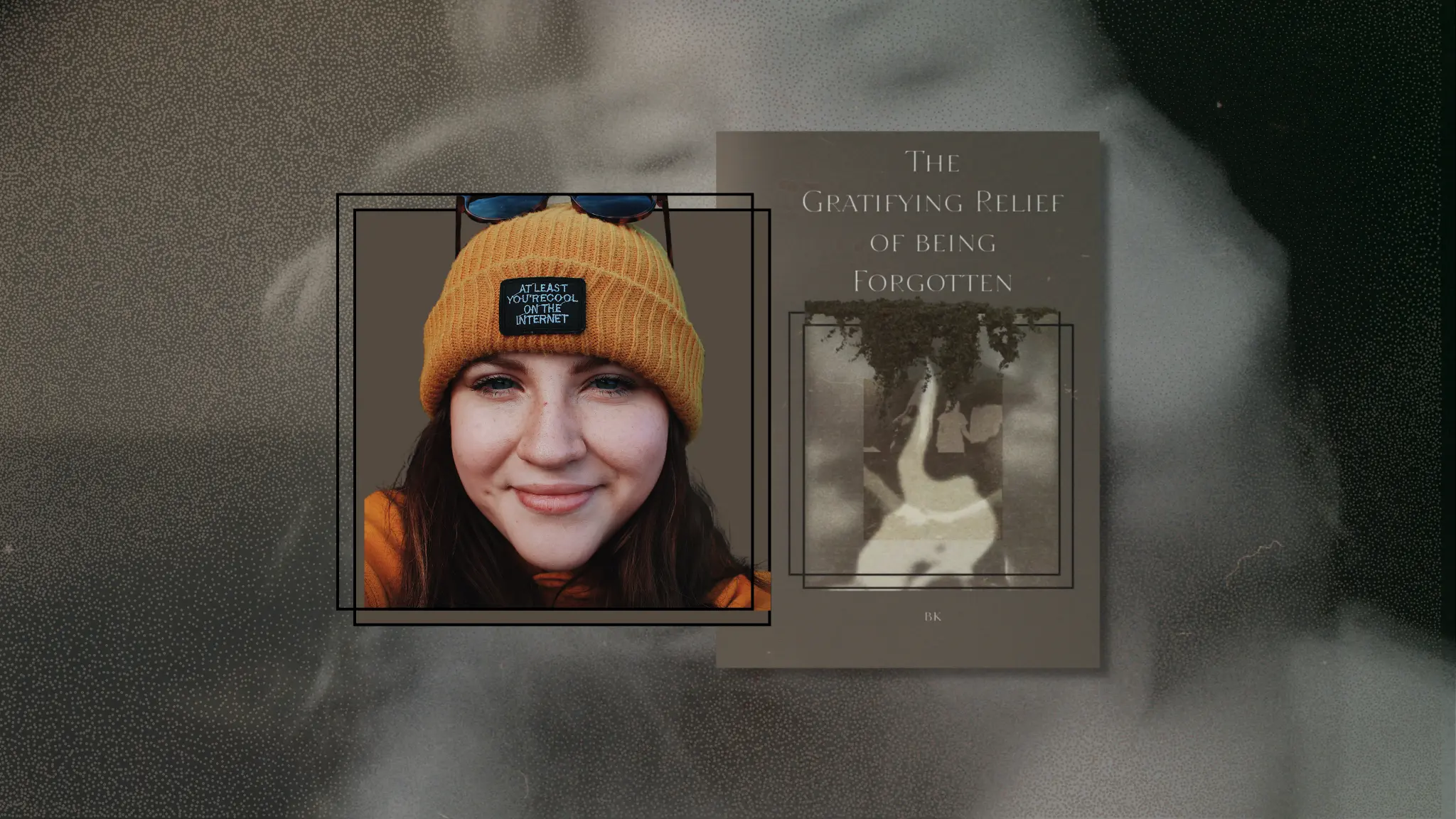
- What inspired you to explore the themes of love and loss in your writing, particularly the idea of finding relief in being forgotten?
What has inspired me most to write about love and loss is experiencing these things myself, and wanting to put them on paper in a way that could be tangible to anyone, whether they have experienced them or not. I have always had a longing to be understood, and my being able to write about love and loss in such an articulate and succinct way has helped me greatly in that way. To put something as big as love or loss into just a few words, and for it to get the message across perfectly, is something I have always had an appreciation for. I had felt lonely for most of my life, even in my marriage, and I had a lot in me that I wanted to be seen. I had struggled with the thought that it would be better if I were gone. If I were to be forgotten completely in death, instead of being forgotten in life. I enjoyed the idea of being something for nature to consume, because nature holds no bias. Everyone belongs to nature and will eventually return to it, and that helped with the chronic loneliness I felt. That in nature, I could be something I had never felt— needed.
2. Can you describe your writing process? Do you have any specific rituals or routines that help you create this poetry?
I don’t have any specific process, usually what happens is I will think of a subject and maybe a word, and try to build around that. Most of my poems come to me at night when I am trying to sleep, maybe a word or two. I have gone through spurts of writing where I am inspired constantly, this usually comes after I am extremely moved by something I have witnessed. Such as a song, a movie, a life event. Oftentimes I just sit down with a pencil and paper (so I can revise), and just write whatever comes to me. This allows me to flesh out all the “bad” writing and make it into something I would find to be more artistic and emotionally dense. I think there was a time I wrote about 10 poems in one sitting that were nearly perfect on the first try. It helps me so much to actually see it on paper, and publishing this book has given me the opportunity to give the readers that experience as well.
3. Your work frequently connects with nature as a source of solace. How do you think our relationship with the natural world impacts our emotional journeys?
Because I was raised in a rural area, I was outside for most of my childhood. We took drives in the woods and went camping all the time. I have always been connected to nature in a special way. My mother had a beautiful garden and my father has always loved being out in the woods. As a result of that, I have cultivated an appreciation for the world that holds us. I believe it’s incredibly important for people to get out and connect with nature, it’s a great way to help yourself get out of your own head and start to appreciate what we all have. I believe that if you live in an area where you don’t have direct access to even the smallest bit of nature, it can create a hostile environment in your own self. Being out in the world, places that belong only to the earth that no man has built upon, gives the mind a type of freedom that is not provided by anything else. It’s so helpful, I think, to embrace the world from time to time and remind yourself that beauty is something that occurs naturally, and it does not always need to be bought or structured.
4. Throughout your book, there are references to familial relationships, particularly with your parents. How have these relationships influenced your understanding of love and grief?
Family has always been an important pillar in my life. I have a fairly large family, and an even bigger circle of people that I consider to be family that care for me as if I am. I had the amazing privilege of growing up with two extremely loving parents who love each other and helped to lay the groundwork for me to lead a happy life. They showed me the beauty of nature and of God, and how the two intermix. We were not without issues, but they were the steady ground on which I could always stand. They taught me emotional maturity and that money is not something to be chased. And what matters most is being a good person. Most of my parents teaching comes from the values that are taught by our religion (Jehovah’s Witnesses). While this does have a heavy influence on my overall conduct and writing, I chose to focus on wording and structure that anyone can relate to no matter their circumstance or upbringing. My parents are the type of people that show up, whether it be for the good or the bad, they make sure to be there for anyone who might need them. I have such a deep appreciation for them as individuals, and I’m so privileged that I get to be their daughter.
5. You convey a strong sense of vulnerability in your writing. How do you navigate sharing such personal experiences and emotions with your readers?
Something my father said to me once in reference to the possibility of being judged was, “They can think what they want, I know who I am.” This really stuck with me, and I asked myself if I knew who I was. And eventually after trial and error, I slipped into who I have always been, and that version of me has been there since my childhood. Sometimes I made myself small for others, and while that was never ideal, it taught me to make room for people. Since realizing who I am, I live so peacefully, and I am able to be that steady ground for myself and others around me. I used to be terrified of even existing, I struggled with embarrassment over everything. Now I know that the human existence goes far beyond being perceived by others. What matters is how you see yourself, and once you like what you see, you won’t be worried about what anyone else thinks. I think sharing my personal experiences and showing vulnerability to the readers could inspire them to explore those feelings within themselves. I have learned over the years that the human experience, while unique to every person, has vast shared experiences. Everyone will experience love, loss, pain and joy. How they react to those things may be different but the fundamentals remain the same. And I can only hope that my writing can shine a light on these experiences and make even just a few people feel a little less lonely.
6. The concept of self-worth appears to be a recurring theme in your work. What do you hope readers take away regarding the complexities of self-identity and validation?
I have always struggled with my own self worth, thinking that I was only something to be used. I became okay with that idea, and I shrunk into oblivion. After my husband died, I realized I didn’t need to shrink, in fact, I needed to become someone, something bigger and louder for my daughter. I didn’t want her to grow up with a mother that was emotionally large with nowhere to put it. I didn’t want her to have to bear the burden of making sure I was okay. Children should be allowed to be children, and not their parents’ go-to therapist. I learned that you cannot attach yourself so completely to someone or something, in a way that makes you completely dependent on them and defines your own existence. Find things you enjoy, integrate them into your life but do not become consumed by them, be able to be defined by your conduct. I know not everyone can have the experience I did, so I wanted to write it down, and possibly help someone realize that they are in charge of becoming. They bear that responsibility. I want to inspire readers to find worth in everything, and then inevitably find it in themselves. Because having that self respect and self worth will decide their future, and the future of those who come after them. They should not become rubble for their children or others to pick up and rebuild and take care of. They should build that structure within themselves. This is not to say they shouldn’t make room for others, or build others up when they need it. I saw a lovely quote on the internet that said, “If you want a village, you have to be a villager.” I think that goes perfectly with this question. You need to show up for others in order for them to show up for you, and in doing that, you are cultivating your own self worth.
7. In your exploration of mortality and acceptance, what message do you hope to convey about embracing life’s bittersweet moments?
What I went through was earth shattering, and being so young, I hadn’t gained the life skills yet to properly absorb it all. I realized after a little while that I didn’t have to do it all at once. I could let the grief move through me at its own pace. I realized that life did in fact still hold beauty, and realizing that is something that saved me a great deal of pain. Even in the throes of grief, I made it a point to notice when the sky was beautiful, when the grass was especially green, when the birds sang and when the sky opened up to shine light on the rain. While I might never fully recover from what has happened to me, I can work to be one of those beautiful things about life. I can be someone for others to look to, and I can be a lighthouse in a storm. I haven’t got it all figured out, and something that helps with that is that I can accept that I may never have it figured out. Life, death, all these giant things you encounter throughout your life cannot ever be fully understood or “figured out”. All I have to do is appreciate what I do have, what I do know, and try my best to learn anything I can from the world around me. It grounds me back to the earth and keeps me from floating off into “what if’s.”
About BK:
 BK is a writer based in Central Oregon. At 21, she crafts introspective prose and poems that explore themes of spirituality, memory, nature, grief, and the complexities of identity. Her work is marked by a quiet lyricism and emotional depth, often reflecting on the interplay between solitude, belonging, and the natural world. Writing from a place of reflection rather that performance, BK seeks to illuminate the quiet beauty found in ordinary moments.