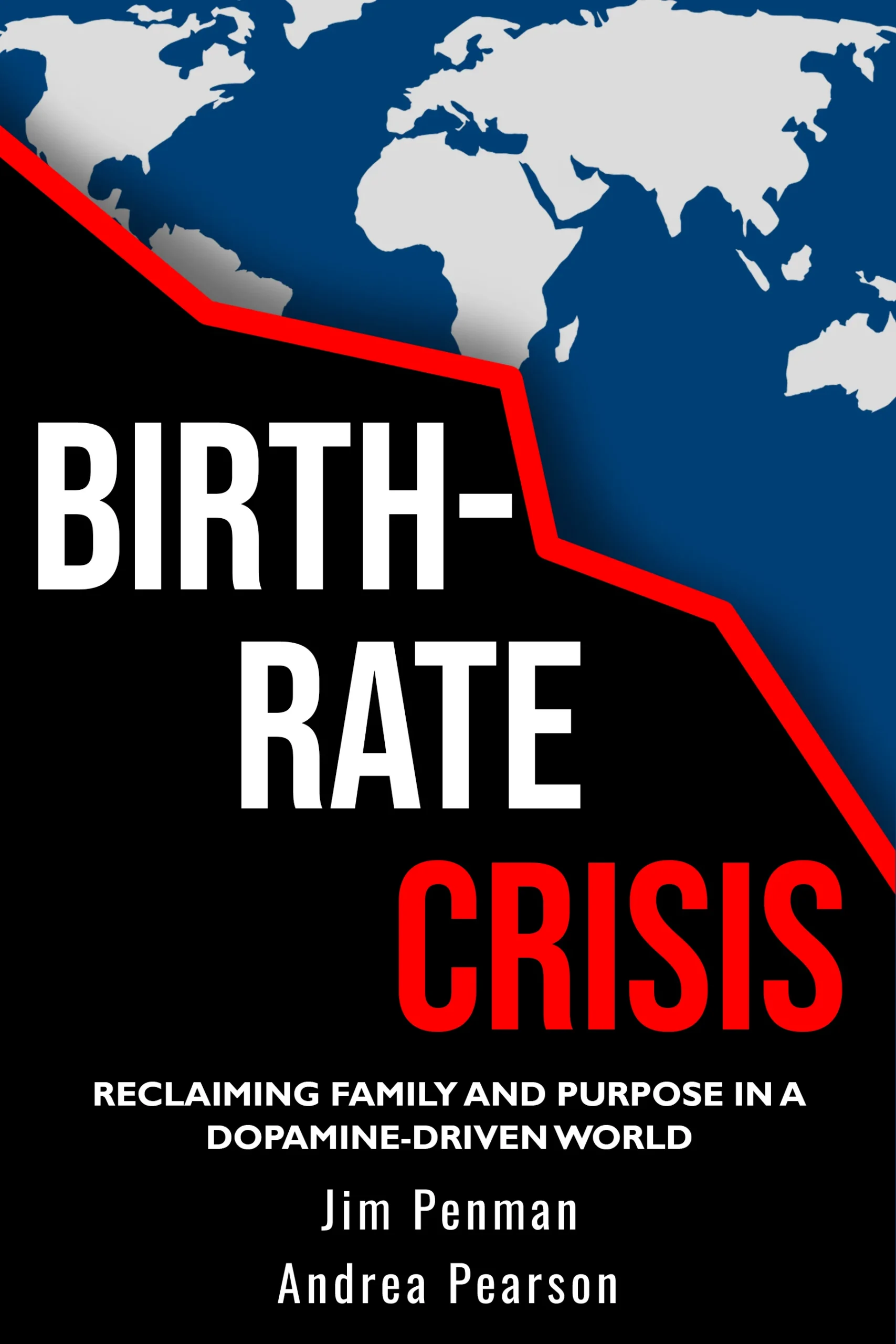

Birth-Rate Crisis: Reclaiming Family and Purpose in a Dopamine-Driven World by Jim Penman and Andrea Pearson
Many people imagine a future with children, only to end up with a smaller family than they hoped for — or no children at all. Money, relationships, health and timing can each play a part. But why is this gap between hope and reality appearing across so many societies?
In Birth-Rate Crisis: Reclaiming Family and Purpose in a Dopamine-Driven World, Jim Penman and Andrea Pearson investigate that question through demographic trends, history, neuroscience and their own experiences of parenthood. They acknowledge the practical obstacles to raising children while asking whether we’re missing a larger piece of the puzzle — how the trappings of modern life are also changing how much we enjoy it.
A Question With Personal Stakes
Penman, the Australian entrepreneur behind the Jim’s Mowing franchise, is a father of ten who has loved spending time with children since he began babysitting as a teenager. Pearson grew up as one of seven kids and envisioned having eight to twelve children herself. Relationship setbacks, health challenges, miscarriages and unsuccessful fertility treatments ultimately left her with three.
Pearson’s account is particularly moving because she did not casually postpone her dream of motherhood. She pursued it, and life intervened. Her story adds a perspective to the discussion of delayed childbearing that statistics alone cannot provide.
While delayed childbearing naturally limits the number of children a couple can have, there’s also the question of what childrearing is like today. The daily pressures of parenting seem to be increasing, while the support needed to ease them is declining. Academic competition, organized activities and constant supervision can turn raising children into an exhausting, never-ending marathon. Meanwhile, parents often live far from relatives and lack nearby adults who can lend a hand. “It takes a village,” as the saying goes, but what happens when that village becomes fragmented or nearly nonexistent?
What Makes Family Life Rewarding?
The authors argue that financial assistance, though useful, cannot fully explain or reverse declining fertility. Governments have spent heavily on incentives, yet many countries continue to struggle with low birth rates.
Penman proposes a biological explanation. His framework distinguishes intense dopamine “surges,” associated with activities such as gambling, compulsive scrolling and pursuing status, from the gentler “ebb and flow” of familiar relationships and steady accomplishments. He theorizes that repeated overstimulation reduces dopamine sensitivity, making activities such as caring for children or completing routine work less satisfying.
The book explains this distinction in plain language, then explores it from several directions. Ancient Roman concerns about childlessness offer an intriguing comparison with modern efforts to encourage births. Penman also challenges familiar explanations of the postwar baby boom, proposing that Depression-era childhood experiences helped shape a generation more inclined toward family life.
The chapters on the Amish, Latter-day Saints and Orthodox Jewish communities are especially interesting when read together. These groups engage with modern society to different degrees, yet share practices that reinforce family commitments and provide practical assistance to parents. The authors interpret those practices through their dopamine theory while describing how they work in everyday life.
From Daily Habits to Further Research
Short sections, charts and personal accounts keep the book approachable as it moves between demographic data and biological explanations. Penman’s enthusiasm for fatherhood and satisfying work gives the discussion a friendly, conversational voice.
Readers will also find helpful parenting advice in these pages. Giving children meaningful chores, allowing more independent play, putting phones aside and spending time with friends are some concrete ways to make family life less pressured and more enjoyable.
The closing chapters explore possible biological treatments that might help restore sensitivity to ordinary rewards. These proposals remain avenues for investigation. The authors acknowledge limitations, reject coercion and emphasize that medical interventions would still need to accompany healthier habits and supportive relationships. The authors encourage researchers to test and refine their theories, an effort Penman is already advancing by funding research into biology and behavior.
Birth-Rate Crisis explores the connections between population decline, life inside families and the neurological effects of modern distraction. Its insightful study of close-knit communities and parenting styles offers concrete ways to make raising children feel more manageable and more rewarding today, while its call for research into possible biological treatments offers hope for the future.
Birth-Rate Crisis is available to purchase here.
About Jim Penman
 Jim Penman is one of Australia’s best-known entrepreneurs and the founder of Jim’s Group, the largest franchise organization in the Southern Hemisphere, with more than 5,700 franchisees across Australia, New Zealand, and Canada. While earning his PhD in history at La Trobe University, he developed a deep interest in the biological drivers of social change, leading him to fund an international research program in neuroscience and epigenetics that has produced numerous peer-reviewed publications. A bestselling author and sought-after speaker, Jim is also a devoted husband and father of ten, believing that true success is measured not by wealth, but by family, purpose, and the legacy we leave behind.
About Andrea Pearson
 Andrea Pearson is a USA Today bestselling author, speaker, entrepreneur, and podcast host with more than 15 years of professional writing and public speaking experience. She has authored more than 85 books and over two million published words under three pen names. A lifelong student of human behavior with a deep interest in marriage, family, and parenthood, Andrea considers her greatest accomplishments to be found in her family, believing that nothing compares to the joy she shares with her husband and their three children.