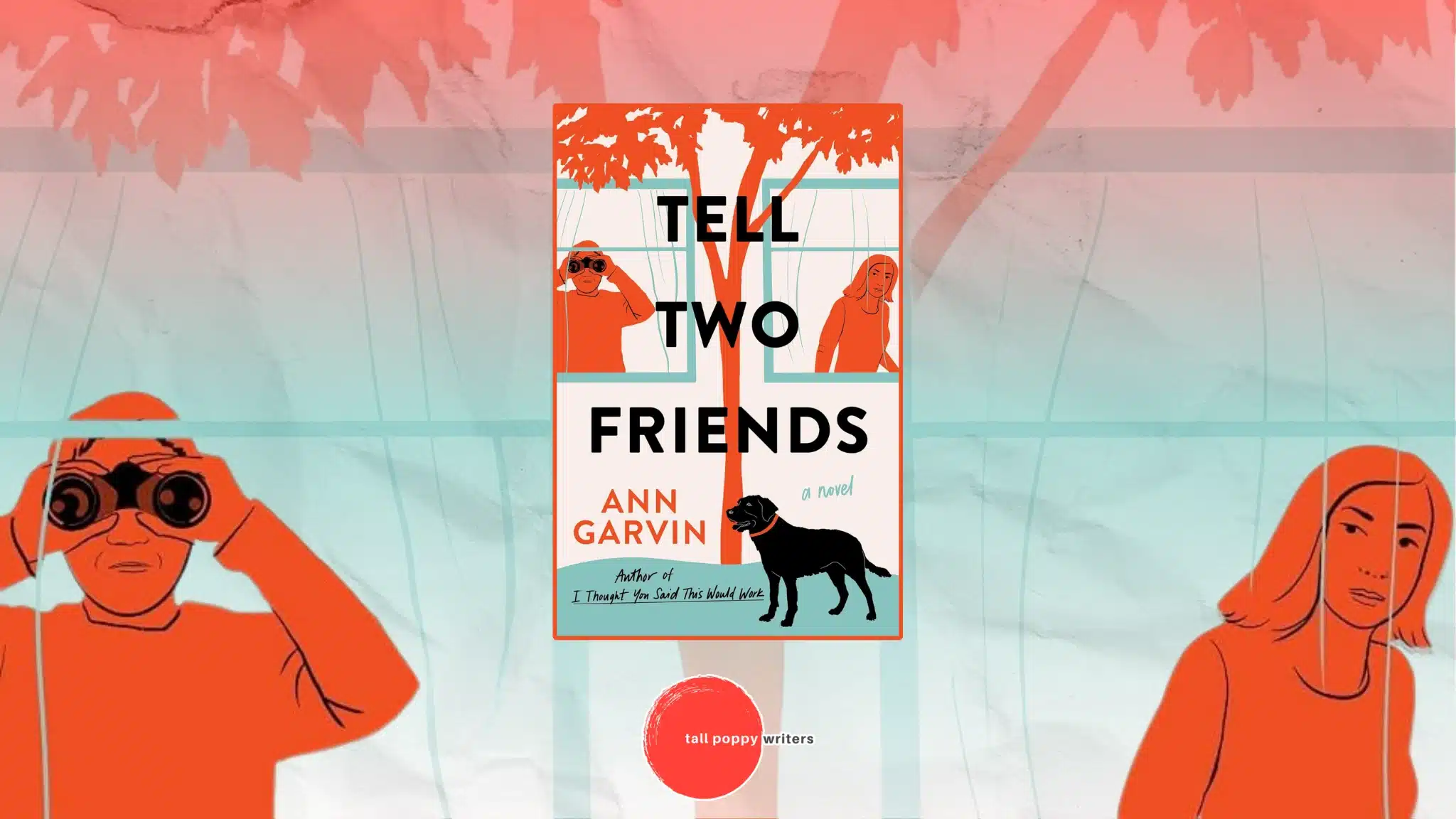
Ann Garvin’s new novel, Tell Two Friends, features a handful of her hallmarks: laugh-out-loud humor, deep friendship between women, a charmingly flawed yet relatable main character, and circumstances that feel impossible to navigate.
But Tell Two Friends marks a departure for Garvin. Notably, she braids elements of suspense and foreboding into her story, which gives it a gritty vibe not found in her other books.
Does this new Garvin edginess work? As they say in Norway, Ja.
Jane Baye, Garvin’s heroine, is a physics professor and doting aunt to 15-year-old Cricket. She’s also the former pen pal of Truman the felon. Unbeknownst to Jane, Truman has been released from prison and is living in the apartment building next door, where he’s watching her every move. Truman is creepy, for sure, but Jane is too preoccupied to notice. After all, she’s fretting about her deceitful ex-husband, who’s turned half their small town against her. And don’t even get her started on the app she has to create for work—and the prep she still needs to do for the upcoming Norwegian heritage festival. There’s lefse to make, by golly!
As Truman formulates his “plan” for Jane and Cricket (the reader isn’t privy to all the details, but it feels sinister), Garvin’s story revs up, and readers will find themselves growing increasingly unsettled. The crescendo of the book is both unexpected and satisfying, and that’s all I’m going to tell you because I don’t believe in spoilers.
I sat down with Garvin so we could discuss important topics like Scandinavian sweet treats, physics, and dogs. Her responses to my questions are as delightful and thought-provoking as Tell Two Friends itself.
Tell Two Friends is your seventh novel. Does it feel any different than the others?
Yes! With this one, I’ve leaned into suspense in a way I haven’t done before. I always like to have a little mystery or crime in my stories, but I’ve never had a book where I can definitely say that it’s thriller ish.
Tell Two Friends is funny, sad, and scary—a distinctive combination. What else feels funny, sad, and scary to you?
Getting sick. Every time I get sick, I find myself in an existential crisis where I’m pretty sure that it’s going to be a downhill slide for the rest of my life. I’m so dramatic, and it makes me laugh—like, this stuffy nose is going to be the end of me. But then I get terrified thinking about how life is so fragile and uncertain, and yet here we go, with so much hope for the future that we buy raspberries on a Tuesday, certain that we’ll be around on Wednesday to eat them.
Although you don’t have a lick of Norwegian blood in your veins, you embrace the Norwegian culture. Are you Team Norwegian Dance or Team Norwegian Baked Goods?
I’m on both teams. I’ve learned to make baked goods whose names I can’t pronounce, and I also have to do the dances that mimic calling in cows from the field. Both are exercises in loyalty and devotion.
Your main character, Jane, teaches physics. Did you take physics? What do you remember from class?
I took physics in high school and college. There’s a book called Quantum Physics for Poets, and I think about it all the time. The author, Leon M. Lederman, says that nature is lumpy, and what is more true than that?
Have you ever been pen pals with an incarcerated individual?
Yes, in college—just like Jane. He was lovely to me, even though I’m sure I sounded like an absolute child, naïve about how the world worked.
Jane must develop an app for work—specifically an app that helps users identify cheating behavior. It’s called “Is Your Husband My Husband?” If you could create an app, what would it be?
I would make an app that heralds unsung heroes, like nurses and physicians, who actually save lives. It would be like social media without an algorithm so that we could find and celebrate people the world doesn’t seem to care about.
Jane’s cheerful and precocious niece is a fountain of wisdom. What’s your favorite Cricket sound bite?
“No.” When she says no, she means no. It’s especially impressive coming from such a young person.
Some people might consider Jane to be a pushover—at least at first. What’s your own most regrettable pushover moment?
I hired someone to do the soffits on my old Victorian house. The guy told me I needed to pay him upfront so he could buy the equipment. He removed some of the soffits, and then I never saw him again. He left a really tall ladder and an air compressor with a broken wheel. didn’t know back then that you shouldn’t pay people up front, so he must’ve thought I was an easy mark. I felt so foolish.
Gunther is Jane’s pup, guaranteed to steal readers’ hearts. Have you ever written a novel that doesn’t feature a dog?
My first book, On Maggie’s Watch, doesn’t feature a dog, but that’s only because I didn’t have a dog at the time. I didn’t know back then that dogs are the key to a happy life.
What is lefse and why is it important?
Lefse is a flat potato pancake that can be eaten with butter and sugar or cinnamon and sugar, or you can wrap a hotdog in it. It’s made with potatoes, butter and lard, and you fry it in a lefse skillet, and it’s very, very Norwegian.
True or false: lefse is for lovers.
Absolutely true.