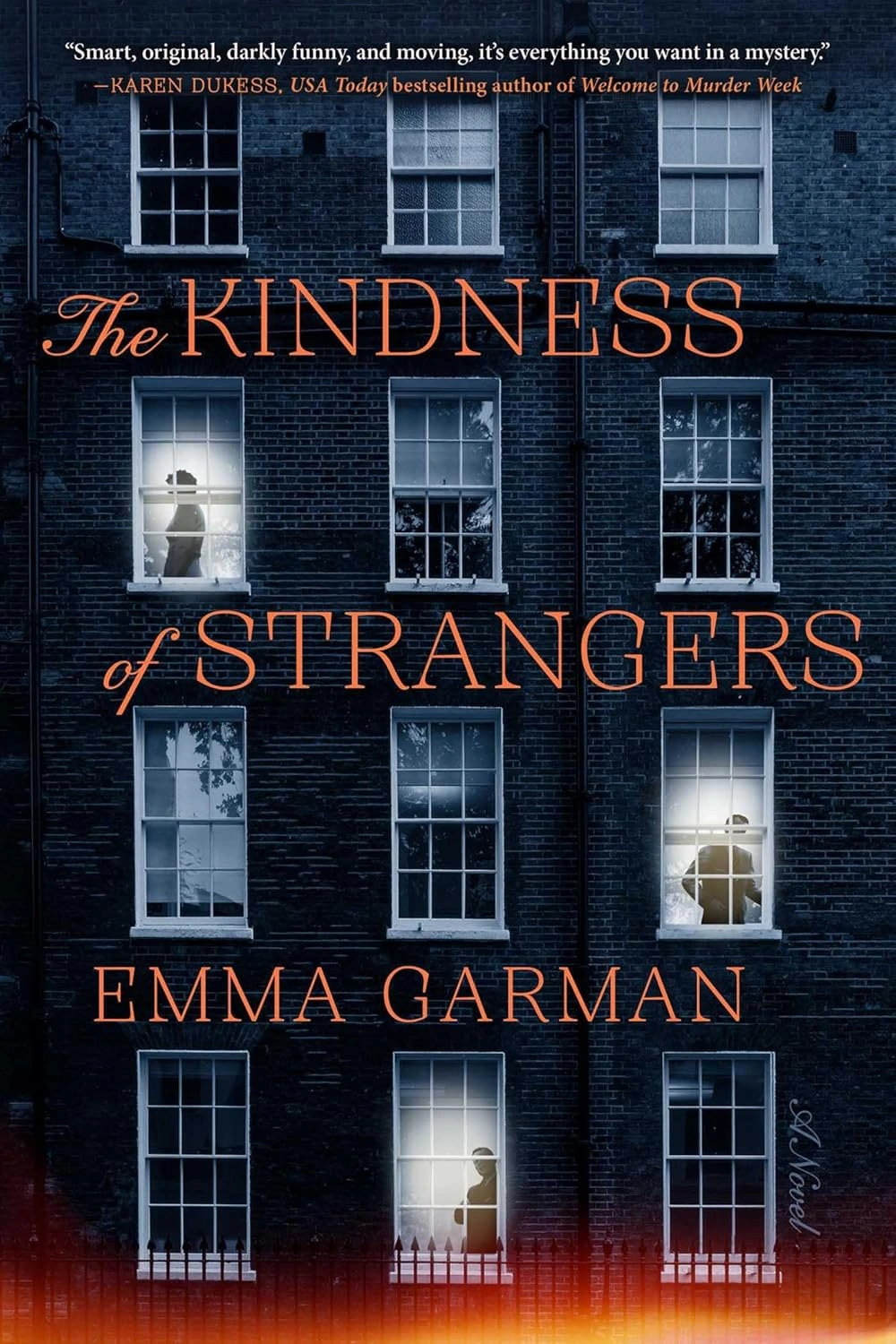
The Kindness of Strangers by Emma Garman
Jimmy was cold, paralyzingly cold, and sticky wet above the waist. Blood soaked his sweater, churned in his throat, filled his lungs. He tried to move, to turn onto his back, but an iron bar of pain held him in place. Circling above like seagulls’ squawks were voices discussing, with maddening dispassion, whether he was alive or dead. None of them tried to help. Why would they. To be rid of him was their dearest wish.
A House Full of Secrets
London, 1953. In Emma Garman’s The Kindness of Strangers, an eclectic assortment of lodgers live in the old Victorian house owned by the widow Mrs. Honor Wilson.
Robbie, 32, loiters on the fringe of the literary world, but wishes for more. George, 25, an artist’s model and debutante, is pregnant, but she’s not sure by whom. Mina, 17, works at a local cinema, attends a local charm school, and is intent on a glamorous career or a rich husband, whichever comes first. And Saul, a refugee and poet in his 40s, handsome, well-dressed, Jewish, has never gotten over being separated from his family during the war, though that hasn’t stopped him from having an affair with Honor.
The lodgers don’t realize it, but there is a reason Honor has selected each of them to live in her house. She knows their secrets (or thinks she does). Some of their secrets are from their past. Some of them are very much in their present. Few of them would look good in the open air.
That is why it’s so disturbing when a young man named Jimmy Sullivan moves into the house with them and starts vigorously stirring the pot. A flustered Honor claims he’s a family friend, but he certainly doesn’t act like a friend. What hold does he have over Honor? Why is he poking around in all their lives? Something must be done.
As you can tell by now, something very much is done, though by whom is not immediately clear. The only thing that is clear is that they will have to dispose of the body themselves. No one else must know.
That doesn’t mean their troubles are over, however. Jimmy may be dead, but his past isn’t. There are so many more secrets to be uncovered, not only about him, but about all of them. Many surprises await.
For you, too.
Crafting the Story Behind the Mystery
The Kindness of Strangers has already been drawing comparisons to Agatha Christie, Kate Atkinson, Richard Osman, even Alfred Hitchcock, but it is a book that is gloriously its own, one filled with twists, dark humor, and characters in a constant state of revelation. You’ll gulp it all down – and then wait impatiently for Emma Garman’s next book.
“I’ve always been drawn to stories, in real life and fiction, where people slip into new identities and leave their old selves behind,” says Garman. “What that says about me is probably a question for my therapist! But in this current age of hyper-surveillance and ineradicable online footprints, it’s fascinating to contemplate how easy it once was to reinvent yourself, as my heroine Honor does during World War II. War and displacement, of course, impose new lives on people: Honor’s lover Saul, a stateless Holocaust survivor, can’t integrate the ‘before’ and the ‘now’ within himself. As the tangled pasts of these two people took shape in my mind, it brought into focus the novel’s animating principle: the past has a habit of appearing in the rearview mirror, no matter how resolutely we may try to banish it.
“As for the setting, London rooming houses are a bygone phenomenon, and therefore intriguing to me. Up until the 1950s, it was commonplace for ‘grand’ period houses to be divided into cheap rented rooms, and no stigma was attached to living alongside strangers in this way. The figure of the resident landlady appeared in many British movies of the time as a recognizable cultural stereotype – a stereotype Honor defies!
“1953, when the main action takes place, was a strangely pivotal year in British history. A bill to reform abortion law was debated in Parliament (eventually leading to the Abortion Act in 1967). The Wolfenden Committee was formed to review laws against homosexuality, in the wake of high-profile arrests of men including Alan Turing and the actor John Gielgud. In January 1953, nineteen-year-old Derek Bentley was hanged for murder, a miscarriage of justice that was key to the eventual abolishment of capital punishment. And in March, the prolific serial killer John Christie was arrested, then hanged in July – a case that gripped the nation and reverberates in the public consciousness still. All these events came to be reflected, explicitly or otherwise, in The Kindness of Strangers.
“It was a challenge to keep everyone’s backstories straight,” says Garman, “and I would draw maps of crisscrossing lives/timelines to mentally grasp it. I don’t know if this is commonplace with novelists, but I see plot as a physical object, a shape in my mind’s eye, so I often need to doodle it on paper. I also did a lot of calculating of birthdates, ages and calendar years to make sure it all logically held together. I should add that I didn’t envisage it all ahead of time – I’d love to be a good outliner, but I’m not at all. Instead, I tinkered with the novel’s architecture as I progressed with the draft, often going back and retrofitting certain elements.”
As for the characters themselves, “It’s hard to avoid putting a bit of yourself in them – or more than a bit – and I’m sure it happens unconsciously. I might insist, ‘I have nothing in common with these people,’ while my friends might disagree. But also, I think I project certain qualities I’d like to possess onto my characters. Honor, George, and Mina are all tougher and braver than I am – they’re fighters and survivors, a breed of person I particularly admire. If I’m being candid, Robbie is probably the most like me – a neurotic overthinker, for whom insecurity and arrogance are two sides of the same coin! I will say that my main goal, when writing, was for each character to be wholly distinct. A not uncommon criticism from fiction reviewers and readers is that a cast of characters all think or sound the same, and this is presumed to be the voice of the author. I went out of my way to avoid that, and I hope I succeeded.”
In invoking that, Garman knows what she’s talking about. She herself is a literary critic and holds an MA in both creative writing and literature. How did all that affect the way she approached writing her novel?
“This is a great but difficult question! In a way, studying literature and reviewing fiction is quite poor training for writing novels – as a critic or scholar, you imagine you’re astutely weighing up the craft and skill of the novelist. Then you sit down to do it yourself, and you realize just how many tiny, difficult, consequential decisions are involved in conjuring a fictional world that’s even vaguely believable. The nuts and bolts of fiction can be taught and analyzed, and yet there are these ineffable dimensions to the practice that must be experienced firsthand. That said, doing a creative writing degree was for me very valuable – I progressed a lot, I think, from workshopping with fellow writers. The director of the creative writing program I attended at City College, novelist Linsey Abrams, was also a great source of inspiration and encouragement – being taken seriously as a writer by someone you respect is sometimes all you need to keep going.”
And she needed every bit of it. As she admits, “‘Odysseys, fraught with pitfalls’ is a terribly apt summation of my overall path to publication. I’d previously completed, and been agented for, many novels before this one. (We shall not talk about how many!).
“However, for The Kindness of Strangers, the process was astonishingly smooth. My wonderful agent, Cara Lee Simpson at Susanna Lea Associates London, offered to represent me and the novel as soon as I’d sent it to her. She then quickly sold it to Virago in the UK and Summit Books in the US – both dream publishers, staffed by people at the top of their game. So to anyone reading who’s feeling thwarted or despondent about their writing ambitions: publishing is the weirdest business, and you truly never know what’s going to happen.”
She does know what’s going to happen in her next book, though. “It’s set in a girls’ finishing school in 1967, just as the sexual revolution renders such places obsolete. The plot swirls around a possible haunting, a lost Shakespeare play, and a not-quite-forgotten 1920s tabloid scandal involving the school’s proprietress. My working elevator pitch is Hotel du Lac meetsThe Name of the Rose.”
Can’t wait.
About Emma Garman:
 Emma Garman, a Brighton-based writer and critic, has been a columnist for The Paris Review and a contributor to Literary Review, The Daily Beast, Lapham’s Quarterly, and History News Network. She has an MA in creative writing from the City College of New York and an MA in literature from Queen Mary University of London. The Kindness of Strangers is her debut novel.