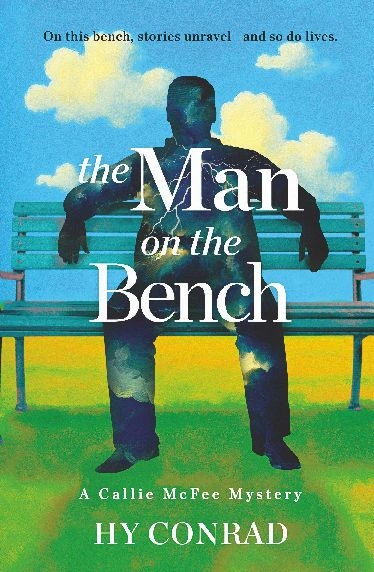
The Man on the Bench: A Callie McFee Mystery by Hy Conrad
In Hy Conrad‘s The Man on the Bench, sits Barney, a man on a bench who greets Callie with warmth and attention. He looks unhoused, yet he carries himself with an educated ease. He quotes poetry, he asks careful questions and he listens without rushing the conversation. Callie starts stopping for a chat. One stop becomes five days a week.
Callie does not stop only for company. She stops for relief. Her father, Lawrence “Buddy” McFee, still holds the aura of a Texas power broker, yet dementia has started to steal his sharpness in uneven bursts. Callie and her brother keep that truth close. Barney feels like the rare outsider who can hear it without turning it into gossip.
Conrad handles these early scenes with calm confidence. He builds trust the same way Callie does, through small details and repeat encounters. The bench becomes a private room in public. And Callie, a working journalist with a guarded streak, starts to unclip parts of herself.
A Murder That Turns Personal
Then Barney dies. He is shot near the bridge, and what looks like a grim but familiar tragedy turns personal in an instant. Callie identifies the body. Her brother, homicide detective State McFee, steps into the case. The grief strikes hard, yet the danger lands even harder.
State finds a detail that tightens the story’s grip. Barney carried a notepad, and Callie’s name sits on the page next to a few sharp reminders. Why would a man who looks like a casual listener keep notes at all? The answer matters. Someone wanted Barney silent.
Callie tries to process the loss in the only place that makes sense. She returns to the bench. She expects loneliness. She finds community instead. Other “bench buddies” appear, each with a different reason for trusting Barney and a different fear now that trust has ended in violence.
From here, Conrad widens the lens. The case starts in a park, then pushes into sleek buildings, tense interviews and the kind of public attention that makes every misstep costlier. The pacing stays tight, yet the book still takes time for character. That balance keeps the suspense grounded.
The Man on the Bench asks a blunt question: what do people owe the strangers who hold their private life for a few minutes? The book answers it through plot, not lectures. The more Callie learns about Barney, the more she has to rethink every conversation that felt safe.
Family, Power and Consequence
The result is a mystery with teeth and with conscience. The twists feel earned. The reveals arrive with emotional fallout, not just cleverness. And the final pieces snap into place in a way that rewards close attention.
Callie anchors the novel. She has grit, sharp instincts and a stubborn refusal to play the polite role people expect from Buddy McFee’s daughter. She too has vulnerabilities that feel human, not decorative. She worries about her drinking. She wrestles with insomnia. She second-guesses her own judgment, then keeps moving anyway.
State provides a counterweight. He is protective, blunt and practical. He knows procedure, yet he also knows the mess that family can bring into a case file. Their sibling bond adds humor and friction, especially in moments where Callie wants to help and State wants her safe.
Austin is not wallpaper here. Conrad uses the city’s mix of casual outdoor life and sharp social stratification to shape the mystery. The bench sits in an open public space, yet the secrets it collects come from every tier. Callie crosses from trails and food trucks to luxury residences and political back rooms. The contrast stays clear without turning into a speech.
The McFee Ranch adds another layer. It sits close to the city, yet it feels like its own small kingdom of history and influence. That setting lets the book blend domestic tension with investigative momentum, which keeps the story varied from first chapters to last.
This is the third Callie McFee mystery. The plot stands on its own.
Readers who love mysteries driven by relationships will find plenty to enjoy here. The puzzle never loses its shape, and the emotional arcs never feel tacked on. The ending delivers closure, then leaves you thinking about the bench itself. It is a small object, yet it holds an entire web of lives.
About Hy Conrad:
 Hy Conrad has made a career out of mayhem, earning a Scribe Award for best novel and garnering three Edgar nominations from the Mystery Writers of America. Along the way, he developed a horde of popular games and interactive films, hundreds of short stories and a dozen books of solvable mysteries, published in over a dozen languages.
Hy is best known for his eight seasons as writer/co-executive producer for the ground-breaking series, Monk. Other TV work includes White Collar, The Good Cop and the international hit, Mistry, the hit Hindi-language series based on Monk.
As a novelist, Hy authored the final four books in the Monk series, the Amy Travel Mysteries (Toured to Death, Dearly Departed and Death on the Patagonian Express) and the Callie McFee Mysteries (The Fixer’s Daughter, a Barnes & Noble bestseller, Sins of the Family and The Man on the Bench).The first two Callie McFee novels each won multiple awards, including the Independent Press Award and the NYC Big Book Award for Best Mystery.
All of Hy’s work is infused with humor, but his one foray into pure humor was the best-seller, Things Your Dog Doesn’t Want You to Know, co-authored with Jeff Johnson.
In the world of theatre, his produced works consist of Home Exchange (a mystery), Ta-Dah! (a musical), and Quarantine for Two (a socially distanced dark comedy about the pandemic). In a break from murder, Hy has penned and sold his first romcom, Write Me a Romance, which was sold to a major network in 2025.
When he looks up from his keyboard, Hy sees either the hills of Vermont or the palm trees of Key West, depending on the time of year. He also sees his husband, Jeff Johnson, plus Stella and Dyson, the latest in a dynasty of mini schnauzers.