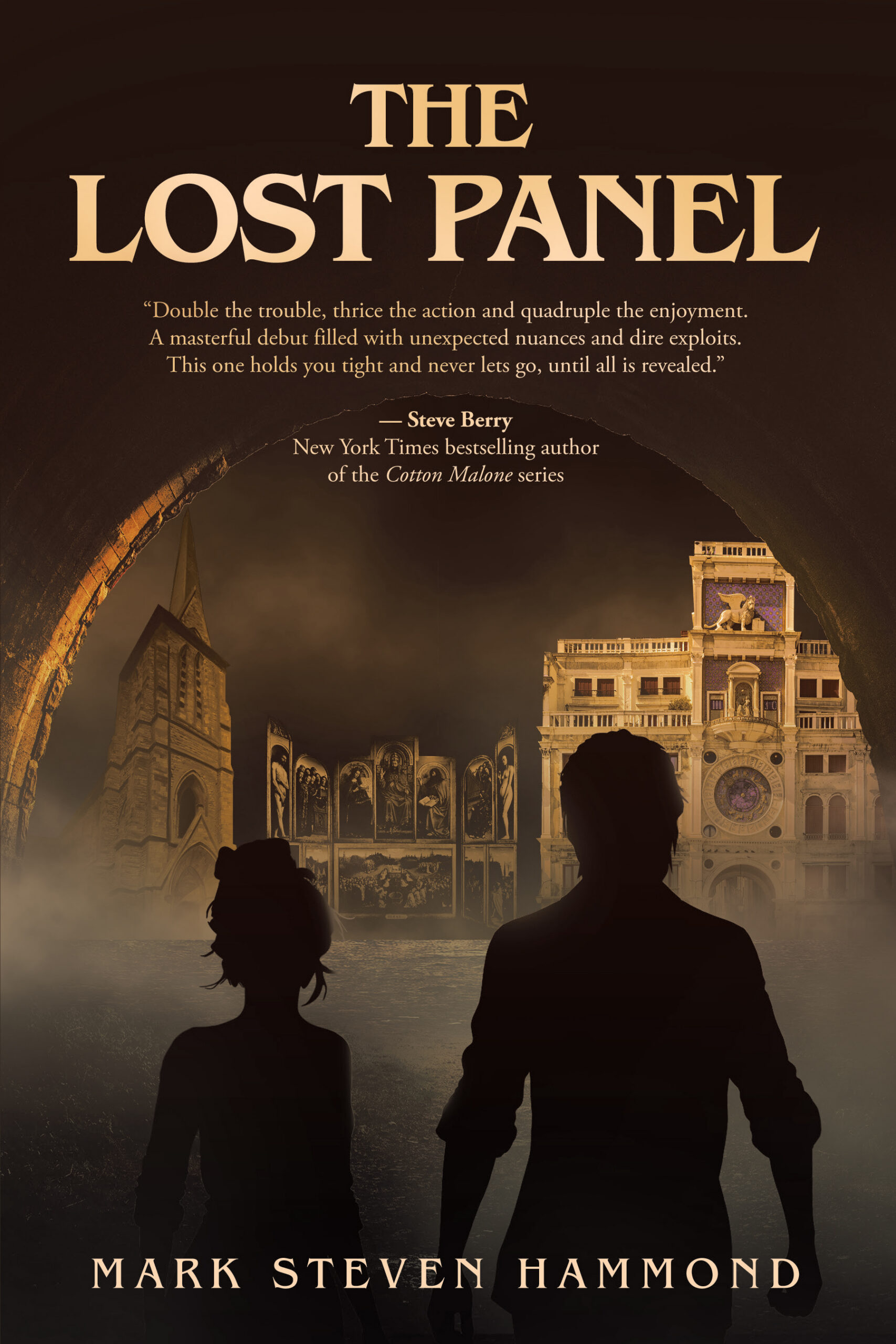
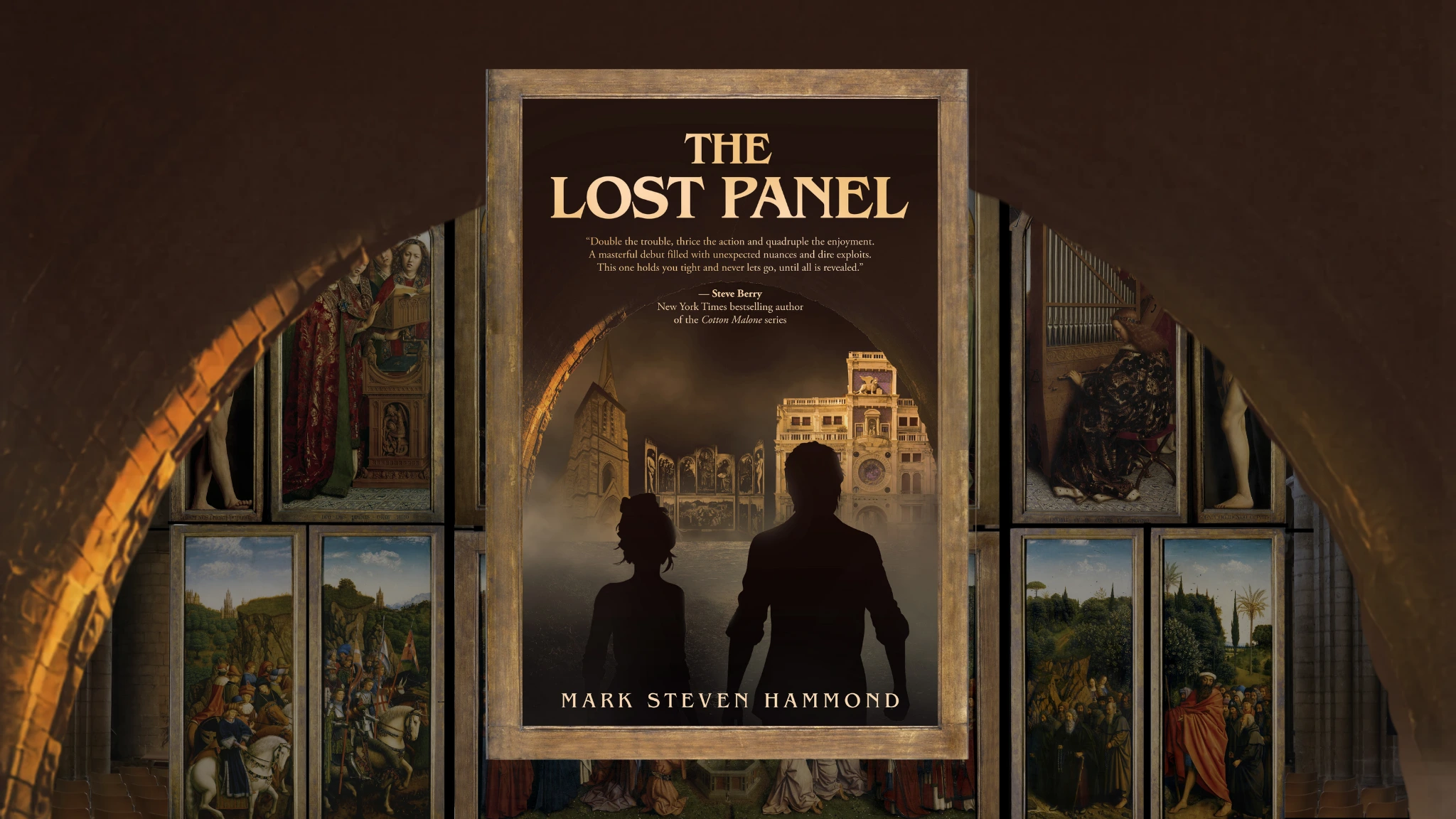
The Lost Panel by Mark Steven Hammond
Among the many treasures of Saint Bavo’s Cathedral in Ghent, Belgium, is a massive altarpiece painted by the Renaissance artist Jan van Eyck. Its many panels depict an array of biblical figures, saints, martyrs, soldiers, prophets, clergy, angels and other figures attending a pastoral scene at the center, where the Lamb of God bleeds from a wound into a golden chalice. It’s an awe-inspiring sight, and, as one of the earliest and most influential masterpieces of oil painting, it’s also an important work in the history of Western art.
But what many visitors to the cathedral don’t realize is that the altarpiece, at least in part, is a forgery. That’s because one of the panels has been missing for nearly a century. A meticulously crafted replica stands in its place instead.
A Daring Heist and Enduring Mystery
In April 1934, thieves stole the panel known as The Just Judges in what remains the greatest unsolved art theft in history. A ransom note followed. Then another. To prove their claim, the thieves returned the reverse side of the panel — an image of John the Baptist. Weeks later, a dying man confessed that he alone knew the panel’s location. He provided cryptic instructions. Investigators pursued the clues he left behind, but the painting was never found.
This is the historical setting behind Mark Steven Hammond’s novel, The Lost Panel. It’s a mystery rife with decades of theories about its location. Where might the thieves have hidden it? Hammond takes a different angle: what if the painting was hidden in plain sight?
The novel opens in 15th-century Bruges, where Jan van Eyck is not just a master painter but a covert operative, embedding secrets within his work under the patronage of powerful political forces. This prologue does more than set the tone — it reframes the altarpiece itself as something intentional, constructed not only as a religious object but as a vessel for hidden knowledge. From there, the narrative shifts to the present day, where a group of historians and researchers is drawn into the long-unresolved mystery of the missing panel.
At the center is Ryan, a driven and instinctive protagonist whose willingness to act propels the group forward — sometimes recklessly. He’s balanced by Sophia, an art historian whose expertise in Northern Renaissance painting gives the search both direction and credibility. Alongside them are Barbara and Matteo, each contributing specialized knowledge as the mystery expands beyond academic curiosity into something far more urgent.
An Intellectual Thriller That Doesn’t Skimp on Action
What begins as an investigation quickly becomes a high-stakes pursuit. The team follows a trail of historical clues, encoded messages and long-buried secrets that stretch across Europe and into the shadowy remnants of wartime history. As the story unfolds, the search becomes a race against unseen adversaries who are equally determined to uncover the truth. The tension escalates through a series of set pieces that blend intellectual puzzle-solving with kinetic action, from archival discoveries to high-speed chases. Throughout, Hammond returns to a central idea: in art, meaning is not always visible on the surface.
This concept is most compelling when the novel leans into the material reality of painting itself. Hammond shows a clear appreciation for the physicality of art — the layering of pigment, the behavior of varnish — as well as its capacity for conveying messages from one generation to the next. These details ground the story, giving weight to its more speculative elements and inviting readers to see art not just as an object of beauty, but as a medium capable of carrying secrets.
While the story moves at a brisk pace, Hammond balances this forward momentum with fascinating historical context that provides the novel with its intellectual appeal. Readers drawn to art history, religious symbolism or coded mysteries will find plenty to engage with here.
Thematically, the book explores the intersection of faith, power and knowledge, raising questions about who controls history and what is allowed to endure. It also plays with the idea of legacy — how meaning can be embedded, obscured and rediscovered over time. These elements add depth without overwhelming the central narrative, allowing the story to function both as a thriller and as a meditation on the enduring mysteries of art.
What ultimately sets The Lost Panel apart is its ability to transform a real-world enigma into a living, breathing narrative. Hammond doesn’t just revisit the mystery of the missing panel; he reimagines it, suggesting that what was lost may have been hidden for a reason — and that some works of art are not meant to be seen, but to be discovered.
About Mark Steven Hammond
 Mark Hammond, a serial tech entrepreneur and native San Diegan, divides his time between Laguna Beach and Las Vegas. He grew up riding his dirt bike on canyon trails, then racing vintage motocross nationally, chasing thrilling adventure and calculated risks — traits he shares with the protagonist of his debut novel, The Lost Panel.