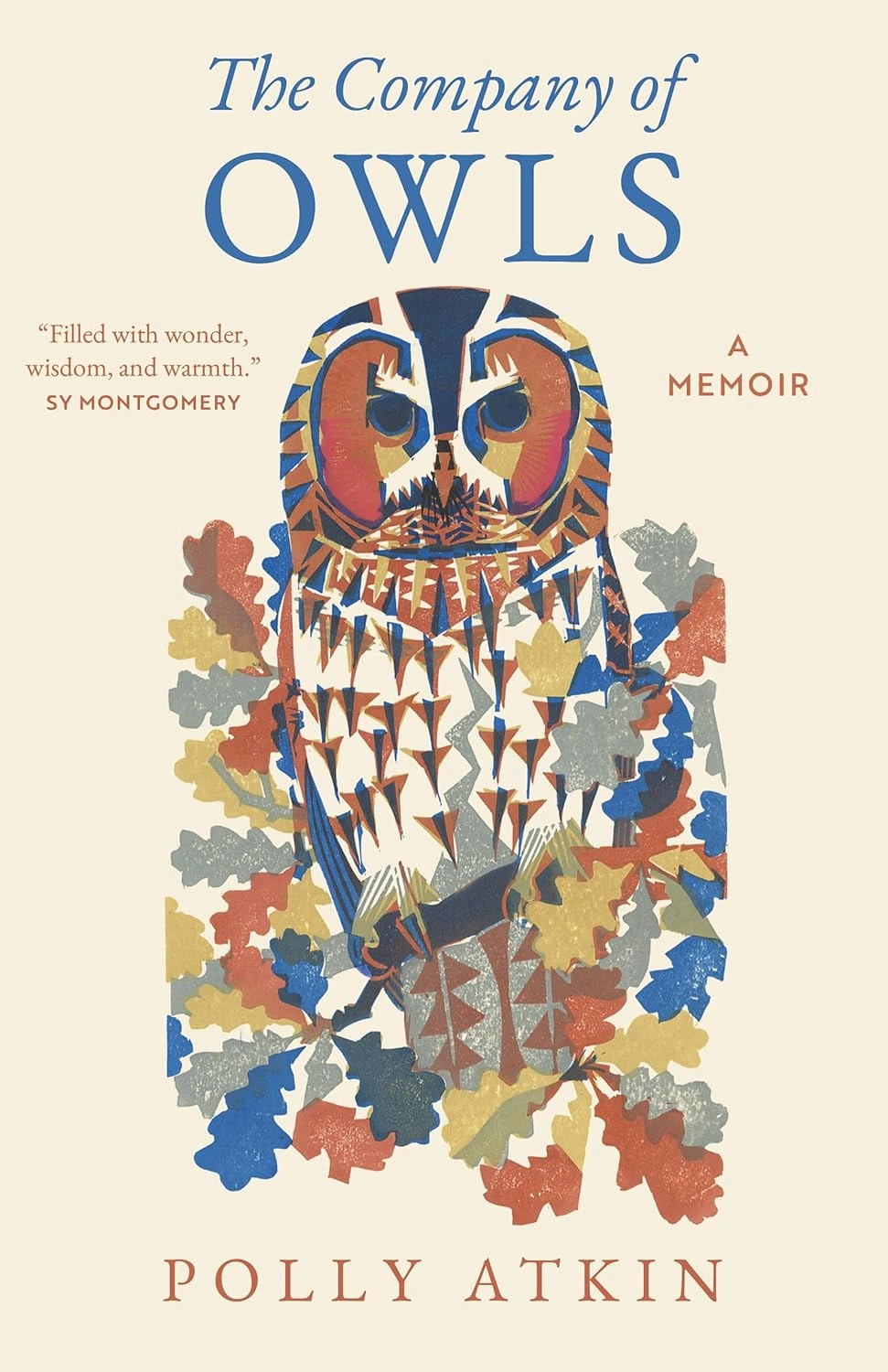
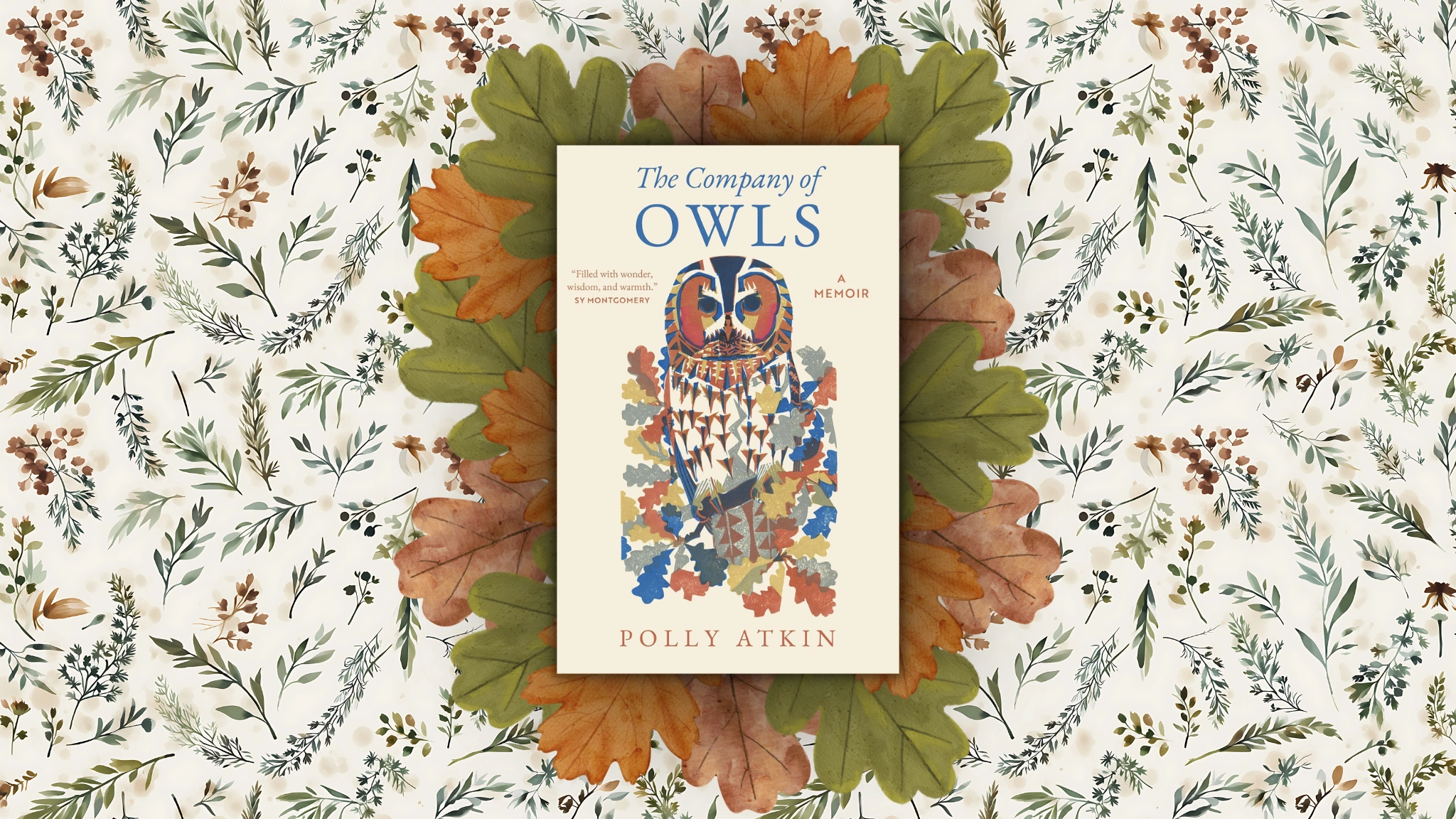
The Company of Owls by Polly Atkin
In The Company of Owls, Polly Atkin’s devotion to her own tawny owls glows like the auroras she enjoys during her evening walks to visit her owl neighbors.
We begin our journey in the night time, a moment when the hooting of owls interrupts sleep. Her first relationship with the owls was only by sound, almost ghosts and indeed, her notation of first seeing an owl in the area was a barn owl whooshing over an outdoor table where she sits with friends and looks up to see it only as a “spectre blotting out the stars for just a moment as I happened to look up.”
The owls invite her back to Grasmere, her homeplace in the Lake District of England, where researching and following the owls becomes a calling. Her first owl neighbor appears there on the Summer Solstice of 2017.
From there, we learn all about the different types of owls who live in the Lakeland area, and then settle in to watch the tawny owls in the forest near Atkin’s home. We experience the joy of seeing the owlets, the sorrow of finding that first owl neighbor dead on the side of the road and the ghost story that ensues, and then a cheering solace of realizing that the grown owlets are coming back to make their own home in the wood.
The Search for Connection
Polly Atkin, the author, developed this relationship with the owls by sheer determination. She lives with chronic illnesses, one of the Ehlers Danlos Syndromes (a connective tissue disorder) and Genetic Haemochromatosis (toxic accumulation of iron in the body). These illnesses can sap her energy and strength, making it difficult for her to get further out into nature.
Before I started bird-watching myself, the picture of birders that came to my mind is an older couple, binoculars around their necks, having a nice wander or sitting on a porch. But while those pictures can be true, the physical requirements of serious birdwatching exceed the easily walkable wander of a smooth path. Many dedicated birders tramp through forests, hike rocky trails or sit still in a hide for hours in order to see a certain bird. Finding accessible outdoor spaces is difficult as, for good reason, the most beautiful spaces resist development.
And that is the second part of this welcoming book. As Atkins says in the prologue, “I cannot wait unmoving in the cold or the dark for hours in the hope of a sighting, or carry myself to places on foot far from home or the road or safe paths to seek them out.” Her dedication to finding ways to engage with the owls shows us that people of every ability can build a relationship with nature.
Learning to Love the Wild, Up Close
Atkins’ joy and dedication for engaging with these fluffy raptors with a reputation for wisdom and prophecy infuses every lyrical word. All along, we feel the interconnectedness of ourselves with these birds. There’s a true solace that comes from reading about nature, seeing the world through the eyes of someone who loves all of it, the good and the bad, the ugly and the transcendent.
For Atkin, the bottom line is only this. “Because I love my neighbours, the owls. I love them, and I want you to love them too.” The Company of Owls fills me with a yearning to get to know the owls of my area. And in that way, Atkin’s goal is achieved.
About Polly Atkin:

Polly Atkin is an award-winning nature writer, memoirist, and poet. She has previously taught English Literature and Creative Writing at Queen Mary University of London, Strathclyde University, Lancaster University, and the University of Cumbria. Her first book, Some of Us Just Fall: On Nature and Not Getting Better, was longlisted for the 2024 Wainwright Prize. She currently lives in Grasmere, England, and is the co-owner of historic independent bookshop Sam Read Bookseller.