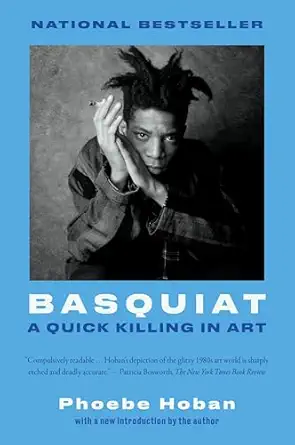
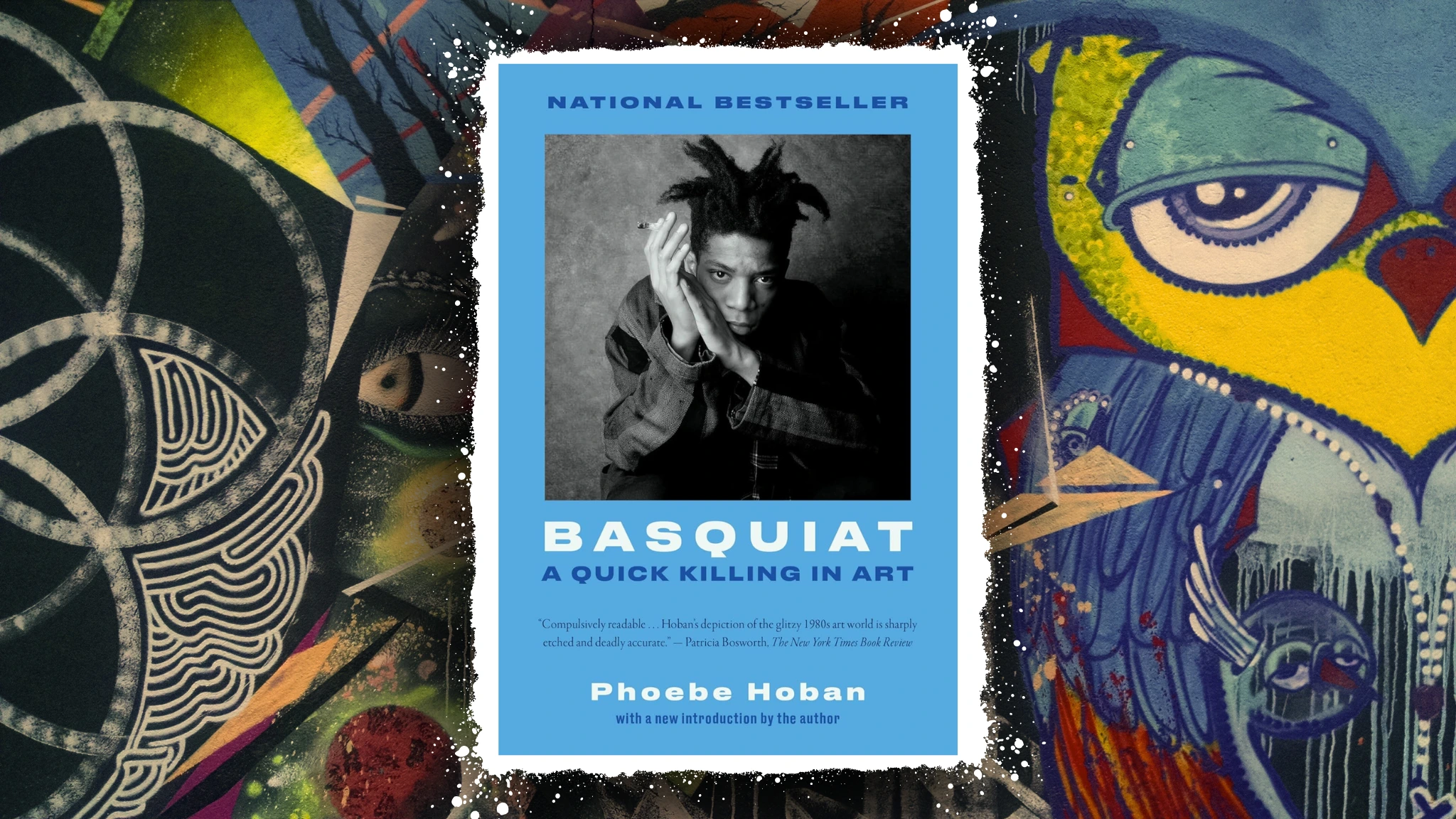
Basquiat: A Quick Killing in Art by Phoebe Hoban
Phoebe Hoban’s Basquiat: A Quick Killing in Art distinguishes itself by refusing to polish its subject into legend. Jean-Michel Basquiat appears not as a figure suspended above the world but as a young artist drawn into the machinery of fame. The book traces his path from Brooklyn to global notoriety, yet its real power lies in how steadily it avoids shaping it into a tidy rise-and-fall narrative.
The story begins with the SAMO graffiti years, when cryptic lines appeared on downtown walls and moves with the restless energy of the 1980s art scene — fast, hungry, volatile. Hoban keeps that backdrop sharply in focus, showing how art became currency and how race shaped every form of recognition. The rhythm of the narrative echoes the decade, letting the reader feel the momentum and the pressure that surrounded Basquiat from the start.
Hoban’s journalistic eye gives the biography its edge. Her reporting makes plain how critics, dealers and collectors constructed a version of Basquiat that could be marketed with ease. The book turns this process into one of its central subjects, revealing a system that embraced his talent while reshaping it into something sellable.
Art, Race and the Economics of Fame
Hoban’s examination of race is among the biography’s most incisive elements. She recognises the racial dynamics that framed Basquiat’s career without reducing his art to commentary. The subtle exclusions, the coded fascination with his so-called exoticism, the tone of certain reviews, all appear with a steady hand and a clear eye.
The title captures the era’s shift toward speculation. Basquiat’s paintings, charged with references to jazz, anatomy and street life, drew admiration and investment in equal measure. They became symbols as well as artworks, a dual status that shaped his entire career. He was both inside the marketplace and threatened by it.
A question remains after the last chapter. Did Basquiat’s transformation into a multimillion-dollar brand affirm or undermine the book’s argument? Hoban leaves the tension unresolved. His afterlife in the market feels like both triumph and warning, proof of lasting brilliance and of a culture that continues to consume what it celebrates.
Ethics, Clarity and the Human Scale
What sets the biography apart is its insistence on proportion. The research is extensive yet never clinical and the prose remains steady, curious and humane. Hoban draws on a wide range of voices and allows their differences to stand. That openness gives the portrait its depth.
The final chapters follow Basquiat’s addiction and decline without melodrama or euphemism. The focus stays on the work, its urgency and intelligence, its resistance to containment. The result is not the familiar tale of the doomed prodigy but a portrait of an artist who understood the forces acting upon him.
By the end, Basquiat emerges not as martyr or myth but as a figure who reflects the systems he confronted. His posthumous fame, marked by exhibitions, soaring auction prices and renewed scholarly interest, shows how those systems continue to define his legacy. Hoban avoids pronouncement, keeping the tone clear and unsentimental.
Verdict
Basquiat: A Quick Killing in Art stands as a study of both an artist and an industry driven by speed and spectacle. Hoban writes with precision and moral steadiness, neither defending nor condemning, only observing with care. That balance gives the book its authority.
By restoring Basquiat’s human scale without flattening his complexity, Hoban accomplishes what many biographies attempt but rarely deliver. The book concerns itself less with death than with the cost of visibility in a culture that treats art as an investment. What remains is not a myth but a man, vivid and unmistakable.
About Pheobe Hoban:

Photo by Grace Roselli, Pandora’s BoxX Project
Phoebe Hoban has written about culture and the arts for a variety of publications, including The New York Times, New York Magazine, The Wall Street Journal, Vogue, Vanity Fair, GQ, Harper’s Bazaar, ARTnews, and The New York Observer, among others. She is the author of three artist biographies: Basquiat: A Quick Killing in Art, a national bestseller and a New York Times Notable Book of the Year; Alice Neel: The Art of Not Sitting Pretty, named a best book of the year by New York Magazine, The Village Voice, and Booklist; and Lucian Freud: Eyes Wide Open. She lives in New York City.