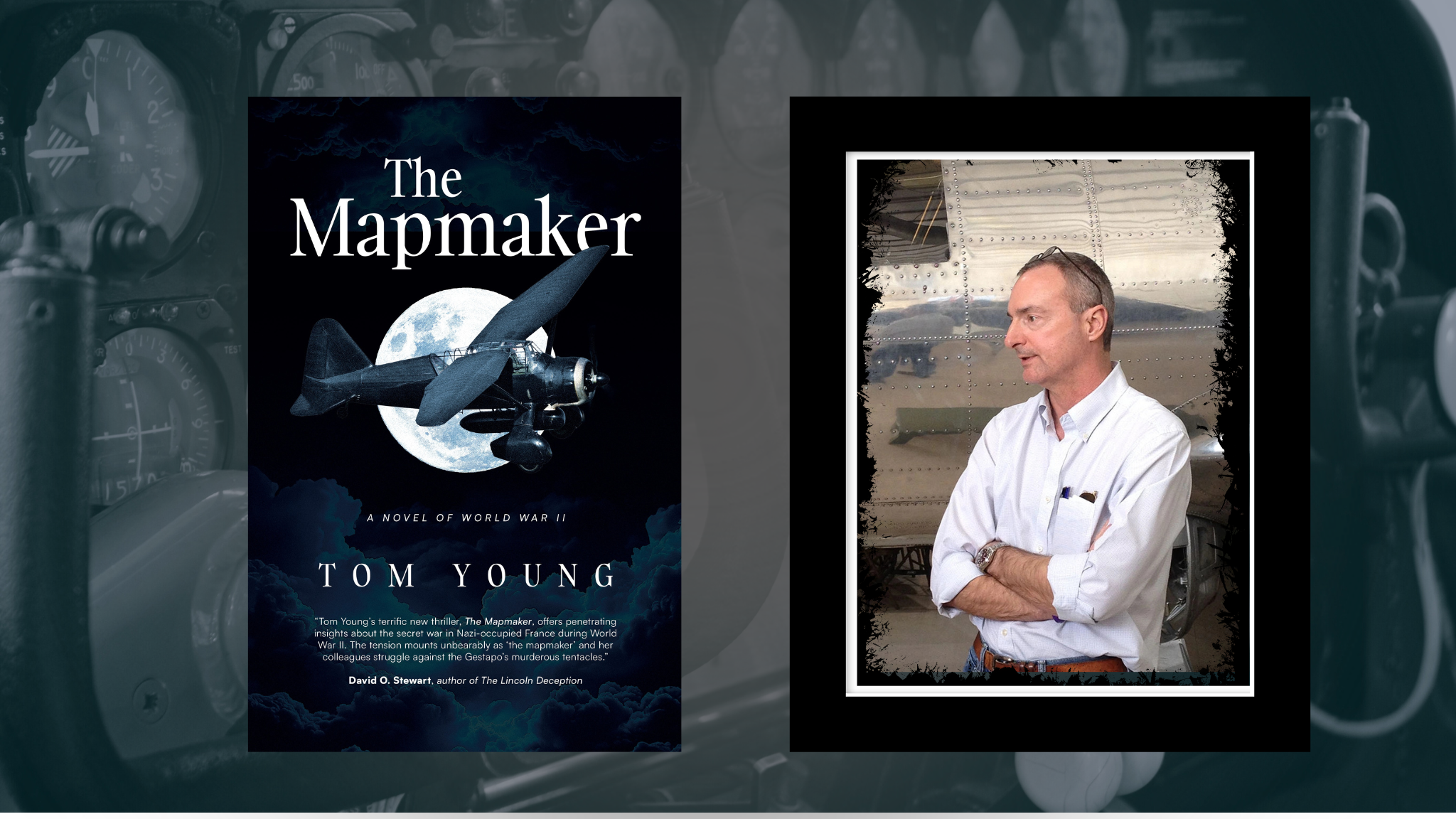
Drawing on his lifelong fascination with maps, his experience in the cockpit, and meticulous historical research, this author weaves a story of resilience and connection between two unlikely allies.
In this Q&A, author Tom Young discusses the real-life inspirations behind his characters, the challenge of blending fact with fiction, and the enduring bonds forged in the fight against tyranny.
What drew you to explore the lesser-known world of WWII cartographers and map couriers in The Mapmaker? Was there a particular real-life story or moment that sparked the idea?
I’ve always been fascinated by maps and navigational charts—which is probably a good thing since I relied on them every day as a pilot. And mapmaking, cartography, is somewhat related to another field that comes up in The Mapmaker: aerial photoreconnaissance. One of my literary heroes, the French author and aviator Antoine de Saint-Exupéry, flew photorecon missions during World War II.
I first learned about Saint-Ex when I was a kid combing through the card catalogue of a small-town North Carolina library. I was looking for anything about flying, and that’s how I discovered his books. In one of them, Flight to Arras, he describes his highly dangerous flights during the Battle of France in 1940. Air crews gave their lives to get photographs, because the photo intelligence was that important.
That’s why I put my character Philippe in the same unit with Saint-Ex. The reader sees his experiences as a photorecon pilot in the Battle of France, and the fictional Philippe becomes friends with the real-world Saint-Ex. Later in the book, they have an emotional reunion—and a tragic parting. The Historical Notes section at the end of the novel provides more information on what part of the story is real and what part is made up.
You spotlight the unsung contributions of individuals like mapmakers and couriers — ordinary people who shaped history in extraordinary ways. What kind of research did you undertake to bring their world to life authentically?
I did a lot of reading on the French Resistance, of course. And I joined an interesting group, the OSS Society. The OSS was the Office of Strategic Services, a forerunner of the CIA. OSS officers did extraordinarily brave and innovative things to support the Resistance, including coordinating with people like my character Charlotte who provided human intelligence on the ground. The OSS Society keeps alive that history.
Most members of the OSS Society are current and former CIA officers or military special operations veterans. However, the Society accepts as associate members people like authors and historians. Every year the OSS Society hosts an awards dinner to honor people who have made significant contributions to the U.S. intelligence community. One of the awards is named for Virginia Hall, another real-world figure who makes a cameo appearance in The Mapmaker. Hall is the only civilian woman in WWII who received the Distinguished Service Cross. You can learn a lot from the people who attend that awards dinner—and you can see the throughline on the value of intelligence from World War II to the present day.
Charlotte and Philippe come from different worlds — one on the ground, the other in the air — but they’re both shaped by personal loss and duty. What challenges did you face balancing their narratives and giving each emotional depth?
Writing Philippe was a little easier than writing Charlotte. He’s an aviator, and so am I. Of course, I haven’t flown the airplanes of his day, and I haven’t faced the level of danger he faced. But some things are universal: the tension you feel before you go into action, the stress of coming under fire, the bond among squadron members.
Charlotte required more research. I had a lot to learn about the French Resistance. But here again, the emotional aspects are universal. When writing certain scenes, I’d ask myself: How would I feel if the Gestapo were after me? How would I feel if I lost a friend and didn’t have time to grieve? What if I were cold, hungry, and on the run? What if I needed help but didn’t know who to trust?
You incorporate real operations like Plan Vert and references to figures like Jean Moulin. How do you walk the line between honoring fact and keeping the fiction compelling?
A novelist can take liberties that you can’t take in nonfiction. But even with fiction, there are guardrails you should respect. If I use a real-world character in a fictional scene, I’ll address that in the Historical Notes section at the end of the book. That’s where I clarify how I folded reality into a made-up story. But even when I fictionalize, I try to illustrate real history. As another novelist put it, the historian tells you what happened. The historical novelist tells you how it felt.
If I take a lot of liberties, I’ll change the name of the real-world figure. For example, I read a terrific memoir by a British RAF officer, Hugh Verity, who commanded a special duties unit that supported the Resistance. I used him as a character in The Mapmaker. But because I made up so many scenes and conversations with him, I thought it best to change the name out of respect for the real Group Captain Verity. So, in The Mapmaker, there is a character named Hugh Venable, inspired by the real-world Hugh Verity, but I make no claim that this character speaks and acts exactly like the actual historical figure.
In many ways, The Mapmaker is a story about connection — between allies, strangers, even across borders. What do you hope readers take away from the bond that develops between Charlotte and Philippe?
Charlotte gives Philippe hope at his lowest moment. More specifically, she gives him hope by giving him purpose. Even when defeat seems likely, they draw strength from each other through their common mission of fighting fascism.
As I wrote this novel, I didn’t think much about theme. I’ve always felt that if you go deep enough into your characters and their story, theme will emerge by itself. But I believe a theme that emerged is the connection you noted: In the face of evil, people can find strength in their connections based on shared values and common purpose.
Do you see yourself returning to this historical moment or these characters in future work? Or are there other hidden corners of WWII you’re eager to explore next?
I’ve been exploring another lesser-known corner of WWII history, and it’s also local history in here in Virginia where I live. During the 1930s, Richmond department store magnate William B. Thalhimer helped bring 38 young Jewish refugees out of Germany. He settled them on a farm in southern Virginia—not far from the farm where I grew up in North Carolina. These refugees had been students at an agricultural institute in Germany. When the U.S. entered the war, many of them joined the American military. Because they spoke German and knew the culture, they became valuable assets. Some even interrogated captured German soldiers. That’s fascinating history that few people know about—even in the area where it happened. And it might inspire my next WWII novel.
But that said, I never know where my historical research might lead me. For example, when I first started researching the French Resistance, I didn’t know about the French pilots who flew for the British RAF. But that discovery led to my character Philippe in The Mapmaker.
About Tom Young:
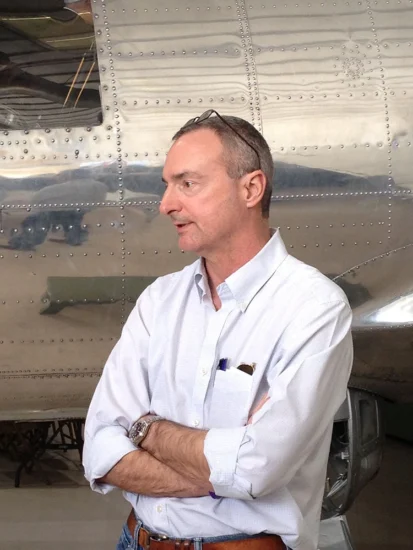 Tom Young served in Iraq, Afghanistan, and dozens of other countries as an Air National Guard flight engineer on the C-130 Hercules and C-5 Galaxy. Military honors include the Meritorious Service Medal, three Air Medals, three Aerial Achievement Medals, and the Air Force Combat Action Medal. A retired airline captain, he now works as an aviation consultant and author.
Young has written nine novels, a novella, and one nonfiction book. Journalistic experience includes ten years with the broadcast division of the Associated Press.
Memberships include the Veterans of Foreign Wars, the National Press Club, the OSS Society, and the National Air and Space Society. Young also serves as the commander of American Legion Post 20 in Washington, DC.
He grew up on a North Carolina farm and holds BA and MA degrees from the University of North Carolina at Chapel Hill.