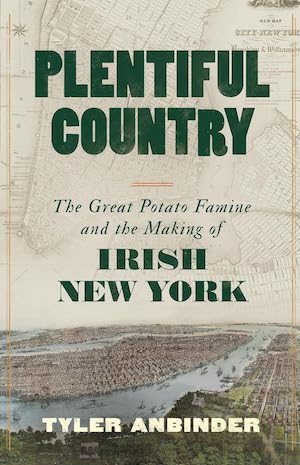
Plentiful Country: The Great Potato Famine and the Making of Irish New York by Tyler Anbinder
Throughout modern history, immigrants have journeyed to the United States (even if some of our citizens believe it is a recent phenomenon). Typically, immigrants arrive in waves. During the 17th century, the first wave came from the British Isles. During the 19th and 20th centuries, waves of Northern Europeans, Asians, Eastern Europeans and Latin Americans contributed to explosive population growth in the U.S. Emigration from Africa surged during the 1960s.
Today, families continue to seek better lives in the United States, just like the two million Irish immigrants who entered the United States between 1845 and 1855. In a new history of the “Famine Irish,” historian Tyler Anbinder, inspired by his own family’s story, engages in some serious historical myth-busting.
Plentiful Country: The Great Potato Famine and the Making of Irish New York (Little, Brown and Company) has an underlying thesis. Anbinder dismisses the stereotype of the Famine Irish as impoverished and stuck in deadly, dirty neighborhoods and jobs. Instead, he argues, many Irish immigrants of this era were upwardly mobile and achieved financial and professional success.
The author bases his ideas on information he uncovered in the newly accessible archives of the Emigrant Savings Bank, now housed at the New York Public Library. Established by the Irish Emigrant Society in 1850, the bank still stands on Chambers Street right around the corner from City Hall in Manhattan. The prime location suggests that it was at the center of things. Equally important, the information that the bank recorded about its patrons extended well beyond the basics that appeared in state and federal censuses.
These records might show, for example, when and where families moved, employment details, savings habits, family crises and personal history such as the precise place of birth and ancestral lineage.
What It Took to Survive
The story opens in densely populated Ireland, where land and houses were controlled in absentia by the “Protestant Anglo-Irish aristocracy,” according to Anbinder. Starving, inhabiting hideous cabins and tenements, the farmers depended entirely on potatoes not only to make a pittance but to feed their families. While emigration from Ireland began as early as 1815, not until the fungus (Phytophthora infestans) arrived in 1845 and decimated the potato crop did the Irish begin to leave in large numbers.
Most emigrants endured the 35-day voyage from Liverpool to New York in steerage, the belly of the ship where typhoid flourished because sanitation was nonexistent. Once passengers had passed through customs and medical exams and were released into the city, so different from their native land, many of the Famine Irish earned money and improved their diets and living conditions to an extent that would have been impossible back across the ocean.
Yet they struggled, especially those without a trade. Nevertheless, unskilled Irish immigrants, unlike other immigrant groups like Eastern and Southern Europeans, did not work in sweatshops.
Rather, the men became laborers. They worked on the docks and canals, raised bridges and dams, risked their lives building the infrastructure of a nation in the birth pangs of industrialization. In the homes of upper- and middle-class Americans, Irish immigrant women became baby nurses, housekeepers and servants. Factory work was always available, too.
A Personal Touch
Manhattan’s notorious Five Points, a neighborhood once located near present-day Chinatown and full of criminals and destitute families, became home to plenty of Irish immigrants, as immortalized in Martin Scorsese’s award-winning film, Gangs of New York.
However, as Anbinder documents, these families eventually got up and out. Many quadrupled their original savings, showed a talent for entrepreneurship, and watched their children reach unimaginable heights.
In order to write Plentiful Country, Anbinder reviewed thousands of Irish immigrant stories, even chasing a few from Ellis Island all the way out to the rural Midwest. While the majority remained in New York City until well into the twentieth century, northern New York State called to quite a few men like my husband’s great-grandfather, who settled in Waterford at the convergence of the Hudson and Mohawk Rivers.
As if his life were a page out of Plentiful Country, this great-grandfather was a saloon keeper, then a fish dealer and finally an insurance agent. His life exemplifies Anbinder’s thesis: “The Famine Refugees had proven that there was no immigrant too poor, too uneducated, or too unskilled to succeed in America.”
 Tyler Anbinder is an emeritus professor of history at George Washington University, where he taught courses on the history of American immigration and the American Civil War era. He is the author of three award-winning books: Nativism and Slavery: The Northern Know Nothings and the Politics of the 1850s (1992); Five Points: The Nineteenth-Century New York Neighborhood that Invented Tap Dance, Stole Elections, and Became the World’s Most Notorious Slum (2001); and City of Dreams: The 400-Year Epic History of Immigrant New York. Anbinder has won fellowships from the National Endowment for the Humanities and served as the Fulbright Thomas Jefferson Distinguished professor of History at the University of Utrecht. His fourth book, Plentiful Country: The Great Potato Famine and the Making of Irish New York, will be published in March 2024.