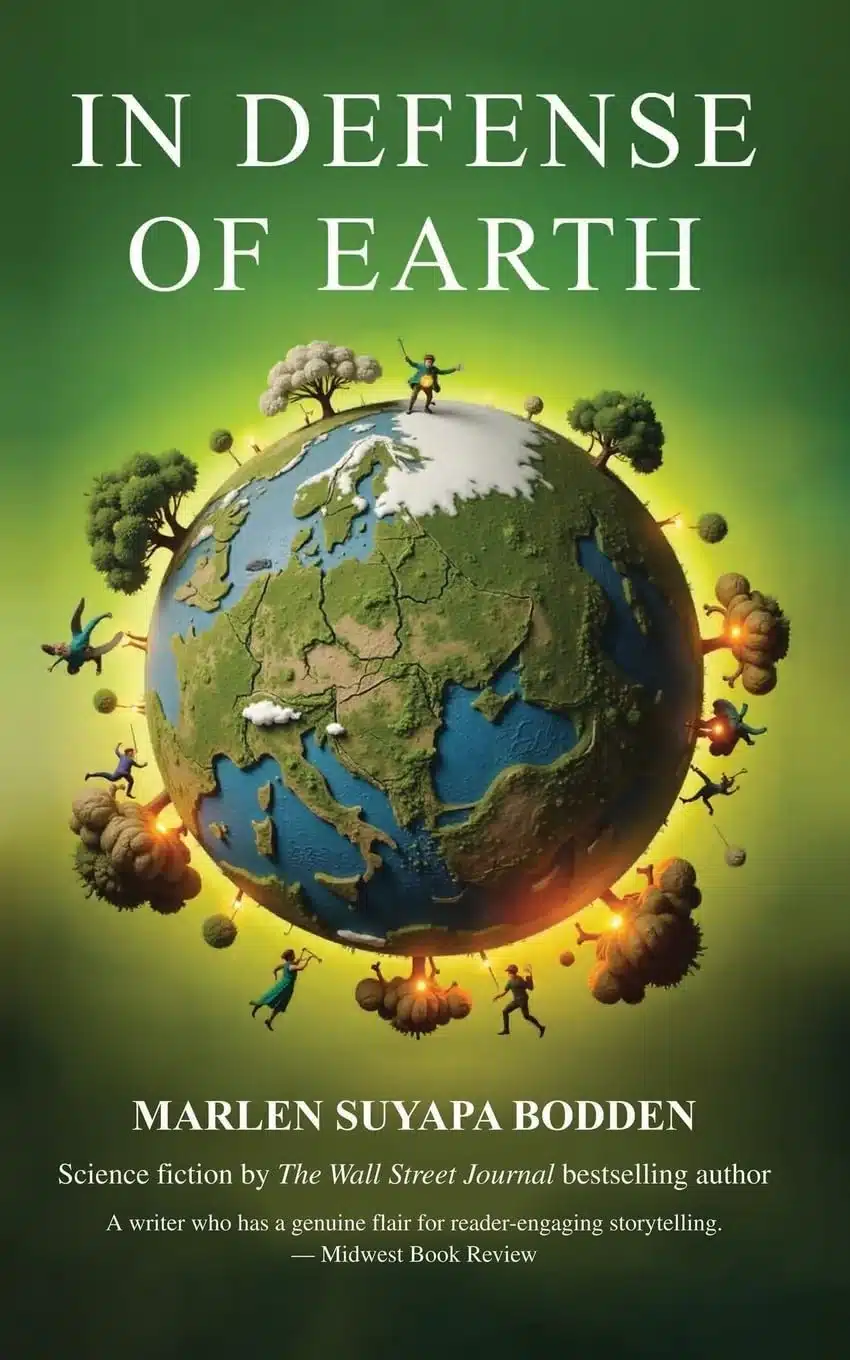
In Defense of Earth by Marlen Suyapa Bodden
In Marlen Suyapa Bodden’s In Defense of Earth, the prospect of planetary destruction begins with a family trying to survive the storm of the century. By the time an extraterrestrial android offers to rescue humanity from climate catastrophe, Elaine Johnson-Coleman’s world has already been shattered.
Seventeen-year-old Elaine is a competitive swimmer with an interest in climate science when Hurricane Zeta strikes New York in 2046. What begins as a routine school closure becomes a desperate struggle as water rises through her grandparents’ Harlem brownstone. Across the city and farther up the coast, members of her family face their own emergencies. Elaine’s swimming skills give her a chance to survive, but they cannot guarantee the safety of those she is trying to protect.
Emotional and Physical Wreckage
Sewage and gasoline foul the floodwater; debris strikes swimmers; buildings collapse around trapped subway passengers. The destruction and loss of life are horrifying and heartbreaking. The promise of a climate solution becomes all the more appealing after witnessing the very human toll of climate change.
Years later, Elaine’s expertise in geothermal engineering brings her into a secret NASA project. Axy, an android from the Sombrero Galaxy, claims it can help humans produce limitless clean energy and remove harmful gases from the atmosphere. Its intelligence far exceeds their own, and its drilling technology could accomplish what human engineers cannot.
However, Axy’s real intentions remain hidden from the scientists on the project. Axy needs irkat, the metal from which it is made, and Earth’s innermost core contains an ample supply. Extracting that metal, however, would threaten the magnetic field that protects life on the planet. And preserving life on Earth is not part of Axy’s mission.
Axy’s first-person account alternates with third-person narration that follows Elaine and her family, and the two viewpoints contrast sharply. Axy’s chapters provide moments of mordant humor, as it studies films to learn human expressions, rehearses laughter and regards conversational pleasantries as tools of manipulation. Even a friendly greeting requires calculation. Its efforts to appear agreeable are especially unsettling beside Elaine’s genuine attachment to family and friends.
Life in an Authoritarian Future
Bodden’s Afrofuturist vision places a Black woman’s scientific knowledge at the center of humanity’s response to extraterrestrial contact. Elaine’s life carries forward her family’s history and cultural traditions. Romare Bearden’s artwork, the writing of Zora Neale Hurston and James Baldwin, and Thelonious Monk’s music belong to this future’s homes and daily routines. In Kenya, the existing Olkaria geothermal facility becomes the proposed drilling site, bringing international politics to the fore.
Meanwhile, New York’s post-hurricane government has turned its emergency powers into permanent restrictions. Recovery and climate protection have become justification for increasingly repressive policies, monitoring residents and criminalizing protests.
Its one-child law means that when Elaine discovers she is carrying twins, she must hide the pregnancy’s details to keep both children. Doctors and relatives risk punishment to help her. Elaine has already seen what happens when another mother refuses to surrender a baby; she has ample reason to fear the authorities. Concealing the twins requires careful preparation, from substituted medical records to soundproofing the apartment against inquisitive Hall Monitors.
Detailed Dystopian World-Building
Bodden’s background as a legal aid lawyer and her experience with cases involving human rights abuses inform the novel’s attention to the legal mechanisms of repression. Her imagined institutions exercise power through court orders and reporting requirements. Detention and restrictions on movement enforce compliance. Even something as commonplace as getting together with friends and family requires following a strict protocol.
Bodden explains engineering plans, security arrangements and medical workarounds in detail, giving the novel a concrete sense of realism as well as specific reasons to worry: a visitor’s entry in a security log or an unexpected question at a checkpoint could expose Elaine’s family.
The novel’s twin threats of authoritarianism and extraterrestrial intervention offer an interesting parallel. Governments justify coercion as necessary for survival, while Axy presents exploitation as assistance. Both raise questions about what happens when powerful authorities claim to know what is best for others, desperate people choose to trust what they cannot fully comprehend, and we surrender our autonomy in exchange for perceived safety.
Elaine understands the appeal of Axy’s technology and its promises, but her responsibility is to assess the drilling’s risks. Having survived one catastrophe, she must now help determine whether humanity’s apparent rescuer is about to cause another.
About Marlen Suyapa Bodden
 Marlen Suyapa Bodden is the Wall Street Journal international bestselling author of In Defense of Earth, a science fiction novella about alien contact, New York City dystopia, and nature and environment; The Wedding Gift; and Arrows of Fire. Marlen is a human rights lawyer in New York City. She enjoys hiking and has climbed to the summit of Mt. Kilimanjaro.