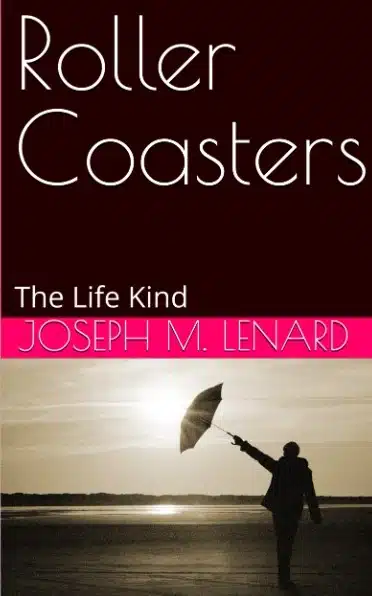
Roller Coasters: The Life Kind by Joseph M. Lenard
Grief does not always behave like an ending. Sometimes it acts more like a ride that refuses to stop: the same drops and turns, the same sickening return to the place where everything irrevocably changed. In the latest entry to his “Life and Living” series, Roller Coasters: The Life Kind, Joseph M. Lenard builds a short, intensely personal tale around that sensation, following one man as loss turns his own mind into an amusement park of jolts, loops and uneasy repetitions. The result is not a conventional plot-driven story so much as a meditation on what grief does after loss, after the shock has nowhere else to go and reality sets in.
Rick’s catastrophe begins in the worst possible way: with an argument. Nevaeh leaves in anger, driving into a violent storm in a DeLorean, and he is left behind with dread and regret already gathering force. He thinks about what he said, what he failed to say, the ways he may have worn her down without meaning to. When a local policeman arrives with the terrible news, Rick’s worst fear becomes fact: Nevaeh is dead. From there, the story stays close to the wreckage inside Rick: the guilt, the second-guessing, the need to keep hearing her voice even if it means keeping her phone just so he can hear the voicemail greeting.
Lost in a Carnival of Sorrow
That detail says a lot about the book’s understanding of mourning. Rick does not simply miss Nevaeh. He keeps reaching for traces of her — songs, memories, objects, the empty driveway. His grief is tangled with regret over the man he was and the better man she saw in him. He struggles between states of remembrance and entrapment. Rick can’t bear the idea of Nevaeh being forgotten, but he also can’t live forever inside the night of her death. His healing, if that is the right word for something so unresolved, begins with learning that memory has to become more than repetition.
The book’s title points to roller coasters, but the metaphor extends to other familiar amusement rides. Roller coasters become images of life’s sudden drops and relationship turbulence. Ferris wheels and carousels capture the misery of going around and around while feeling that nothing has changed, despite the illusion of forward motion. Tilt-A-Whirls suggest mental disorientation; bumper cars stand in for bruising conflicts with others. These comparisons give Rick a language for what would otherwise be shapeless pain. He is a man trying to interpret catastrophe, and the metaphors keep multiplying and morphing because grief keeps demanding another nuance, another angle.
The story’s Christian framework is just as important. Rick’s reflections often move through biblical ideas of suffering, perseverance, free will, the soul and responsibility. His faith gives his grief a moral pressure. He is not only asking how to endure Nevaeh’s absence. He is asking what he is supposed to do with the time he still has, and whether pain can push him toward a more purposeful life instead of a diminished one.
A Narrative Structure That Imitates Internal States
Music runs through the book like a second nervous system. Rick hears grief through songs, old lyrics and fragments that will not leave him alone. Lenard explains in the surrounding material that the musical references are meant to function almost like a film score, and that helps explain the book’s unusual rhythm. The prose circles back, repeats, digresses and sometimes crowds the page with associations. This disjointedness is intentional — a “feature,” not a “bug,” as Lenard puts it — because a grieving mind does not move in clean lines. Neither does life.
The final chapter, “Onward,” does not pretend that Rick has been repaired. He wakes from another nightmare, exhausted and still haunted, then reaches for ordinary things — allergy medicine, coffee, the possibility of a donut — before turning toward something more deliberate. He thinks about writing. He considers asking a friend for guidance. He begins to imagine a book that might carry Nevaeh’s light beyond his own private sorrow. That is where Lenard’s “Carpe Diem” philosophy provides a way forward. Here, “seizing the day” is the difficult decision to stay engaged with life when withdrawal would be easier.
Roller Coasters: The Life Kind will appeal to readers who appreciate reflective fiction, characters’ inner lives, and personal, idiosyncratic storytelling. But its true power lies in refusing to make grief tidy. Rick does not get off the ride. He simply begins to understand that healing does not mean leaving love behind; it means learning how to carry it forward.
Enter to win a free copy here.
About Joseph M Lenard
 Honor. Integrity. Patriotism. For some people, these are words. For bestselling author Joseph M Lenard, these are the core values that he strives to embody every day; they are deeply ingrained in every facet of his life and work. Lenard describes himself as “born in the 1960s and is very much a person of the 1980s.” A former information technology professional, Lenard now dedicates his time to being a published author, blogger, vlogger, podcaster and speaker. He is a lifelong resident of Wyandotte, Michigan.
Buy this Book!
Amazon