Plowman: Harvest of Grain and Innocence by Charles Bruckerhoff
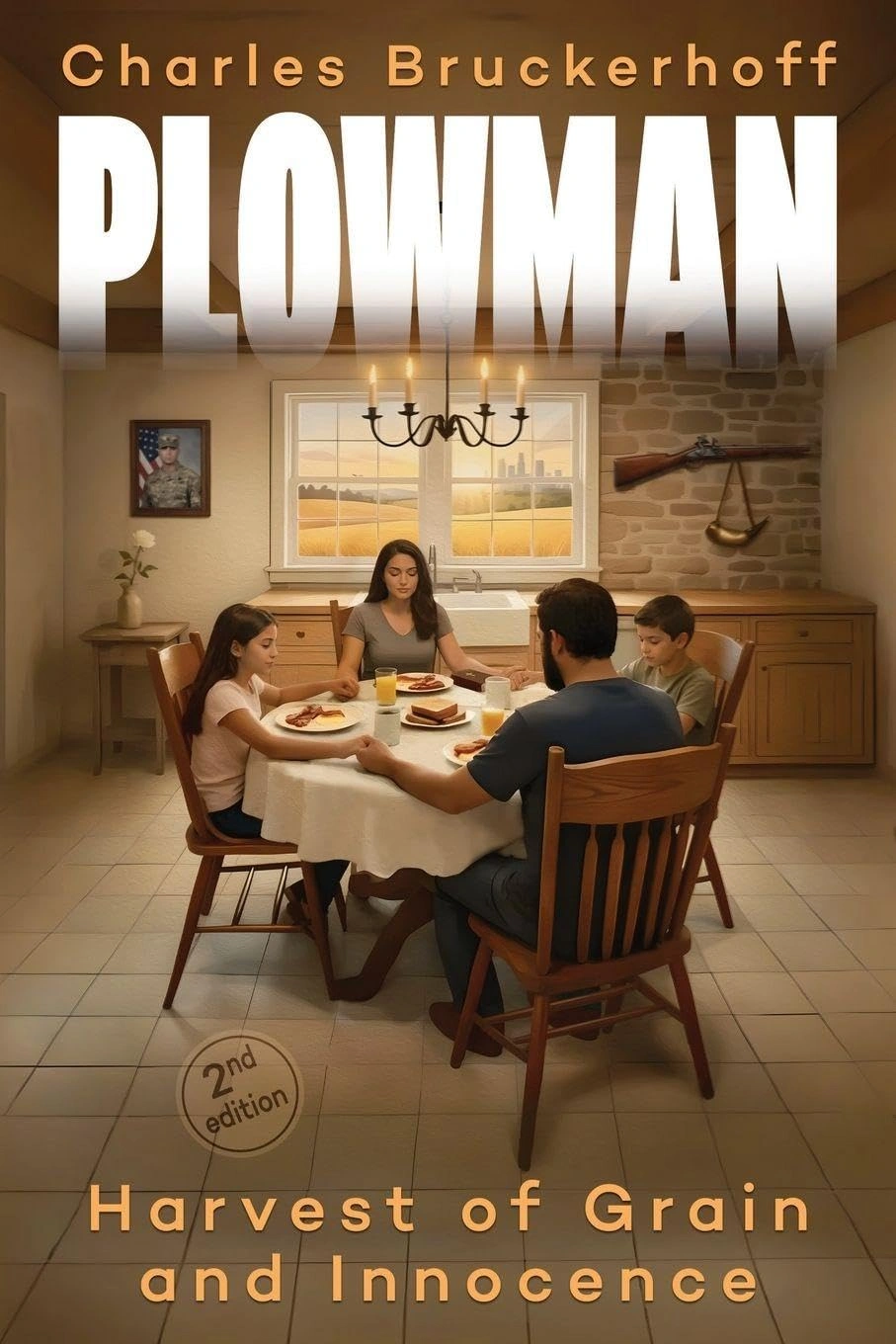
The story in Charles Bruckerhoff’s PLOWMAN: Harvest of Grain and Innocence (2nd edition) begins, in a sense, when a dusty wooden first-aid case crashes down from an attic shelf. It is not medicine inside, but memory: loose pages, wartime journals, military records and family history waiting for someone young enough — and brave enough — to ask what it all means.
Those young people are Stella Emilia Young and Hana Philomena Sanada, born on the same June morning in neighboring hospital rooms and raised almost as sisters. At Stanton Academy for Humanity, they are encouraged to learn by doing: studying Glacier Pond, working with their hands, reading deeply and treating knowledge as something rooted in responsibility.
When Stella and Hana discover the old case in Hana’s grandparents’ attic, they find the wartime journals of Lieutenant George Washington Sanada and Major Craig Alexander Bradley, along with a Vietnam War manuscript by Captain Marcus Stanton. What begins as a school project to write a book based on these discoveries becomes the central act of the novel: two girls trying to understand the wars, sacrifices and moral choices that shaped their families before they were born.
From the Attic to the Battlefield
PLOWMAN moves across centuries, from the samurai past of the Sanada clan to Imperial Japan, World War II, Vietnam, Afghanistan and a future America. It’s a large canvas, and Bruckerhoff fills it with people whose lives intertwine and leave lasting legacies.
One of the book’s strongest strands follows the Sanada clan. The family lineage reaches back to Sanada Nobushige, the famed samurai warrior, but the more immediate drama begins in 1934, when Kenshin Sanada leads a small band of relatives out of Osaka to escape life under Imperial Japan. Their journey into the Hida Mountains is dangerous and costly, but the survivors reach a hidden cave, where they begin a life defined by faith, discipline, farming and secrecy.
That mountain refuge later becomes crucial to George Washington Sanada, a Japanese American imprisoned with his parents in an internment camp during World War II. Major Craig Bradley recruits George for a top-secret reconnaissance mission, and their flight over Japanese cities in a modified Black Widow is one of the book’s most cinematic passages. When George is forced to parachute into the Hida Mountains, his family history and America’s war effort converge in one of the novel’s most meaningful plot turns.
The Afghanistan thread is especially personal because Stella’s father, Captain Jedediah Young, is killed in combat. His death notification and funeral Mass at St. Ann’s are among the most emotionally detailed sections of the book, described in rich detail. The scene shows what the novel values most: not grief alone, but a community gathering around grief with ritual, duty and love.
The novel’s treatment of war is reverent toward soldiers but often furious toward leaders. World War II is presented as a morally necessary fight against tyranny, though the internment of Japanese Americans complicates any easy patriotism. Vietnam and Afghanistan receive a harsher judgment. Through Marcus Stanton’s journal, Private Eleazar Zechariah’s reflections and Stella’s later critique of American decision-making, Bruckerhoff asks why wars are started, who profits from them and how much the public is allowed to know.
A Sweeping Story, Told with Conviction
Bruckerhoff writes with sincerity and a strong sense of mission. His style is expansive, direct and often solemn. He uses details such as names, dates, genealogies, meals, weather, tools, prayers, military equipment and institutional design to create a powerful sense of lived history, as though every object in a room were imbued with texture and meaning.
He is deeply interested in what makes a person strong enough to resist tyranny. For Bruckerhoff, the answer begins with the family, continues in education and is sustained by faith. Stanton Academy is not just a setting; it is one of the book’s arguments. Its curriculum is built around agriculture, science, classical literature, practical work and moral seriousness. Students are expected to become capable, curious and responsible — not passive recipients of information.
Like the plowman of the title, Bruckerhoff views shared history and moral inquiry as fields that must be turned, planted and tended. So must children. So must memory. The Academy’s gardens, Glacier Pond, the Sanada clan’s hidden crops and Gordon Stanton’s farm all become part of a larger metaphor about cultivation: what a society plants in its young people determines what it will harvest later.
Bruckerhoff does not hide his religious, political or educational convictions. He argues for social ideals as much as he narrates a story. PLOWMAN: Harvest of Grain and Innocence is an ambitious, impassioned novel about memory as inheritance and citizenship as a moral duty — a sweeping, deeply earnest saga about the stories families preserve, the sacrifices nations demand, and the fragile harvest of faith, courage and freedom passed from one generation to the next.
About Charles Bruckerhoff
 Charles Bruckerhoff started life in Augusta, Missouri in 1947, in a small clapboard house on the bluffs above The Big Muddy. He spent many days exploring the hills and valleys, fields and streams of the Ozark Mountain foothills.
At 19 he joined the United States Army and served in Vietnam. Returning to the USA in 1969, he went to college, studying English, literature, philosophy and research methods. In 1995, he created a firm, Curriculum Research and Evaluation, Inc. (www.creus.com) focused on the social and cultural life of poor children. He believes the best way to gain personal knowledge, social skills, moral behavior, spirituality and healing for children and adults is the real world, out the back door with friends.
Currently, Charles works as the author and publisher of Sequoia House Books. He also devotes time to shepherding the firm, now run by his lovely wife, Theresa, and to family life with four sons, six grandchildren, friends and neighbors. His hobbies include community service, artisan bread baking, gardening, traditional quilting, and studying American history, the Hebrew Bible and the New Testament. He places no limit on new adventures.