Crown City by Naomi Hirahara
True confessions, this reviewer is a super fan of Naomi Hirahara, the brilliant, always relevant author of complex mysteries as well as nonfiction, beginning with Summer of the Big Bachi (2004), the first in the six-book Mas Arai series and Publishers Weekly honored Best Book of the Year, continuing with the Leilani Santiago Hawai’i and Officer Ellie Rush mysteries. These were followed by Evergreen and Clark and Division, works of historical fiction set in Los Angeles, the Manzanar War Relocation Center and Chicago. Clark and Division received Simon & Schuster’s Mary Higgins Clark Award in 2022 and also was her third Edgar Award nomination and second award winner—the first being Best Paperback Original for Snakeskin Shamisen.
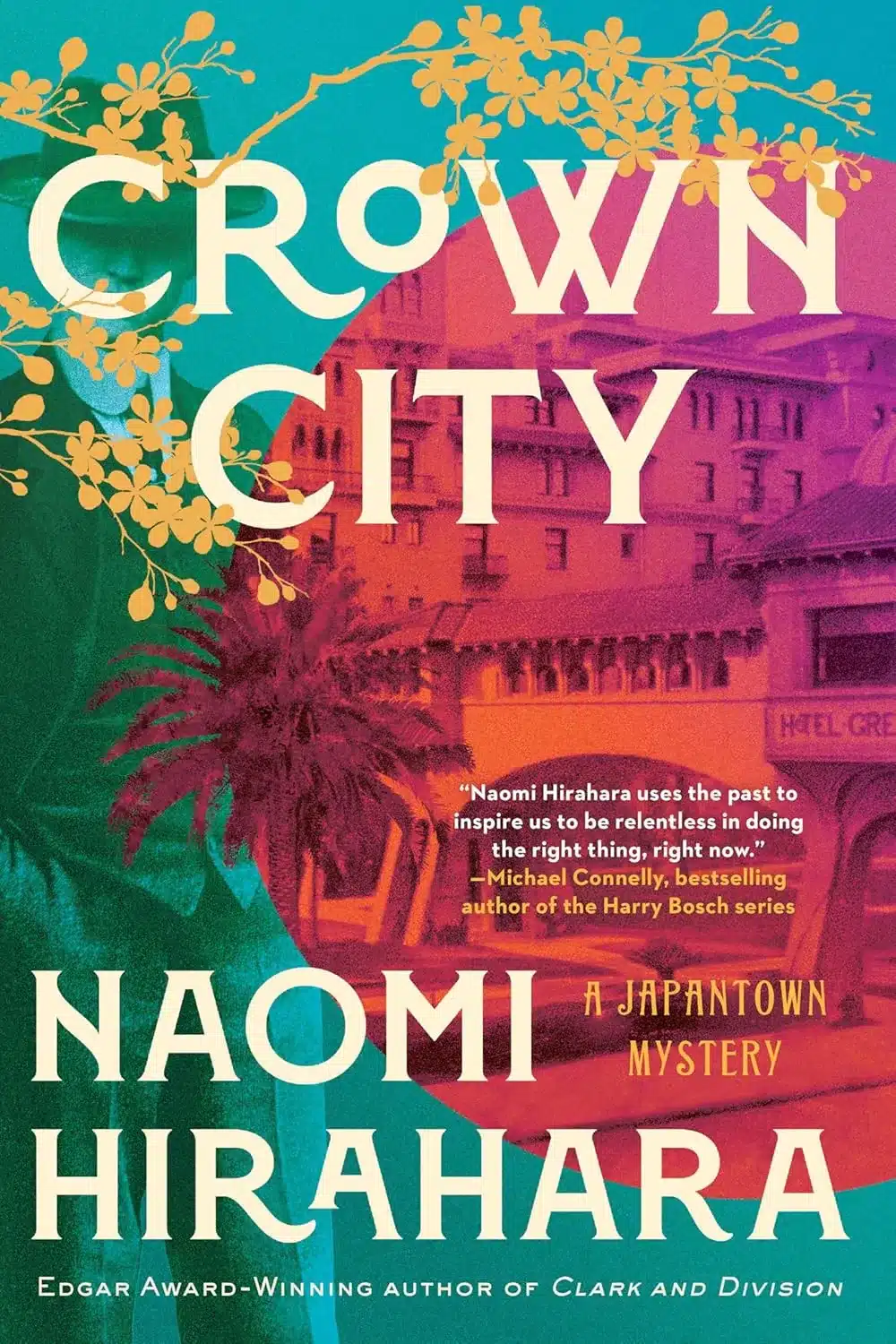
Crown City is a turn-of-the-20th-century historical mystery and love letter from Naomi Hirahara to Pasadena, California, her birthplace and home. The dedication states: “For the ‘Dena, Past, Present and Future.” This native daughter and Stanford University graduate is descended from a Nisei father and Issei mother, both survivors of the Hiroshima bombing that led to the end of WWII. She served as longtime editor of Rafu Shimpo, the largest bilingual daily Japanese-English newspaper in the United States, which was established in 1903.
Historic Pasadena and Its Japanese Population
Pasadena was established as a city in 1886, one year after the San Gabriel Orange Grove Association was founded. The moderate warm climate and fertile soil attracted settlers and tourists alike. Following the assassination of President John Garfield, his widow, Lucretia, resided in South Pasadena in a home designed by the firm of Greene and Greene, who also built the iconic Arts and Crafts Gamble House, a National Historic Landmark with Japanese sensibilities, sloping roofs and intricately carved wooden images. The annual Tournament of Roses began on January 1, 1890, with sponsorship from the Valley Hunt Club to showcase the city’s beauty as a resort destination. Thaddeus S. C. Lowe, a Civil War-era balloonist and entrepreneur, was responsible for the creation of the Mount Lowe Railway, an electric trolley that transported visitors from Pasadena to the crest of the San Gabriel Mountains from its opening on July 4, 1893, until 1938. Nearby, the Mount Wilson Observatory was founded by George Ellery Hale in 1904, helping to advance modern astronomy. The precursor to the fabled Vroman’s Bookstore was already in business with proprietor AC Vroman selling photographic supplies and books. He is featured in Crown City as an acquaintance of the protagonist and a collector of netsuke.
The city included a vibrant arts community with a plethora of cultural events. Japanese aesthetics began to flourish here in the late 19th and early 20th centuries. Arts and crafts, including woodblock prints, paintings, netsuke, Imari, Ikebana baskets and more, were purchased and proudly displayed by collectors with old and new money. Abundant gardens were planned with spare eastern designs to highlight the contours of the landscape. Crown City was fresh, bold and enticing.
Following the passage of the Chinese Exclusion Act of 1882, immigration from Japan initially increased in response to the need for cheap laborers this created. Many participated in the growth of the agrarian economy. By 1920, 42% of the gardeners and landscapers in Pasadena and neighboring towns were Japanese. The Central Business District and Fair Oaks Avenue were well-established centers of commerce, and Japanese-owned businesses grew steadily as the number of immigrants increased and rapidly acculturated to life in pre-WWII California. President Franklin D. Roosevelt’s signing of Executive Order 9066 on February 19, 1942, began the relocation and incarceration of over 120,000 persons of Japanese descent, including natural-born American citizens, to remote inland internment camps.
Boardinghouse Life as a New Immigrant
Crown City begins dramatically with a letter dated July 8, 1943, from protagonist Ryunosuke “Ryui” Wada, a prematurely aged and ill man from the brutally hot Gila River Relocation Center in Arizona, where he, his wife, and his adult son, Richard, are incarcerated. Addressed to his daughter Louise Wada, who had been transferred to Chicago, it begins his reminiscences and launches the novel. He writes to thank her for the piece of cottonwood burl, a natural wood growth, that Louise had collected for him from behind the barbed wire while still interred in the same Arizona camp. It is a faint reminder of the exotic woods stored in his workshop and the beautiful hand-crafted furniture he made for the family in Pasadena in happier times. Using the exacting, time-consuming ancient art of hand-rubbing, polishing and waxing, he will smooth and fashion it into a Kobu.
Ryui Wada eloquently narrates Crown City. His independent life begins in 1903 when the recently orphaned 18-year-old man, an only child, departs his home in Yokohama for America. His mother died first of a lingering illness, soon followed by his master-craftsman carpenter father, killed by a freak accident when wood fell from a cart. Ryui had apprenticed to his father and, although not fully qualified, was ready, with assistance from family acquaintances, to embrace change by moving to Pasadena, California.
The culture shock was staggering, as was the loneliness, which was exacerbated by the strangeness of his surroundings. His name, Ryui, was misheard and morphed into “Louie.” The boardinghouse located for him was clean, and Mrs. Riley, the cook/housekeeper, was friendly, but the unaccustomed American food sickened him. Sharing a room with Jack, a grumbling photographer and otherwise difficult man, was another challenge. However, he is deeply attracted to and fascinated by fellow boarder Gigi, a lovely, free-spirited American girl and seamstress for a theater. The rapidly growing city is populated with many colorful characters and expands our hero’s world with a wealth of new experiences, including a night at the opera with a beautiful girl. The events are not all positive, as he was later a victim of an unrelated anti-Japanese assault.
Rubbing Elbows with Pasadena’s Elite
Working as an art dealer’s apprentice and deliveryman for Australian-born brothers George T. and Victor Marsh at their Japanese art stores, as well as taking on other odd jobs, allowed Louie to meet many of Pasadena’s elite who collected Japanese art. He impressed the acclaimed, successful artist Toshio Aoki, who hired him as a waiter for a grand Cherry Blossom dinner he hosted, among the illustrious attendees of which were J.P. Morgan and John D. Rockefeller. Yokohama-born Toshio Aoki is one of the real historical figures author Naomi Hirahara incorporates into the plot of Crown City. Aoki had been a commercial artist and newspaper cartoon illustrator in San Francisco and a NYC set designer for impresario David Belasco before relocating to Pasadena. His works were exhibited at the Chicago World’s Fair, the Columbian Exposition, in 1893. Following the move, he began decorating homes of prominent residents, painting portraits, murals and decorative watercolors.
The fictional Ryui/Louis Wada met his enchanting 11-year-old adopted daughter, Tsuru Aoki, also a real person, a trained dancer and already an aspiring actress at the artist’s studio and home. The child, born in Tokyo, was an orphan who was brought to America in 1899 by her uncle, Otojirō Kawakami, and his wife, Kawakami Sadayakko, with their acting troupe. They met the artist Aoki in San Francisco, who agreed to adopt the girl when they encountered financial difficulties. It is worth noting that she did indeed realize her dream of performing. Tsuru Aoki began her career in Japanese stage productions, was signed to a contract by silent film director Thomas Ince and on the set of O Mimi San, met her husband, Sessue Hayakawa, future Oscar winner for his role as camp commandant Colonel Saito in The Bridge on the River Kwai. The couple married in 1914 and were together until her death in 1961.
Tsuru Aoki hires Louie and his roommate, Jack, as sleuths when a significant painting is stolen from his studio, and the police offer no assistance. This art theft investigation plunges the men into unanticipated life-threatening danger after they discover the body of a former resident of the boardinghouse who had been seen quarreling with Jack. Solving the crime is a puzzling challenge for the naïve young Louis, who is still struggling to perfect his English and adjust to his adoptive country. There are many surprises ahead in Crown City which deftly combine a complex mystery with captivating, thoroughly early California history. Naomi Hirahara identifies both real and fictional people in a listing of the cast of major characters.
The author’s personal knowledge of Pasadena, its history, culture, and the Japanese community that grew and flourished alongside this beautiful city, combined with her extensive research, enhances the reading pleasure of this fine, must-read mystery.
 Naomi Hirahara is the Mary Higgins Clark Award, Edgar Award, and Lefty Award–winning author of Clark and Division and Evergreen; the Mas Arai mystery series, including Summer of the Big Bachi, which was a Publishers Weekly Best Book of the Year; and the LA-based Ellie Rush mysteries. A former editor of The Rafu Shimpo newspaper, she has co-written nonfiction books like Life after Manzanar and the award-winning Terminal Island: Lost Communities on America’s Edge. She and her husband make their home in Pasadena, California.