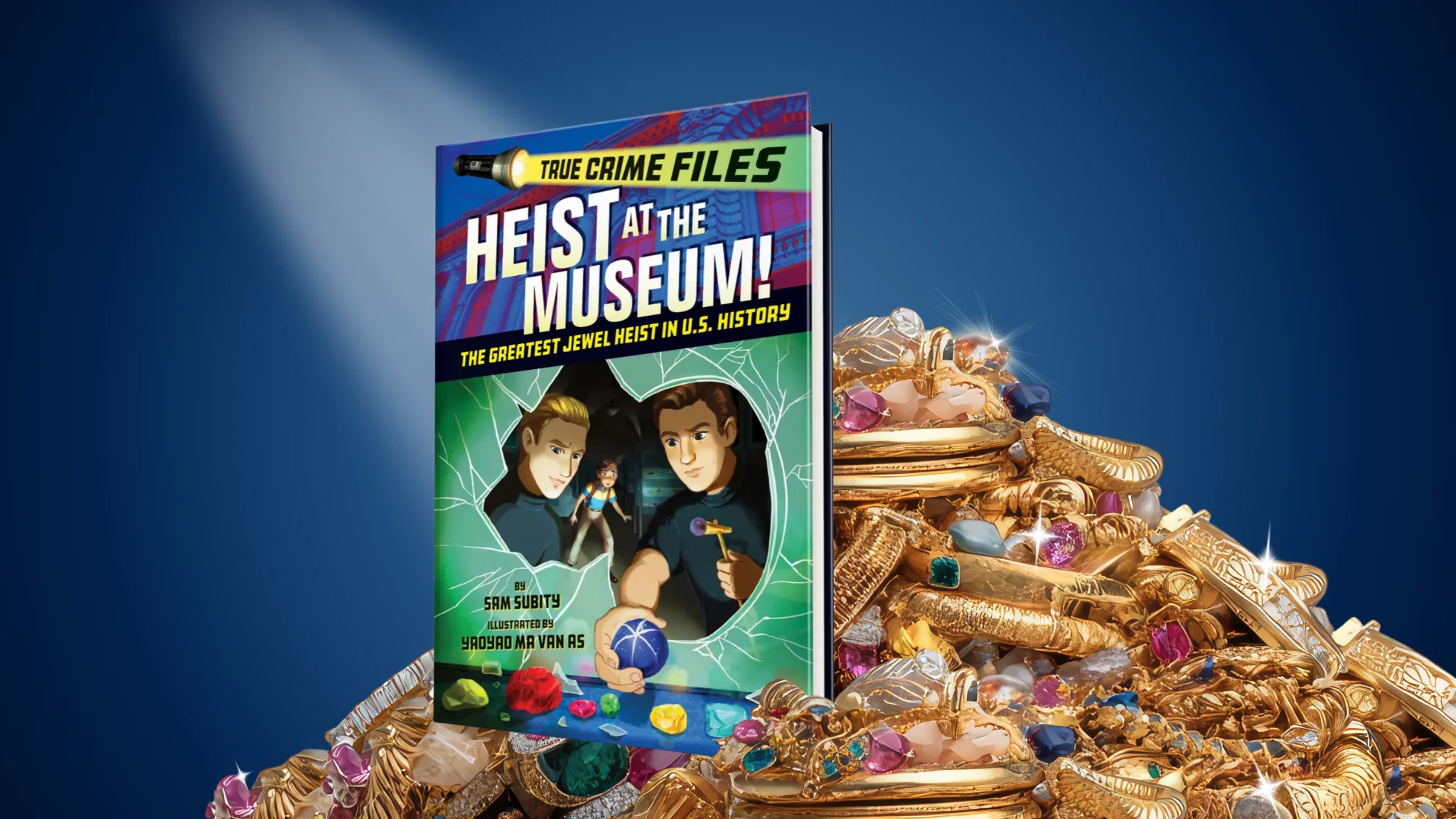
Some true crime stories are so outrageous they seem more like Hollywood inventions than historical fact. That’s certainly the case with the daring 1964 theft of the Star of India sapphire from New York’s American Museum of Natural History, which provides the inspiration for Sam Subity’s True Crime Files: Heist at the Museum! Blending meticulously researched history with a fictional young protagonist, Subity transforms the unbelievable real-life caper into a suspenseful adventure that introduces young readers to true crime while exploring grief, determination and the importance of trusting your instincts. In this Q&A, Subity discusses the wild story behind the book, balancing fact with fiction and why he wanted to tell true crime through the eyes of a child.
Heist at the Museum! is inspired by the real 1964 theft of the Star of India sapphire from the American Museum of Natural History. What first drew you to this true crime story, and when did you realize it could become an adventure for young readers?
When I first came across this heist, I did a sort of mental double-take, thinking, “There’s no way that actually happened.” You’ve got surfers who moonlight as small-time jewel thieves that decide almost on a whim to pull off the biggest jewel heist in history, laughable museum security, and the death-defying way they got into the jewel exhibit. But as I dug into the research, I confirmed everything I’d read was true and discovered even more unbelievable parts to the story. Plus the museum setting that reminded me of the popular “Night at the Museum” movies, which were the inspiration for the book’s title. The story practically begged to be told.
The book blends real people and events with fictional characters. How did you decide which parts of the historical record to preserve and where to give yourself room to invent?
It always kind of bothers me when I read a book or watch a movie that’s supposedly based on historical events, only to find that it’s a very loose interpretation of what actually happened. So it was very important to me to preserve all the major historical facts as they occurred to avoid confusing young readers about what was real and what wasn’t. I then imagined those facts like a large room set up with furniture that I could drop my main character Charlie into, where he could do things like sit on the couch or turn on a lamp but ultimately leave it undisturbed.
Charlie is dealing with grief over his mother while also feeling overlooked by his father when he stumbles onto the thieves’ plans. Why was it important to give him this emotional story alongside the excitement of the heist?
Most true crime stories for kids play out from the perspective of an adult or a sort of detached, clinical narrator. But I wanted to do something different with the True Crime Files series and tell these stories through a kid’s eyes. I also didn’t want my kid narrators to be flat, one-dimensional vehicles for telling a story but to have depth and real problems kids can relate to that they’re dealing with separate from the crime. The result, I hope, is a richer experience that immerses kid readers into the story so that they wonder as they’re reading, “Wow, what would I do in that same situation?”
No one initially believes Charlie, forcing him to investigate on his own. What did you want young readers to take away from Charlie’s determination to trust his instincts and keep searching for the truth?
Probably just about every kid can relate to the scenario of not being taken seriously by adults simply because of their age. That certainly happened to me sometimes as a kid! So I hope Charlie’s story helps kids realize they matter and they should stick up for themselves if there’s something they feel strongly about.
The real-life thieves behind the museum robbery were surfers turned burglars, which almost sounds too cinematic to be true. What surprised you most while researching the people and events behind the heist?
When we think of protecting priceless items like the Star of India today, most people probably picture sophisticated security systems with laser grids and touch-sensitive ballistic glass like we see in movies. However, this heist happened in 1964 before even basic security cameras were in wide use. But perhaps the most surprising thing is that, even with today’s technology, very similar types of heists happen all the time around the world. From major museums like the Louvre heist in October 2025 to small local galleries almost every month, thieves are repeatedly proving that our most irreplaceable artifacts are often woefully underprotected.
The book includes material explaining what was true, what you fictionalized and what ultimately happened to the thieves and stolen gems. What do you hope readers become curious about after finishing the story?
As a kid, I loved listening to a radio show called “The Rest of the Story” where host Paul Harvey would share an outrageous story from history and wait until the end to reveal the identity of the famous person featured in the story. Those short anecdotes always piqued my curiosity to research more about that person, and I hope my “The Rest of the Story” segments at the end of the True Crime Files books do the same for young readers today. And for even more extension activities, kids and educators can check out the book’s website at https://www.samsubity.com/heist-at-the-museum/.