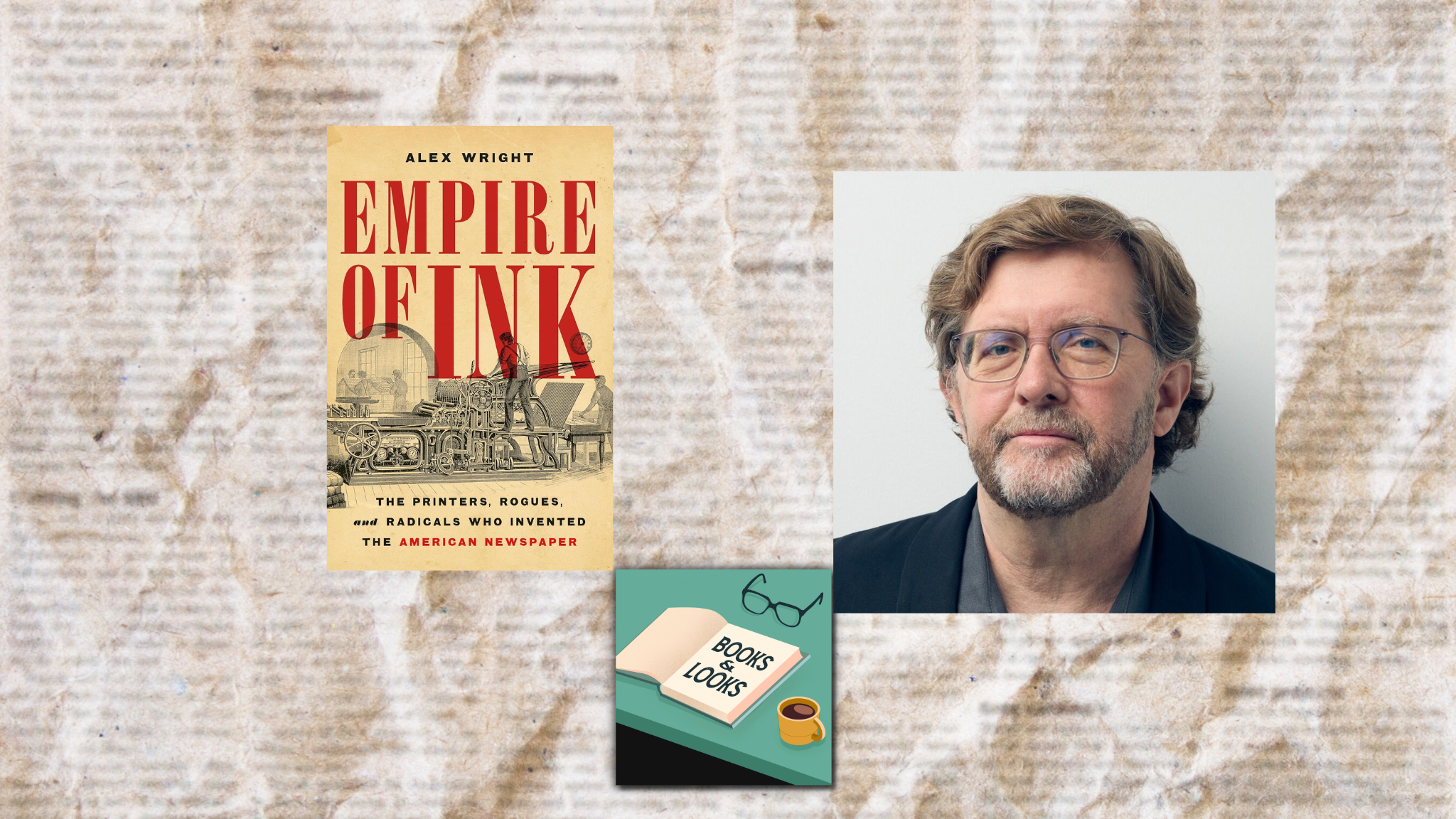
Books & Looks: Real Books for Real Readers was started as a literary podcast to supplement Blaine Desantis’ website, ViewsOnBooks.com, and expand into audio and video interviews with authors.
With Books & Looks, Blaine’s goal is to focus on real books that real people will read. At least half of the books he reviews are either new authors or unknown authors that many in the general public are unaware of. After a segment reviewing books or interviewing authors, Blaine ends each episode with a discussion of the movies and TV shows he is currently watching.
Learn more about BookTrib’s partner and Blaine at ViewsOnBooks.com.
This Week’s Episode
Before the Hearsts and the Pulitzers, before the front page as we know it, the American newspaper was built by teenagers covered in soot, women who risked hanging, and editors who settled arguments with pistols. Alex Wright joins Blaine DeSantis to talk about Empire of Ink, his sweeping history of how a young republic printed itself into existence between the 1700s and the close of the 1800s. It’s a project that started as a personal search into Wright’s own family of country newspaper publishers in Georgia and turned into fifteen years of research.
The conversation moves fast and covers ground most newspaper histories skip entirely. Wright explains what a printer’s devil actually was and why the job cut a man’s life expectancy in half. He tells the story of the entrepreneur who imported Egyptian mummies by the boatload because their wrappings were cheaper than American rags, and the French naturalist who watched wasps chew wood into pulp and wondered whether people could do the same thing. There’s Mary Katherine Goddard, whose name appears at the bottom of the first Declaration of Independence to carry the signers’ names, an act she knew could be read as treason. There’s the Vicksburg Sentinel, which burned through eight editors in roughly a dozen years, several of whom died in the line of duty.
Wright also takes us to the corners of the story that shaped whole communities. The Cherokee Phoenix, published in an alphabet invented from scratch by Sequoyah, became a political voice for the Cherokee people until their press was taken from them. In San Francisco, Yee Gen hand-built a workaround for printing thousands of Chinese characters and launched the first Chinese American paper. Union soldiers carried portable presses into camp and printed papers with blank pages so the men could write home on the other side. And a young Samuel Clemens swept floors as a print shop apprentice before he ever thought to call himself Mark Twain. If you have ever suspected that today’s media chaos is something new, this episode is a useful corrective.
Listen to the latest episode of Books & Looks: