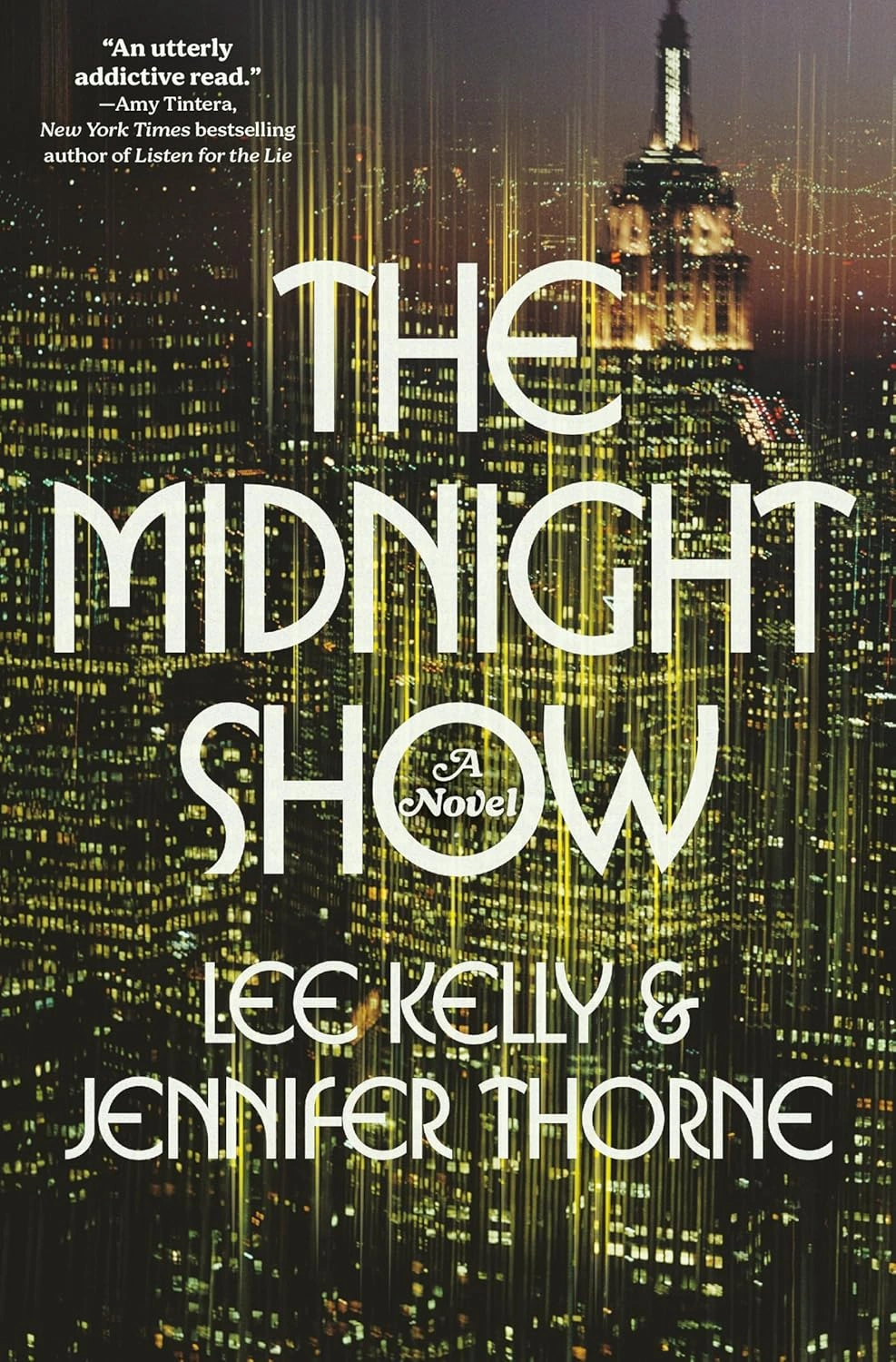
The Midnight Show by Lee Kelly and Jennifer Thorne
Lee Kelly and Jennifer Thorne’s The Midnight Show is that rare novel that manages to be both wildly entertaining and deeply poignant. It pulls readers into the smoke-filled, late-night world of the 1980s New York comedy scene, weaving a razor-sharp whodunit with a cultural critique of what it meant to be a woman daring to be funny at a time when men dominated. The result is a propulsive, immersive novel that feels at once like a binge-worthy true-crime documentary and a moving exploration of ambition, identity, and the cost of fame.
A Star Is Born — and Lost
The book starts with a group of college improv comedians who get the chance of a lifetime: a spot on a brand-new late-night show, airing live from New York every Friday. It’s called The Midnight Show, and it quickly becomes the breakout hit of the decade, changing the comedy landscape forever. But more than the fame and hype, it’s the story of Lillian Martin—destined to become the comedian darling of her generation. But then, on Valentine’s Day, in the dead of winter of 1983, she disappears near the Williamsburg Bridge. What follows is a forty-year mystery: was Lillian’s death the result of personal excess, random violence, or betrayal by someone in her inner circle?
A Story Told in Voices
Enter Madeline, a modern-day journalist determined to revisit Lillian’s story through a modern lens. Her interviews and reporting form the backbone of the novel, allowing the story to be told through a patchwork of interviews, articles, and transcripts—a structure that makes the narrative feel startlingly real. Much like Taylor Jenkins Reid’s Daisy Jones and the Six and Layne Fargo’s The Favorites, the book captures the cadence of oral histories, where each voice feels distinct and believable. The pacing is brisk and the flow seamless, with each new perspective building both tension and character depth. One of the most enjoyable elements is the way suspects rotate through the “hot seat,” giving readers the chance to test their own theories about who, if anyone, is responsible for Lillian’s fate.
What makes the book sing, though, is not just the mystery but the atmosphere Kelly and Thorne conjure. From dingy improv stages to the glitz of exclusive night clubs, from summer detours to Los Angeles to late nights on set, the novel unfurls chronologically, taking readers step by step through the rise and evolution of the cast and Lillian’s untimely disappearance. Along the way, readers get an inside look at the strange alchemy of comedy itself—its grind, its repetition and its reliance on both collaboration and competition. One particularly memorable line captures this tension perfectly: producing The Morning Show “is like trying to make 1000 recipes using the same seven ingredients week after week.”
The Cost of Ambition
Lillian herself is a fascinating figure. She’s described by peers as having “waif-fairy-princess energy,” and early on she comes across as a lone wolf—timid, watchful, always circling the perimeter before deciding how and when to enter. There’s a moment when Madeline asks in an interview, “Would you say women have to be particularly ruthless in terms of taking advantage of an opportunity to get ahead when it presents itself?” That question feels like the heartbeat of the whole novel. How far do women have to go? And what does it cost them when they do?
The book also captures the intoxicating, corrosive nature of fame. The highs are dizzying—VIP sections, headlines, roaring applause—but the lows are equally stark, especially when the rules were written by and for men, women often stereotyped. You could be “the bitch,” “the slut,” or “the Rapunzel,” but good luck convincing the audience you were anything more than that once they’d decided. Kelly and Thorne neither romanticize nor vilify this world; instead, they render it in all its complexity, allowing readers to experience both its allure and its sharp edges.
Comparisons to Daisy Jones and the Six are well earned, but The Midnight Show also carves its own niche, diving headlong into comedy, patriarchy, and the hunger to be seen. And while Layne Fargo’s The Favorites is, in part, about ambition and love in the world of competitive skating, The Midnight Show is about ambition and survival in comedy. Both novels expertly ask what happens when women try to write their own stories in worlds that want to script them differently. But Kelly and Thorne also add an irresistible hook: solving a cold case that has loomed over the industry for decades.
Verdict: The Midnight Show is an addictive, layered read that will keep readers guessing until the conclusion while also being smart and socially aware—and it deserves a standing ovation.
More articles by and about Tall Poppy Writers
About Lee Kelly and Jennifer Thorne:
 Lee Kelly and Jennifer Thorne are the co-authors of the novels The Antiquity Affair, The Starlets, My Fair Frauds, and The Midnight Show. Independently, Kelly is the author of the acclaimed speculative fiction novels City of Savages, A Criminal Magic, and With Regrets. Thorne is the USA Today bestselling author of Diavola, Lute, and the forthcoming Newbourne Park, as well as several books for younger readers.