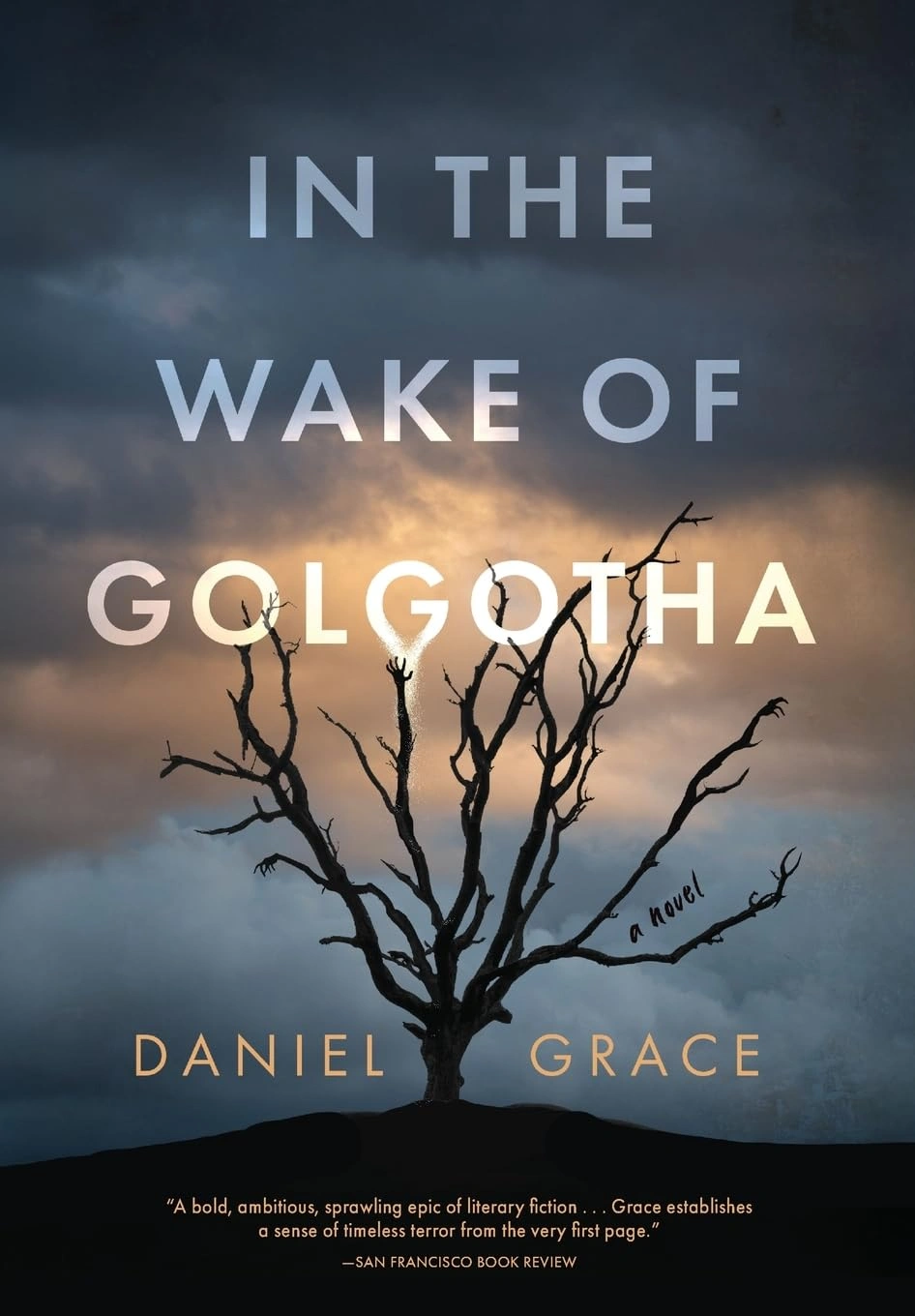
In the Wake of Golgotha by Daniel Grace
Someone has staged them with nails, blood and a cold sense of purpose. The police see a grotesque crime scene. A defense attorney sees a case that will swallow his career. A social worker sees a summons that feels older than the city itself.
Daniel Grace’s debut novel, In the Wake of Golgotha, starts with that shock and then keeps its foot on the gas. It reads like a legal thriller built around a sensational murder, yet it never settles for shock alone. Grace ties the case to two men whose lives keep repeating across centuries. One remembers every time. One forgets, then wakes up too late.
The book carries a grim premise with real conviction. Grace writes about punishment, guilt and the hunger for retribution. He keeps the story grounded in streets, courtrooms, subway rides and late-night dread. He still reaches back to ancient history, and those chapters land with weight rather than gimmick.
A Crime Scene That Echoes an Old Sentence
The modern story follows three men on a collision course. Jude Issachar lives in New York and tries to do decent work in a hard place. He serves meals at Xavier’s, he teaches at Calcutta Community College and he keeps his own pain close to the chest. He carries a private fear of ropes, branches and dawn, and he rarely explains it. Jude does not look like a mythic figure. Grace makes him feel like a man who has seen too much and still shows up.
Peter Pheiffer sits at the other end of the city’s power spectrum. He works at Brown, Shaffer, Markels, Osterman & Salyer, a global law firm that treats reputation as currency. Peter knows how to argue. He knows how to stay polished. Then a sociopath named Balthazar Bedrossian requests him as defense counsel, and Peter feels a crack in his own certainty.
Balthazar, an MRI technologist, stands accused of crucifying three men in a basement. The murders come with staging and message. They pull the press into a frenzy and pull prosecutors toward the most severe sentence possible. Grace gives Balthazar chapters that are cold and intimate at once. The man does not rant. He speaks with calm control, and that calm lands as the most frightening part.
Grace frames Jude and Peter as reincarnations of Judas Iscariot and Pontius Pilate. Jude lives with memory across lifetimes, and that memory behaves like a sentence. Peter lives in ignorance, and ignorance turns into a cruel cycle of recognition. Grace does not lean on religion for easy awe. He treats the concept as a moral trap, then he forces his characters to act inside it.
New York Wants Justice, and It Wants It Now
The book’s legal spine gives the novel steady forward motion. Grace draws the courtroom with precision, down to the way a jury watches a defendant’s smile. He writes opening statements that read like performance and threat. He keeps the defense strategy clear, and he never loses sight of the human cost behind the language of “procedure.”
Grace threads the case through a renewed debate over capital punishment in New York. In the novel, a ballot measure nicknamed Prop-Death brings the death penalty back into public life. Peter’s firm helped fund that political push. Peter now defends a man on track to become the first executed under the revived statute. The irony cuts deep, and the book refuses to let Peter ignore it.
Jude brings a different lens. His work puts him close to addiction and homelessness, and he sees the state’s appetite for punishment from the ground level. His closest friend, Leonard Abraham, carries the scars of that world, and Grace writes their bond with care. Leonard is funny, stubborn and sharp. He brings warmth to a dark story, and his presence keeps Jude anchored in everyday human stakes.
What keeps a story coherent when it spans two millennia? Grace answers that question in plain terms: choice and consequence. Jude knows what betrayal costs, and he cannot forget. Peter knows what procedure can hide, and he has hidden behind it for years. Balthazar forces the issue by turning violence into a kind of argument. The book asks what counts as justice, and who gets to define it, and it does not let the reader sit back in comfort.
Grace Earns the Book’s Large Swings
The novel’s structure takes risks. Grace cuts away from Manhattan into historical chapters set around Jerusalem and the Roman Empire. He brings the reader to the hill called Golgotha, and he shows the politics and fear that surround it. He brings Pilate into sharp focus, and he portrays a man shaped by ambition, insecurity and cruelty. He sketches Judas in scenes marked by rage and need, and he tracks how that rage curdles into the act that changes history.
These historical sections do not exist for atmosphere alone. Each return to the past sharpens the present. A line spoken in a Roman courtyard echoes in a modern office. A moment of cowardice in antiquity echoes in a modern legal strategy. The book treats history as an active force, not a backdrop.
Grace keeps the prose lively across these shifts. In the present, the writing tends toward brisk scenes that move the case forward. In the past, Grace allows longer passages of reflection that read like a fevered confession. The contrast works. It gives the book its pulse and keeps the reader alert.
Jude’s classroom scenes deserve special praise. Grace lets Jude teach tragedy through Shakespeare, Brontë and pop references, and the result feels like a real class with real students. Jude’s lectures never read like homework for the reader. They read like a man trying to name the pain he sees every day, then trying to make sense of his own.
Violence With a Point, and Mercy With Teeth
This is not a gentle novel. Grace describes murder in direct detail, and the book does not flinch from addiction’s damage. Those elements serve a purpose. They put the reader face-to-face with what the justice system claims to answer. They raise a harder question about vengeance, and about how easily a society can confuse punishment with repair.
Grace avoids a simplistic moral ledger. He gives Jude compassion that reads as earned rather than sentimental. He gives Peter ambition that reads as human, then brittle, then open to change. Even Balthazar receives a backstory that explains patterns without excusing the crimes. That balance keeps the book from becoming a sermon or a stunt.
The final act tightens every thread and brings the book to a quiet, piercing close. Grace resolves the central conflict without flattening the moral questions that drive it. The ending lands with emotional truth, and it leaves room for the reader to keep thinking about guilt and forgiveness after the last page.
In the Wake of Golgotha will appeal to readers who like legal thrillers with real bite. It will appeal to fans of dark crime fiction and stories that wrestle with big religious ideas. Grace writes with a strong ear for rhythm, and he knows how to build tension across scenes that feel grounded and immediate. This debut aims high, and it hits its mark.
About Daniel Grace:
 Daniel Grace is a London born, California bred, former owner of an international advertising agency who produces critically acclaimed Tuscan wines at his family winery, Il Molino di Grace, in Panzano-in-Chianti, Italy. He is a storyteller by trade and a mythologist at heart. Daniel splits his time between San Francisco and Tuscany with his wife, three daughters and English Setter. In the Wake of Golgotha is his debut novel.