
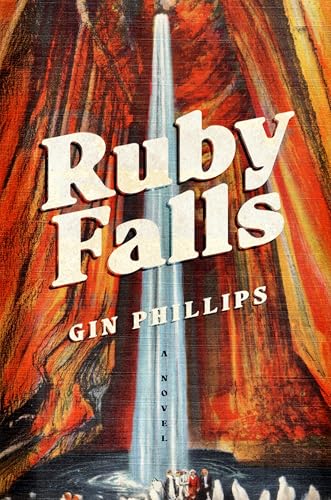
From the first time I visited Ruby Falls in Chattanooga, Tenn., I wanted to set a novel there. I rode an elevator two hundred and sixty feet underground and stepped into a different world. Solid rock everywhere, first sheared smooth from dynamite and, later, with stalactites hanging like sharp teeth. The light and shadow and the limestone formations you could imagine into anything, like you do with clouds.
That first trip came with a story, too, about a man — Leo Lambert — crawling for seventeen hours in the dark, finding a waterfall no human had ever seen before, and naming that waterfall for his wife. Stop and think about that: I did. What in the world would make a human being see a pitch-black hole in the endless rock and think, “I’m gonna go see what’s in there!”
What Drives a Person to Crawl Into the Unknown?
It was that question — that image — that first hooked me on the idea of caving. When I started crafting my new novel, Ruby Falls, I knew from the beginning that I needed to get dirty. I knew I wanted to crawl through spaces like Leo did back in 1928, and I wanted to splash through underground streams and hopefully see some bats. I assumed I would figure out pretty early on whether I was claustrophobic or not.
It’s not as if it’s unusual for a writer to do research. But there’s a difference, I think, in diving into a study of, say, opera or astronomy for your story as opposed to Amity Gaige learning to sail to write Sea Wife, Joshilyn Jackson learning scuba diving for her thriller Never Have I Ever, or Stephen Kiernan learning glass blowing for his latest, The Glass Chateau.
It adds another level of connection to put not only your mind, but also your body into a book. To feel an ache in your muscles. To bleed a little. My second novel, Come in and Cover Me, was set on an archaeology dig in New Mexico, and I spent two weeks in the desert for that one, interviewing archaeologists but also sifting dirt, washing sherds of pottery, skidding down hillsides, and washing my hair in creeks.
Getting Dirty to Bring Fiction to Life
For this novel, I spent time in multiple caverns around Chattanooga, but my first and greatest expedition was at Raccoon Mountain, where I headed underground for two hours into undeveloped sections of the caves. I’d only been in caves — like the main level of Ruby Falls — that could handle big groups and school field trips. I pictured underground spaces as high chambers and long hallways, like a coal mine. I pictured walking, slowly and possibly stooped, but staying on two feet. I learned how wrong I was pretty quickly. We suited up with helmets and thick gloves and headlamps, and within five minutes of leaving the sunlight, we were kneeling on the ground facing a wide
opening between two and three feet high. Our guide explained that we should get on our bellies and slither through the rock for the few dozen feet until the space opened up and we could climb to our knees again — then she disappeared into the rock with a few kicks of her thick-soled shoes.
I followed her, and those first few seconds where you’re splayed on your belly, rock in every direction for as far as you can see, and you know you can’t lift your head more than an inch or two? Well, it’s a shock. But not a bad one. I was surprised by the satisfaction — the pleasure — that came from narrowing the world to no more than the beam of my light. Everything became tighter and more focused, and any static in my head evaporated. There was no world outside, no past or future — just the next push of my legs or grab of my hands.
I loved it. For the next two hours, we climbed straight up walls and slid on our butts and slithered and twisted and ducked. I sidestepped across a 35-foot chasm with my hands on one side and my feet on the other. Sometimes we could stand at full height, but mostly we were on our knees or hunched over — the world was smaller and also bigger. I did see bats, along with blind salamanders and millipedes and tiny albino fish.
Slithering Through Rock and Finding Focus
By the time I left, I was covered in red dirt from head to toe. I had to change clothes before I could get in the driver’s seat, and, later, in the shower, I could hear the rattle of pebbles hitting the tile as I washed my hair.
As a novelist, you hope to fall into the world of your novel…and you hope to do it deeply enough that you can pull your readers along with you. I think learning the physical rhythms of a fictional world helps a writer to fall more deeply. I hope that when you read Ruby Falls, you’ll feel the tightness of those spaces and the beauty of them, too: I hope you’ll want to turn on your lights a little brighter to keep back the dark.