
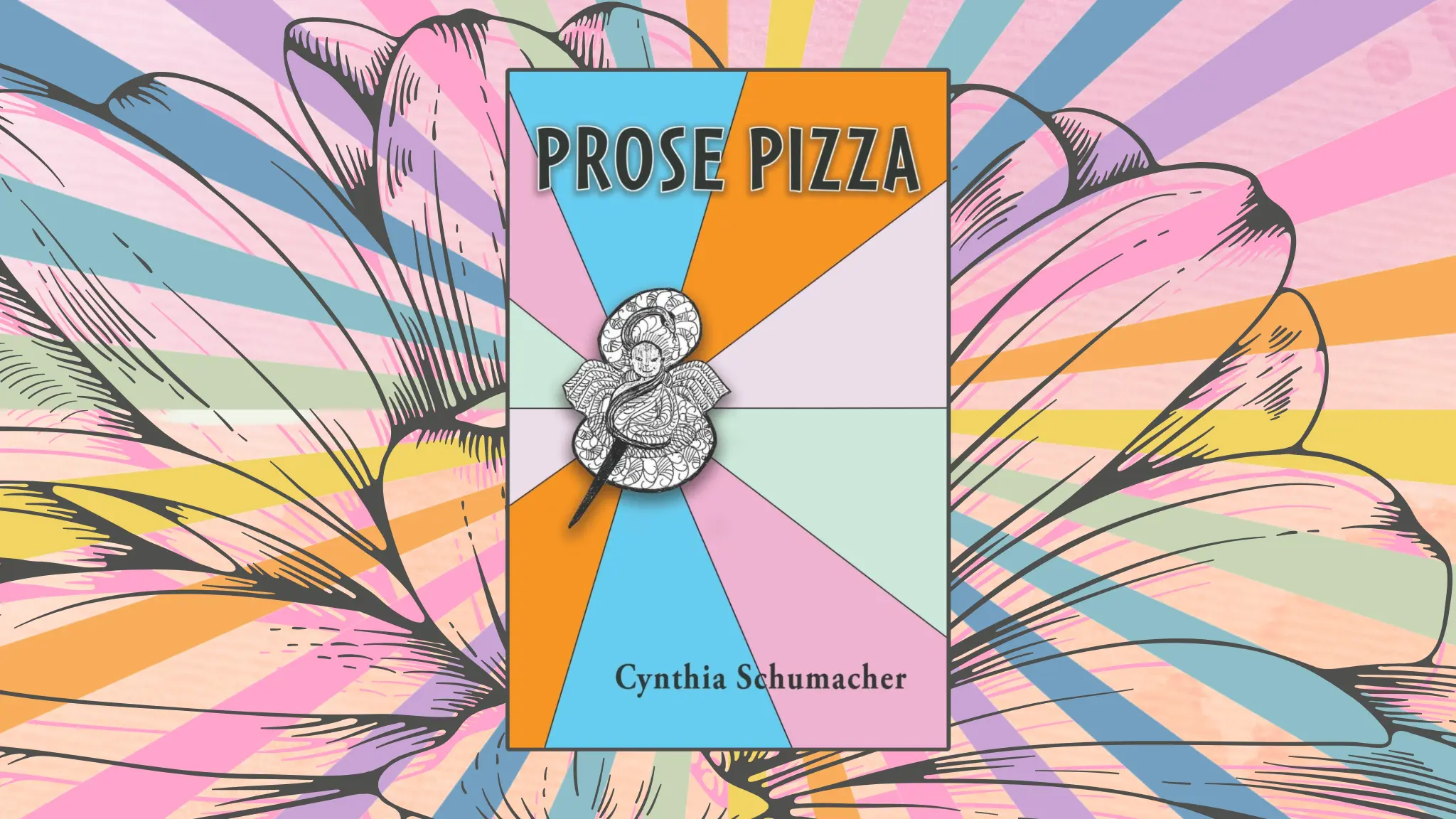
Prose Pizza by Cynthia Schumacher
Cynthia Schumacher’s Prose Pizza is a charming, thoughtful collection of nine stories that reveal the extraordinary layers beneath ordinary lives. With a warm yet incisive eye, Schumacher explores private desires, social expectations, small rebellions and the moments — quiet or sudden — that reorient a life.
The opener, “Sunless Sea,” follows a practical man whose unexpected purchase of a jade-like Buddha exposes his secret longing for adventure beyond his routine existence. That impulse toward reclaiming a hidden self appears again in “Sing No Sad Songs,” in which an elderly woman’s spontaneous decision to buy a fashionable hat becomes a doorway to reconsidering aging, identity and the quiet pressures of propriety.
Questions of authenticity surface sharply in “State of Matrimony,” where a professor’s wife confronts the gulf between her idealistic sense of marriage and the cynical social codes of campus life. Her brief crisis of confidence gives way to a reaffirmation of self, a theme that echoes across the collection. “Morning Stroll,” by contrast, offers a gentler meditation: a businessman enjoying his walk to work brings the first blush of spring into the sterility of his office, discovering solace in the natural world.
Two stories step into a more playful or fantastical register: “A Cautionary Tale,” reported by an otherworldly Caretaker guiding a selfish businessman toward his final judgment, and “To Whom It May Concern,” a witty, affectionate defense of the German cockroach.
Playfulness, Nature and Unifying Threads
The collection’s centerpiece, “Second Half,” is its most substantial and accomplished piece. A tomboy excluded from a neighborhood football game leads the boys on an imaginative campaign against an unseen foe. The story’s subtle commentary on gender roles is matched by some of Schumacher’s most memorable characters.
“Change of Heart,” featuring a beleaguered gardener and a surprisingly helpful cat, and “Pond Pal,” a quiet, painterly vignette of a frog suspended in time, close the volume with a tender appreciation for the natural world.
Part of the pleasure of Prose Pizza lies in the delicate threads connecting the stories — acts of expressing one’s “secret self,” challenges to what is deemed “proper,” contrasting characters, shared symbols like a tree climbed for revelation or refuge. These subtle links give the collection a satisfying unity without sacrificing the individuality of each piece.
Schumacher’s greatest strength is her eye for meaningful detail — the poisonous elegance of a hostess’s hand in “State of Matrimony,” or the battlefield solitude of the tree in “Second Half.” Her images resonate long after the stories end.
True to the book’s own playful description — “Choose your piece and enjoy!” — Prose Pizza offers slices of life that vary in tone and style but come together as a coherent, nourishing whole. There is something here for every reader, yet all the stories feel baked from the same imaginative dough. It’s a collection that invites reflection, rewards attention and lingers pleasantly, like a meal shared with good company.